
Networked production
Radio signals from the ceiling lighting
Researchers at Fraunhofer IOSB-INA are working together with OWL University of Applied Sciences on solutions to enable machines to communicate with each other on factory floors via light pulses in the future. The technology is not new, but the task now is to develop it further for industry.
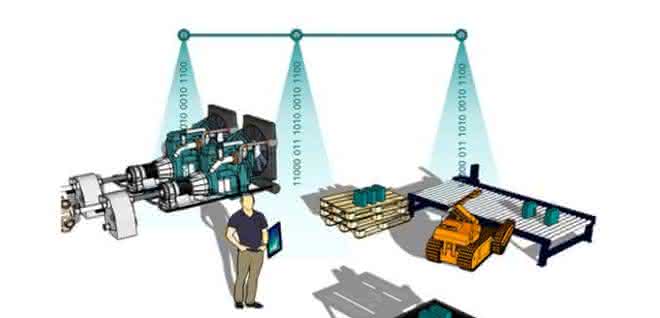
Automated guided vehicles, conveyor belts, motors, robots, sensors, drones, monitoring systems, mobile end devices, different machines and systems - they all communicate with each other in the production environment and exchange data. The components are often operated at different locations, which makes wireless networking indispensable. Wireless communication must function smoothly, otherwise production downtimes could occur.
In our professional and private lives, we have been using the advantages of wireless connections such as WLAN and Bluetooth for a long time - in production, conventional wireless communication is reaching its limits: WLAN and Bluetooth only offer limited bandwidth, and the radio spectrum is overloaded in view of the increasing number of users, receivers and devices. Although 5G technology will alleviate this problem, the challenges of communication in the production environment can be mastered more effectively and without a license - this is the view of the researchers at Fraunhofer IOSB-INA in Lemgo, Institute for Industrial Automation of the Fraunhofer Institute of Optronics, System Technologies and Image Exploitation IOSB.
They are taking a different approach and choosing the visible spectrum of light for wireless data transmission. Experts call this technology Visible Light Communication. "The light spectrum is around 4,000 times larger than the entire available radio spectrum, ranging from 380 to 800 nanometers in wavelength," says Daniel Schneider, a scientist at Fraunhofer IOSB-INA. Together with his colleagues and the OWL University of Applied Sciences, he is working on transferring VLC to industry. The research work in the Visible Light in Production project of the Federal Ministry for Economic Affairs and Energy BMWi - a joint industrial research project of the German Research Association for Automation and Microelectronics (DFAM) - began a year ago.
Conditions for VLC in industrial environments not researched
VLC is already being used in office, home and laboratory environments and has recently been used to implement indoor navigation systems in shopping centers. In factory halls, however, the hurdles for communication technology are high or have not yet been sufficiently researched due to the particular interference factors.
"As an alternative to conventional wireless network access, we will use commercially available, energy-efficient LEDs for Visible Light Communication. It is crucial that we can establish a system that is resistant to as much interference as possible," says Schneider. Such a system is reliable if coverage problems caused by walls, metal objects, machines and other interfering signals can be overcome. "Artificial light sources, shadows and reflections can influence data transmission via light. In collaboration with five companies from industry, we have investigated the extent to which, in which areas and at what heights they do this as part of a measurement campaign."
Among other things, a spectrometer was used for the tests, which can be rotated around two axes and measures the interference source distribution in the room. The measurement campaign focused on a total of three influencing variables: Ambient light sources, particles and ambient reflections. The experts also refer to the latter as multipath propagation.
Light reflections interfere with data transmission
The tests showed that dust particles do not pose a problem for optical signals. "Factory halls are usually well ventilated, so the typical particle concentrations do not significantly attenuate the light signal," says the researcher. People and vehicles moving slowly at 0.2 meters per second do not affect the quality of the signal either. Ambient light sources, on the other hand, influence the entire optical spectrum.
The project partners have identified a total of ten models to whose lighting conditions VLC systems react: These include welding processes and fluorescent tubes, but also optical tracking systems. However, they only occur locally and not across different locations. VLC systems must therefore be able to react adaptively to the lighting conditions and minimize such disruptive influences - according to the test results.
The researchers were also able to identify multipath propagation as an interference factor: "A lamp emits light in several directions, which reaches the receiver via reflections. If these are very different, the light arrives at the receiver distributed over time and with attenuation. This distorts the useful signal in the nanosecond range and reduces the transmission quality," explains the scientist. Based on the quantitative measurement results, Schneider and his team are developing environmentally adaptive VLC systems for industrial use.
No chance for data thieves
Compared to WLAN, VLC not only offers greater bandwidths, data security is also guaranteed. A radio signal radiates through walls and communication can be intercepted and manipulated outside the factory building. This is not possible with light, so potential attackers have no chance here. Another bonus: 1000 or more devices can be wirelessly networked with each other via VLC.
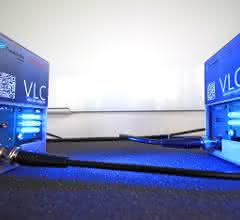
"Once we have optimally designed our VLC system based on our measurement campaign, we will be able to operate over 1,000 devices at one location in an energy-saving, tap-proof manner and insensitive to electromagnetic influences," summarizes the researcher from Lemgo. In addition to the ceiling lighting, the required hardware should be limited to Internet access and a transceiver that is connected to the end device. This demonstrator is currently being tested under real-life conditions at the SmartFactoryOWL in Lemgo. Both large and medium-sized companies should benefit from the finished system as early as mid-2021. as


You might also be interested in
Spectra Launches 5G RedCap Router for Industrial IoT Applications
With its new 5G RedCap routers, Spectra is expanding its portfolio to include a mobile communication technology for industrial applications designed to bridge the gap between traditional 5G and established IoT standards such as LTE-M and NB-IoT.
 read more...
5G in the industrial IoT
The Chair of Production Systems at Ruhr-Universität Bochum LPS is researching industrial applications with a local 5G network in the context of Industry 4.0.
read more...Implement milling tasks economically
Milling covers a wide range of applications - from the machining of large free-form surfaces in the aviation industry and in the manufacture of wind turbines to the milling of cavities and highly automated mass production.
read more...Mitsubishi Electric invests in the future
Further production building in Owariasahi City
Due to the growing importance of the Japanese region of Owarisahi in Aichi, Mitsubishi Electric Corporation is increasing its planned investments and announcing the construction of a second production building.
read more...Industrial Connectivity Lab opens
Siemens customers test wireless technologies
Siemens has opened a new test lab for industrial connectivity technologies at its Erlangen site. Embedded in the Siemens Technology Center on the Erlangen campus, the Industrial Connectivity Lab offers 300 square meters of space for testing...
read more...A sustainable foundation for the industry
The networks are growing together - this refers to the ongoing merging of IT and OT. Christian Korff, Managing Director Global Accounts and Member of the Management Board, Cisco Germany, explains the challenges and levers involved.
read more...It started with a timer for X-ray machines
In 2023, the automation expert Omron can look back on 90 years of innovative company history, in which many technological boundaries have been crossed and milestones set.
read more...Flexible component transport in production
Stein Automation presents the Stein 400 workpiece carrier system for parts weighing up to 80 kilograms and the C5G logistics control system.
read more...Extended image processing options
High-performance multispectral line scan camera with 5GigE
The new Linea2 4k Multispectral 5GigE camera takes machine vision systems to the next level with its performance and value, offering a 5GigE interface with five times the bandwidth of the Linea GigE camera.
read more...