
Industry 4.0 and the cloud
What IoT can do at the edge
Edge computing is playing an increasingly important role in Industry 4.0. Fueled by the increasing spread of the Internet of Things and cloud technologies as well as the implementation of the first 5G campus networks, the possibilities for implementing new solutions are growing. However, for IoT and edge computing to go live successfully in the industrial environment, companies need to pay attention to a few points.
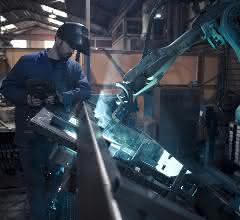
Comprehensive networking is no longer a vision of the future. The Industrial Internet of Things (IIoT) opens up a wide range of possibilities, especially in the manufacturing industry. The combination of sensor technology and analytics makes it possible to access data in real time that was previously unavailable. The findings derived from this can be used without delay for all processes along the supply chain. This enables a fundamental optimization of processes - from greater automation and faster detection of productivity weaknesses to improved quality control and thus a reduction in the error rate. Thanks to IIoT, those responsible gain more transparency about machine data across multiple locations and thus more accurate predictions about the condition of a plant, which in turn enables more efficient maintenance and cost savings. All of this means that industrial companies are able to implement forward-looking business models.
Predictive maintenance using sensors and AI
Predictive maintenance is now a widespread application scenario for IIoT. Unplanned maintenance is poison for productivity: sudden machine breakdowns are expensive. For this reason, it is better to carry out maintenance at short intervals, even if it is not yet necessary. By evaluating usage data, it is possible to detect impending breakdowns in good time, carry out maintenance work remotely if necessary or schedule it for a period when machine downtime is less likely to cause problems. It is usually difficult to schedule maintenance work efficiently, as interruptions sometimes occur after a month, sometimes after six months. Using data collected via IIoT, an algorithm can calculate when a breakdown is likely to occur. With this knowledge, enormous savings can be realized. But even if no failure is imminent, heavily worn components can increase energy consumption due to leaks or friction, for example. By comparing this with historical data, this can be detected in good time.
With the increasing spread of 5G, mobile robots and tools or autonomous transport systems are also taking center stage. The new standard enables special networks according to requirements: from ultra-fast mobile
Broadband with data transfer rates of up to 10 GB/s, communication for real-time applications with response times in the range of 1 ms and data communication with many participants such as machine-to-machine. At the same time, 5G gives industrial companies the opportunity to operate their own mobile networks without requiring a general telecommunications license. These campus networks have reserved frequency ranges and close the gaps left by other wireless technologies. WLAN, for example, is sufficient for static processes such as monitoring a stationary machine. However, driverless transport systems or autonomously operating robots show the limits of WLAN - when moving to another cell, the systems would first stop to establish a new connection.
Industrial processes often consume large amounts of energy, which means that even small improvements in load management can save companies considerable costs. Thanks to IIoT, those responsible are able to find out about the resource consumption of individual machines, specific locations or the entire company and optimize it.
Special requirements for the infrastructure
However, when setting up edge computing infrastructures for IIoT, industrial companies need to consider various points in terms of scalability, real-time capability, interoperability, data protection and security. Holistic, prefabricated IIoT solutions with a greater technological breadth and partner ecosystems are particularly suitable for getting started in order to shorten the deployment and amortization time. The basis is a framework that analyzes the collected data, makes it available to users and sends instructions back to the devices. It thus provides the basic functions to leverage potential and drive improvements in areas such as maintenance and operations. At the same time, such a framework facilitates device connectivity and provides an interactive view of system and software applications. Merging the data feeds also increases transparency, as employees can now easily access all information relating to the machines.
Directly at the edge, i.e. at the edge of the network, devices and tools are needed that can cope with the sometimes harsh environments caused by dust or high or low temperatures. Standard IT components, which are often used for the control and monitoring of industrial systems, cannot cope with these requirements. At the same time, companies should ensure that the solutions are based on open standards - a vendor lock-in makes cross-system integrations more difficult. The IT partner also plays a central role. Together with the industrial company, they identify the use case and define the measures for implementation, including analysis and classification of the data. Last but not least, the issue of security also plays an important role. Basically, a multi-level security architecture is required. This includes monitoring all components and segmenting the individual production areas, as well as end-to-end encryption, for example from the robot to the corresponding application for warehouse management, and protected remote access for maintenance technicians.
The transformation of a conventional manufacturing operation into a digital factory will be on the agenda of every industrial company in the near future. With an IIoT infrastructure, they can monitor, collect, exchange and analyze data. The insights gained provide important information for controlling business processes and decisions - and thus for the future viability of the company.
Uwe Wiest, General Manager & Director Sales OEM & IoT Solutions DACH, Dell Technologies


You might also be interested in
Spectra Launches 5G RedCap Router for Industrial IoT Applications
With its new 5G RedCap routers, Spectra is expanding its portfolio to include a mobile communication technology for industrial applications designed to bridge the gap between traditional 5G and established IoT standards such as LTE-M and NB-IoT.
 read more...
5G in the industrial IoT
The Chair of Production Systems at Ruhr-Universität Bochum LPS is researching industrial applications with a local 5G network in the context of Industry 4.0.
read more...Implement milling tasks economically
Milling covers a wide range of applications - from the machining of large free-form surfaces in the aviation industry and in the manufacture of wind turbines to the milling of cavities and highly automated mass production.
read more...Mitsubishi Electric invests in the future
Further production building in Owariasahi City
Due to the growing importance of the Japanese region of Owarisahi in Aichi, Mitsubishi Electric Corporation is increasing its planned investments and announcing the construction of a second production building.
read more...Industrial Connectivity Lab opens
Siemens customers test wireless technologies
Siemens has opened a new test lab for industrial connectivity technologies at its Erlangen site. Embedded in the Siemens Technology Center on the Erlangen campus, the Industrial Connectivity Lab offers 300 square meters of space for testing...
read more...A sustainable foundation for the industry
The networks are growing together - this refers to the ongoing merging of IT and OT. Christian Korff, Managing Director Global Accounts and Member of the Management Board, Cisco Germany, explains the challenges and levers involved.
read more...It started with a timer for X-ray machines
In 2023, the automation expert Omron can look back on 90 years of innovative company history, in which many technological boundaries have been crossed and milestones set.
read more...Flexible component transport in production
Stein Automation presents the Stein 400 workpiece carrier system for parts weighing up to 80 kilograms and the C5G logistics control system.
read more...Extended image processing options
High-performance multispectral line scan camera with 5GigE
The new Linea2 4k Multispectral 5GigE camera takes machine vision systems to the next level with its performance and value, offering a 5GigE interface with five times the bandwidth of the Linea GigE camera.
read more...