
Raspberry Pi
From the tinkering table to the control cabinet
With over 17 million devices sold worldwide, the Raspberry Pi is the most popular single-board computer of all time.
It is not only passionate hobbyists who rely on the versatile miniature computer - it has also long since found its way into industry. Originally designed for the hobby and education sector, the Raspberry Pi is now also unfolding its potential in industrial computer technology after a few stumbling blocks have been overcome.
What industrial applications is the mini computer suitable for and what does its future look like? Sven Pannewitz, Product Manager Active/Passive Components (Programming/Developer) at Reichelt Elektronik, provides insights into the possibilities for professional use of the Raspberry Pi.
Innovation instead of tradition
Particularly in measurement and control technology (MCR), the mini-computer breaks down outdated structures and creates space for innovation. Thanks to the open source principle and a multitude of freely available software libraries, programming languages and instructions, the Raspberry Pi offers flexibility like no other system.
Its hardware can also be adapted and expanded as required using plug-in add-on modules such as the PI Hats, for example to create additional interfaces. This means that a large number of new ideas and prototypes can be implemented directly in the production environment without having to accept long development cycles. Such a customized Raspberry Pi-based solution is also relatively inexpensive compared to traditional industrial products.
The limits of the Raspberry Pi
When used in harsh industrial environments, the original Raspberry Pi initially reaches its limits. Even slightly higher ambient temperatures, due to the compact size of the computer, cause the core temperature to rise sharply - the compensating CPU throttling leads to massive performance losses.

The microSD cards used as read-only memory only allow a very limited number of write cycles and are not suitable as retentive memory, which is why they cannot meet industrial requirements. As the latest model in the product family, the Raspberry Pi 3B+ is already Gbit Ethernet and WLAN-capable and therefore fulfills an essential requirement for Industry 4.0 applications. However, it still lacks industrial interfaces such as RS485 or CAN.
Exemplary industrial solutions
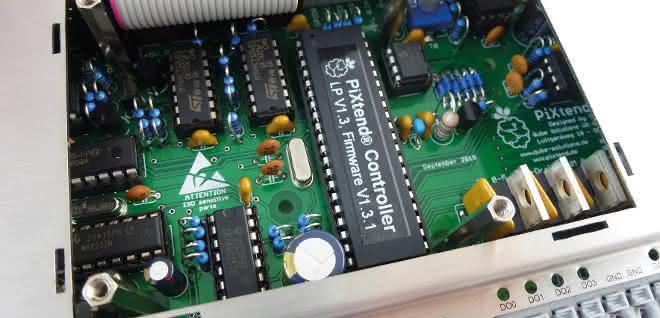
However, some further developments of the Raspberry Pi can remove these hurdles. The PiXtend as a professional expansion board for the Raspberry Pi can, for example, be used for control and regulation tasks as well as a learning environment for control, circuit and software technology. Its industrial-grade features include serial interfaces (RS232, RS485 and CAN bus), a remanence memory and the option of real-time monitoring. It can also withstand ambient temperatures of up to 50 °C and can be installed directly in a control cabinet thanks to its top-hat rail housing.
The Andino X1 Kit combines the Raspberry Pi and Arduino to create an industrial solution made in Germany. Thanks to its own microcontroller, precise signal pre-processing and adaptation of signal transmitters and actuators is possible. In addition, the Andino X1 protects all essential interfaces of the Raspberry Pi in accordance with the applicable industry standards. The supported digital inputs and outputs are galvanically isolated and prevent overvoltage of the Pi.
The future of the Raspberry Pi
As the automation industry demands ever more compact, effective and cost-effective solutions, the Raspberry Pi has become an indispensable part of the industry. Developers can benefit massively from the existing knowledge of the Raspberry Pi community.
As the body responsible for the popular single-board computer, the Raspberry Pi Foundation is increasingly focusing on the software sector in order to support 3D software, the use of AI and IoT applications in the future, for example. However, the market is also undergoing constant change in terms of hardware. Despite extreme conditions, the performance of the computers is to be continuously maximized, while the external dimensions are becoming ever more compact.


You might also be interested in
Protection against electrostatic discharge
StoFloor ESD KU 614 from StoCretec: dissipative flooring with the latest technology meets all ESD standards, is economical, extremely durable, mechanically and chemically resistant. The surface can be adjusted to be slip-resistant. The system is...
 read more...
Cables and wires from Helukabel
Food cultivation on a new level
Vertical farming - cultivation in multi-storey greenhouses - is considered one of the most exciting trends in food production. One of the pioneers in this field is the Romanian start-up Ultragreens. The company relies on solutions from Helukabel to...
read more...Further training for specialists to become security experts
With the "CESA - Certified Expert for Security in Automation" qualification, automation expert Pilz offers a two-day expert course designed to provide participants with compact security knowledge in line with the latest standards.
read more...Meaningful data on the service life of the seal
Seals prevent substances from penetrating or entering technical components. The intelligent seals from Freudenberg Sealing Technologies can significantly expand this core task in the future: the seal itself is also a sensor and becomes a "smart...
read more...Online stud configurator according to drawing
For standard bolts, with head, thread or hole
For standard bolts, with head, thread, bore or as a version with recess, mbo Osswald configurators map the standard specifications, are very easy to use, take a lot of work off the user's hands and save a lot of time.
read more...Safe palletizing with the Cobot
Verla-Pharm's medicinal products and food supplements have been available for decades. Ever-increasing throughputs result in ever-increasing logistics costs, whereby optimum utilization of the available production space is necessary.
read more...The tiger among processors
Since the move towards the Industrial Internet of Things (IIoT) and Industry 4.0 has picked up speed, processor boards and modules must be able to process exponentially growing amounts of data.
read more...VDWF publishes "Sustainability Compendium"
Nowadays, nobody can avoid "sustainability": In addition to a far-reaching presence in the media, it is also becoming increasingly important for companies in the tool and mold making industry to develop and implement appropriate concepts.
read more...More transparency and synergies with QM software
Weber, manufacturer of wood and metal sanding machines and extruders, has reorganized its quality management with ConSense IMS Professional. The software solution enables transparent documentation and more efficient processes.
read more...