
Flexible assembly concepts
That is so predictable
Flexible, digital assembly concepts. Digital factory planning is no longer a figment of the imagination. With Flexcell, Ipolog has developed a concept that allows production to take place in individual cells rather than in a line.
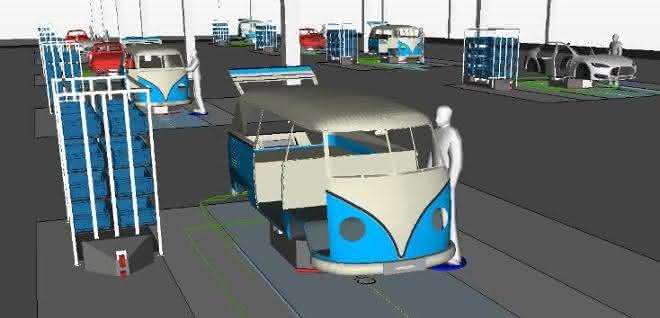
The complexity of production will continue to increase; companies must be able to anticipate the daily fluctuations in quantities and the large number of product variants and adapt to them on a daily basis. Rigid assembly concepts may have to give way to more flexible solutions.
"The basis for flexible cell production is completely digitalized assembly and logistics."
If you want to be prepared for the future, be able to simulate the next day in detail in advance or roughly plan the next year, you need a consistent and holistic digital twin for assembly and production logistics. At the same time, the digitalization of assembly and logistics enables assembly to be made more flexible. After all, there is no question that assembly concepts need to be adapted in order to remain competitive.
Digital factory planning and flexible assembly concepts are no longer a figment of the imagination. Ipolog demonstrates this with the concept of flexible cell production (Flexcell). The idea behind this is that production does not take place in a line but in individual cells. At the heart of this is the Flexcell algorithm, which has been tested with real data. A digital twin of assembly and logistics is created in the Ipolog software. The algorithm integrated in Ipolog simulates flexible cell production on the basis of the digital twin and controls the necessary automated guided vehicles (AGVs). Each cell can be controlled individually using the Flexcell algorithm programmed for this purpose. The FiFo principle is eliminated.
The algorithm calculates the optimum allocation of cells and assigns the appropriate assembly orders to them. Cells that are not relevant for the product are simply skipped by the AGVs. Cycle sequence loss times are almost completely eliminated. Calculations based on real data show that assembly in flexible cells and the use of AGVs can increase worker utilization by twelve percent compared to a conventional line. Labor costs are reduced by a similar percentage.
With its flexible cell production, Ipolog is knocking down doors in industry and research and has won several prizes with its Flexcell simulations. For example, the team (which operated as Ipo.Plan GmbH until the turn of the year) won first prize in the handling award at Motek 2019 in the "Warehousing, order picking, intralogistics" category.
The company is also involved in the Aimfree research project. In addition to Porsche and e.GO, well-known partners are on board to research new production and assembly concepts in the context of alternative drive concepts and changing market requirements. The aim is to operationalize ideas that have already been simulated for practical use. Project manager Amon Göppert, Machine Tool Laboratory WZL at RWTH Aachen University, hopes that the research project will lead to "free-chain assembly being the solution for many companies to be able to keep individualized products in our high-wage locations despite cost pressure."
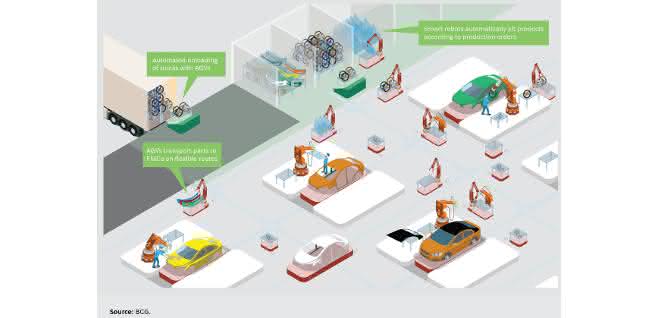
With assembly in flexible cells and the use of AGVs, worker utilization can be increased by twelve percent.
Ipolog is contributing its research and simulation results from the Flexcell studies with the Boston Consulting Group and other customer projects in order to ensure decisive added value advantages through flexible cell production. It is important that the deviations between the simulated and actual process are made transparent and recalculated at runtime. Matthias Kellermann, co-founder and CEO of Ipolog, believes that the biggest challenge lies in controlling the material flow, as a separate shopping basket has to be picked for each product and each cell. The core of the Flexcell concept is to always make optimum use of the assembly employee's capacity and to prefer to have the orders to be produced waiting for the employees in front of the cells rather than the other way round. It is also important to always be able to react directly to delays or changes in the real process compared to the simulation. To this end, criteria are to be researched to determine when a deviation is so serious that a correction must be made - with potentially far-reaching changes for material handling.
"We are still at the very beginning of an exciting journey towards flexible cell production," says Kellermann. "It is important to start today and to continue along this path step by step. The basis for flexible cell production is completely digitalized assembly and logistics. With the Ipolog software, significant double-digit increases in efficiency can be achieved in the 'classic line' even in the course of this digitalization if assembly processes, employee routes, material provision and the logistics chain are holistically optimized. With a digital twin, you can create clarity today for the challenges of tomorrow. You can be sure that production will run smoothly because you have run through the effects of changes digitally before they cost you a lot of money and nerves in the real factory. Costly surprises during implementation or even production downtimes are a thing of the past. It doesn't matter whether these changes are the result of your optimization ideas or were brought to you from outside. Every day, the digital model becomes more detailed, more intelligent and can show the consequences of your planning decisions even better."
With the Ipolog software, the situation is visualized three-dimensionally in the factory layout exactly as the factory will behave with the respective production program. This means that everyone involved can literally get a picture of the situation and everyone is on the same page. There are various views and aggregation levels to make all the information available to colleagues and superiors. Manually transferring results to PowerPoint is a thing of the past, as are overlooked formula errors in Excel. This means that everyone - from the planner to the owner, from the trainee to the CFO - can see directly in Ipolog how their factory will work. The 3D visualization including animation of assembly employees and logistics resources helps just as much as the KPIs that can be configured for the respective role, which can also be displayed in aggregated form on smartphones, tablets or VR glasses. as


You might also be interested in
Robotics and autonomous order picking
Locus Robotics acquires Nexera Robotics and expands autonomous warehouse logistics
Locus Robotics takes over Nexera Robotics and may have taken a decisive step towards truly universal warehouse automation. A new gripping technology should now make possible what was previously considered difficult to automate.
 read more...
How bridging steps, stairs and catwalks are changing processes in production and logistics
At Logimat 2026, Munk Günzburger Steigtechnik will be showcasing modular bridging steps, stairs, platform and walkway systems for production, warehousing and logistics. With online configurators, distances can be efficiently shortened, processes...
read more...Highly automated warehouse for...
SSI Schaefer implements highly automated warehouse for CERP in France
SSI Schaefer and CERP are building a highly automated logistics center for pharmaceutical logistics in Wissous with shuttle storage, A-Frame, robotics and WAMAS software.
read more...Start of construction for new production hall
Mayr Antriebstechnik invests in its home base and internationally
Mayr Antriebstechnik strengthens location and international logistics: Construction of a new hall in Mauerstetten - parallel expansion of the plant in Poland as a logistics hub.
read more...Conveyor systems that adapt
Modern conveyor systems must reliably transport different product sizes, shapes and materials. The new modular product system from Kipp offers flexible, modular solutions for this: Adjustable side guides ensure precise alignment and gentle...
read more...Focus on sustainability and AI at the trade fair
With more than 120,000 square meters of exhibition space, LogiMAT 2025 will once again occupy all ten halls of the Stuttgart exhibition grounds. From March 11 to 13, global players, medium-sized companies and start-ups will provide an overview of...
read more...Workstation system for shipping and logistics
With Sintro Packing, Karl is launching a workstation system that is designed to meet the specific requirements of shipping and logistics. It is characterized by modular adaptability and ergonomic efficiency.
read more...Deutsche Messe announces Robotics Award
On the occasion of Hannover Messe 2025, Deutsche Messe is once again presenting the Robotics Award after a break of several years. Prizes will be awarded for robot-supported automation and logistics solutions. Companies and institutions from Germany...
read more...Micro motors as the driving force behind intralogistics
Suitable transport structures in intralogistics are a prerequisite in all industries in order to withstand competitive pressure in the future. The basis for this is comprehensive automation, which would be inconceivable without an armada of powerful...
read more...