
Condition monitoring
Surge protection with IoT function
The Varitector PU AC IoT surge arrester from Weidmüller combines the functions of a surge arrester with those of an IoT device. At the same time, the new devices protect industrial energy networks.
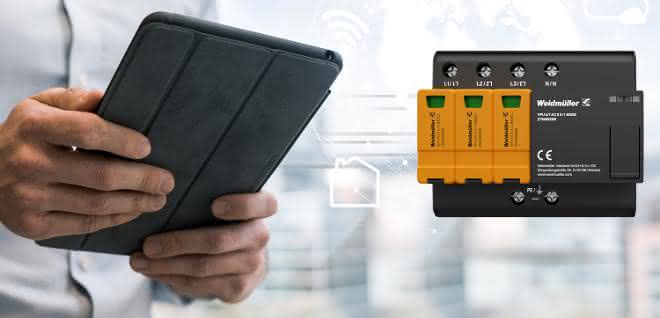
Surge protection is becoming increasingly important, as the infrastructures of intelligent devices and systems are becoming more and more sensitive due to increasing digitalization. Weidmüller developed the new Varitector PU AC IoT surge protection devices specifically for stable 230/400-volt networks; they protect industrial energy networks at the highest level. High demands are placed on the surge protection of production machines and energy generation systems, including their cost-intensive technology. This is also underlined by the IEC/EN 61643-11 standard.
The Varitector PU AC IoT not only protects systems professionally, it is also suitable for use in building infrastructure. Its unique feature is real-time status monitoring - i.e. live monitoring of the arrester. This instrument becomes important in cases where there are deviations from the standard, which are automatically displayed to the user. The Varitector PU AC IoT logs the overvoltage pulses and monitors the status of the protective conductor connection or the history of temporary overvoltages (TOV).
This allows conclusions to be drawn about the service life of the trap and service calls to be better planned, for example for early replacement of the trap. For example, the user receives the operating data for monitoring or a message that the trap has been used up and needs to be replaced at the next maintenance interval.
The operational readiness of the Varitector is particularly important in use. The IoT function withstands the lightning current so that the data is still available for real-time monitoring even after an overvoltage. In addition to applications in building infrastructure, this offers a wide range of possible uses, such as in wind turbines.
When designing the solution, the developers placed particular emphasis on fast and simple cloud integration and communication. One option for networking is the fast direct connection with mobile devices in a point-to-point transmission. Data can also be transmitted via local web interfaces such as routers, switches and IoT couplers.
Intuitive integration into the industrial IoT can also be achieved via web servers. By using the MQTT protocol, users have access to data as standardized protocols that they can easily integrate into their existing engineering systems. The MQTT protocol manages and administers all data traffic via the so-called MQTT broker - messages are received and distributed directly. However, it is not only the standardized provision of data in the cloud that is necessary for IoT applications; simple and cost-effective data monitoring via cloud services is also a decisive factor for easy use in industrial IoT applications. as


You might also be interested in
ESTIA aims to strengthen Europe's cloud
New tech alliance for EU sovereignty
Twelve companies, including Dassault Systèmes, are founding the European Sovereign Tech Industry Alliance (ESTIA). The initiative aims to strengthen Europe's technological independence and define requirements for sovereign cloud services. The start...
 read more...
Deutsche Telekom and Nvidia launch one of Europe's largest AI factories
With the Industrial AI Cloud in Munich, Deutsche Telekom and NVIDIA are creating one of the largest AI factories in Europe. Companies can train AI models, carry out simulations and access 10,000 GPUs.
read more...Leveraging data potential with AI and streaming
Huge data treasures are still lying dormant in many manufacturing companies. And yet it is high time that these treasures were unlocked. There is often a lack of resources and capacity to make data usable in real time. Streaming production data can...
read more...More awareness of noise
Dematic offers solutions that are tailored to different cloud environments and reduce environmental impact through reduced material consumption and improved energy efficiency.
read more...Generative AI in the automation environment
The mechanical engineering and automation industry is undergoing profound change. This transformation is being driven by more volatile global trade, geopolitical crises and increasing market pressure, which demands greater agility, technological...
read more...Rigid data structures have had their day
The traditional data center is no longer the center of data. A hybrid cloud storage approach enables manufacturing companies to both meet the current requirements of data-intensive processes and future-proof their infrastructure.
read more...Software as a service in three stages
CIM Database Cloud is a new out-of-the-box solution from Contact for end-to-end digital product development.
read more...How production can benefit from AI
Together with AI technology, IIoT networking makes it possible to better control machine parameters and optimize quality with predictive quality. Downtimes and set-up times can also be further minimized. Cloud platforms also make these technologies...
read more...More expertise for digital engineering
Altair, a computational science and artificial intelligence (AI) company, has acquired OmniV, a technology from Michigan, USA-based software company XLDyn.
read more...