
Single-board computer
Small, strong and really good
Single-board computers are becoming increasingly popular - now also in industry. This is because they are mature, powerful and save manufacturers a lot of development work. The compact embedded boards are flexible thanks to numerous interfaces and come with open source technology, which makes customization much easier. In this report, we show you which are the most important single-board computers and what they can do.
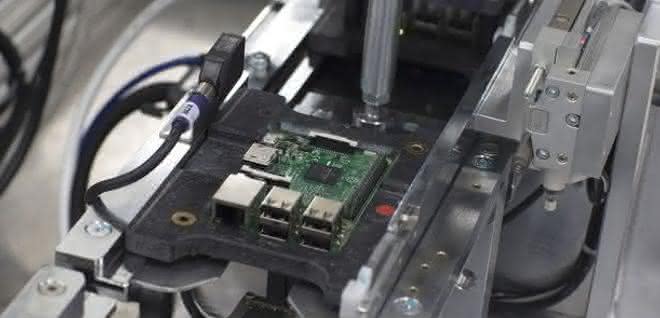
Today, many manufacturers offer more or less professional single-board computers. Most work with ARM Cortex CPUs, some also with Intel or other processors. Two to four CPU cores and clock rates of up to or even over 2 GHz are not uncommon. The processor cores are integrated into a system-on-a-chip (SoC), which also contains most of the computer's other functions. The computers generally use a Linux distribution as their operating system. This is in line with the open source strategy and makes development work easier. A wide range of software is also available. With a few exceptions, other components of the compact computers include a powerful graphics chip (GPU) and RAM of between 512 MB and 4 GB. In addition to performance, the interfaces vary greatly from model to model.
There is now a whole range of compact embedded computers that are suitable for professional use due to their high performance. Not all boards are designed directly for use in harsh industrial environments. However, appropriate adaptations such as housing or improved cooling make it possible to use these single-board computers for control tasks, for example. We present some of the most important systems here.
The classic: the raspberry
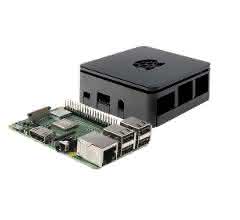
The best-known and probably most widespread of the single-board computers is the Raspberry Pi, which was initially developed in England for learning and educational purposes and launched on the market in 2012.
The latest Pi 3 B+ model of the open source board was released in March 2018. The SoC comes from Broadcom and contains a 64-bit ARM Cortex-A53 processor with four processor cores clocked at 1.4 GHz. The GPU also comes from Broadcom and has a composite and HDMI connection. The selection of possible operating systems is extensive: in addition to the Debian-based Raspbian and other Linux distributions, a Windws 10 version is also available.
In contrast to the previous models, Android has also been running on the Raspberry Pi since the Model 3 B. The Pi 3 B+ has four USB 2.0 interfaces, as well as Bluetooth and now also dual-band Gigabit Ethernet. The GPIO general purpose interface offers 26 pins for free programming. A microSD card reader is integrated for fixed memory. An audio output via HMDI or 3.5 mm jack as well as CSI for connecting a camera, DSI for the monitor and I2Cround off the range of interfaces.
Everything except windfalls
The Banana Pi, which was developed in China, is based on the Raspberry Pi, but is not related to it. The core of this open source computer is an Allwinner SoC with an ARM Cortex CPU. Versions with two, four and eight processor cores are available. With 2 GB DDR3 SDRAM, the M3 and M64 models - the latter with a 64-bit CPU - are generously equipped with memory. The newer versions of the Banana Pi are also equipped with a microSD slot. The M2+, M3 and M64 models each have two USB 2.0 hosts and 40-pin GPIO as well as Bluetooth. HDI as well as DSI for M3 and M64 are available as video interfaces. M2+ and M3 also have a CSI camera connection. WLAN and GB-Ethernet are common to all models. The board dimensions of the Banana Pi are similar to those of the Raspberry Pi models.
Integrated development environment
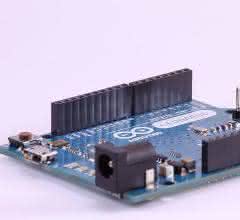
For years, Arduino has been offering a range of different, predominantly simpler, single-board boards with CPUs or microcontrollers with 8 or 32 bits in open source format. The most common are controllers from Atmel, while the more powerful boards are equipped with 32-bit ARM Cotex-M processors. They have digital and analog inputs and outputs. The great advantage of the Arduino platform is that it includes an integrated development environment. This is free and available for Linux, Windows and Mac OS. The integrated compiler is gcc, so programming is based on C or C++. A graphical operating system is not provided.
Of beagles and pandas
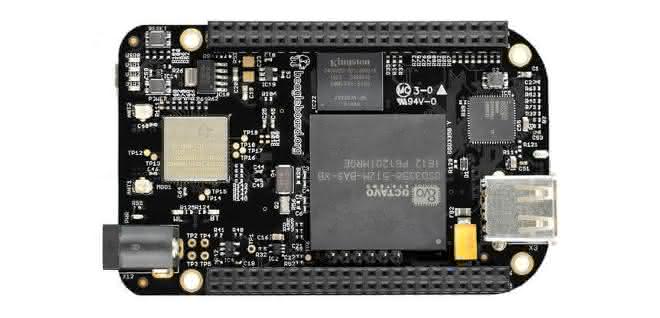
Texas Instruments developed the BeagleBoard in collaboration with Digi-Key back in 2008. Based on an ARM Cortex, which is integrated into an OMAP3530 SoC from Texas Instruments, the performance of the board is moderate with a clock frequency of 720 MHz and 256 MB RAM. Various Linux distributions serve as operating systems. Graphics connections are S-Video and HDMI.
The BeagleBoard offers USB, RS-232 and JTAG as additional interfaces. There is also an SD card connection. The board is characterized in particular by its low power consumption, so separate cooling is not necessary. Today, the further developments of the BeagleBoard are of particular interest. The BeagleBoard xM from 2010 offers 512 MB RAM and four USB 2.0 ports. The PandaBoard, also from 2010, is also a further hardware development with the OMAP4460 SoC from Texas Instruments with 1 GB RAM and 1 GHz CPU clock.
TI then used DDR3 RAM for the first time in the BeagleBone Black from 2013. The computer, which is powered by a 1 GHz ARM Cortex on a Sitara SoC, also from Texas Instruments, received 512 MB of it. HDMI is on the board, as are Ethernet and WLAN. There are also two expansion slots that enable the connection of additional boards, so-called capes. This allows the range of functions to be significantly expanded once again.
And there's more ...
There are many other interesting embedded boards. These definitely include the Cubieboard, which was developed in China and, in addition to the option of using an Android operating system, is characterized on the hardware side by a SATA connection and, in the latest version, by its USB 3.0 interface.
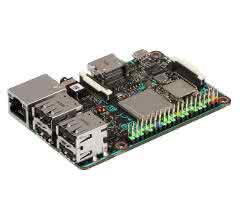
The Asus Tinker Board is a fairly new development, which was only released in 2017 and therefore has very up-to-date hardware. The Rockchip RK3288 SoC is powered by a 32-bit ARM Cortex-A17 processor that is clocked at 1.8 GHz and can reach up to 2.6 GHz in turbo mode. 2 GB LPDDR RAM, GPU and a 40-pin GPIO, Bluetooth, WLAN and Gigabit LAN round off the powerful hardware data. Linux and Android are suitable operating systems. In terms of performance, the Tinkerboard is definitely superior to the Raspberry Pi. However, it comes at a slightly higher price.
In summary, it can be said that the range of embedded single-board computers is quite large. Most of them are suitable for industrial applications - with appropriate adaptations if necessary. The prices for all boards are very moderate and therefore not only interesting for developers. The variants that have been available for some time are often very sophisticated, which minimizes the risk of failure. Despite their small dimensions, most boards offer many features such as WLAN, Bluetooth or Gigabyte Ethernet. The range of interfaces is also satisfactory to extensive on many models.
Anyone interested in mini single-board computers and looking for more information on their possible applications in industrial environments will find what they are looking for at Embedded World in Nuremberg from February 26 to 28, 2019. Manufacturers, distributors and users will be showcasing the latest models and explaining their special features.


You might also be interested in
Alternative to optical positioning methods
Solutions for workplace and intralogistics systems
With the SensorBoard for detecting the position and orientation of components, RK Rose+Krieger is integrating a technology commonly used in television studios into its modular system for customized system solutions.
 read more...
Schubert System Elektronik at the embedded...
Industrial computer technology "Made in Germany"
This year, Schubert System Elektronik (SSE) will once again be exhibiting at embedded world in Nuremberg. From March 14 to 16, 2023, SSE will be presenting innovative, industrial computer technology "Made in Germany" for various sectors and...
read more...The tiger among processors
Since the move towards the Industrial Internet of Things (IIoT) and Industry 4.0 has picked up speed, processor boards and modules must be able to process exponentially growing amounts of data.
read more...IFR publishes "World Robotics R&D Programs"
Countries around the world are investing in robotics to promote the further development of the technology for industrial and social applications. But what are the current goals of the official funding programs in Asia, Europe and America? The...
read more...App ensures safety during maintenance
The "5i.Maintenance" application improves transparency and occupational safety during machine maintenance.
read more...Compact computer for industry
As a versatile and compact computer, the Raspberry Pi is also interesting for industry. However, appropriate adaptations to the harsh production environment are necessary to bring the Raspberry Pi world into factories.
read more...Changes to the Executive Board
The Supervisory Board of Schaeffler has appointed Claus Bauer (55) as Chief Financial Officer (CFO). At the same time, Sascha Zaps (46) will become Regional CEO Europe.
read more...Work safely on the machine
The most dangerous workplace accidents occur outside of normal machine operation - for example during maintenance and cleaning. The cause is usually residual energy in the system that has not been switched off.
read more...Isra Vision with a new management team
Isra Vision has entered into a strategic partnership with the Swedish industrial group Atlas Copco, forming the core of the new Machine Vision Solutions division. With a new management team, the course is now being set for further business...
read more...