
Single-board computer
Short time-to-market with Raspberry Pi
The Raspberry Pi is very popular as a development computer. Whether it is also suitable for industrial series production depends on the respective application and requirements. To test this in individual cases, Kontron has developed a starter kit based on the single-board computer.
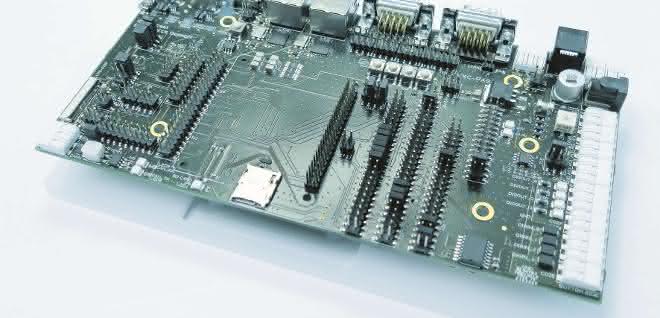
The Raspberry Pi (Rpi) single-board computer is increasingly being used as the basis for product designs. But is it also suitable as a basis for industrial series production? To find out, Kontron has developed an industrial starter kit for the (Rpi) Compute Module 3. This can be used to assess whether industrial production can be implemented on the basis of an Rpi design. The starter kit was used, for example, in the development of the mobile measuring station "Checkbox", a measuring station for vital data of patients in hospitals. Rpi significantly shortened the time to market.
Kontron has developed a solution for a hospital customer that continuously and contactlessly records the most important health parameters of bedridden patients and alerts nurses and doctors if necessary. As a medical device, the instrument had to be certified for the second-highest safety class 2b. The mobile measuring station also had to meet the requirements of EN 60601 for medical electrical equipment and medical systems. The device had to be mobile and installed under the patient's bed. The following requirements were important:
- Fast implementation
- long-term availability
- good price-performance ratio
- Support for yocto Linux
- Support for multiple interfaces such as WLAN, LAN and Bluetooth
- computing power that also allows machine learning
- a second, independent processor to ensure correct measurement results
The latest Rpi Compute Module 3 was selected as the platform. The customer accepted that the criteria of power consumption and long-term availability could not be fully met. On the plus side, the customer benefited from high computing power, comprehensive Linux support and low costs.
The prototype passed the high hurdle of electromagnetic compatibility and the interfaces could be verified with Raspian OS. The developers from Kontron and the Rpi community supported the transfer of the prototype to yocto Linux. The starter kit significantly accelerated development.
Starter kit with standard industrial extensions
For around five years, Kontron has observed that the designs supplied by customers are increasingly based on Rpi. Engineers and developers are familiar with this platform and achieve results quickly.
However, the difficulty was that the Rpi-based design sometimes had to be developed from scratch in terms of hardware and software. The financial and time expenditure was therefore higher than desired and the market launch took longer than hoped. However, a short time-to-market is important to customers in order to be competitive.
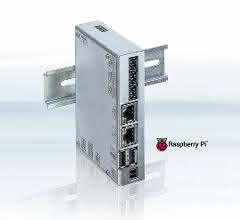
This is why Kontron has extended industrial standards in the starter kit, which uses the same CPU as the Rpi 3 compute module. It has all the interfaces commonly used in industry, such as Ethernet, CANbus, 1-Wire, the RS-485 serial interface for high-speed data transmission over long distances, RS-232 to ensure downward compatibility with older control devices, for example, inputs and outputs for 24 V, analog inputs, reverse polarity protection and greater interference immunity.
Kontron is planning further variants, for example specifically for IoT gateways with a 24 V supply, LAN interface, a security chip and corresponding connectivity. Another version is being developed for controlling displays and touchscreens for web panels or digital signage.
Rpi in comparison with Arm Cortex CPUs
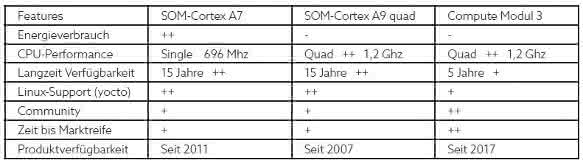
As an alternative to the Rpi Compute Module 3, Kontron also offers two SOM variants and a SMARC module with the comparable family of Arm Cortex-A7 and Cortex-A9 quad-core processors as well as a Qseven module with the Arm Cortex-A7. The comparison in the table shows that the Rpi Compute Module 3 is better than Cortex-A9 quad in four points and better than Cortex-A7 in three points for the requirements of the application described.
The combination of processor performance, short time-to-market and a favorable price-performance ratio make Rpi very attractive for the series development of industrial solutions. Ultimately, the choice of processor depends on the individual requirements of an application. The price of the mini-computer is often not the decisive argument: the ease of use of the software is often more important. The widespread operating system Raspian OS based on Linux makes it easy to install software packages. However, embedded Linux is much more complex to install and administer.
According to the Raspberry Foundation, Rpi had been sold around 22 million times by the end of 2018. On the one hand, this is a big plus, but open source is only of limited benefit to industrial users. Although many applications are available license-free, if the source code is adapted, this must also be published under a free license. The same applies if only individual modules from existing applications are used. If you are not dependent on Linux, you can also use Windows IoT Core.
Starter kit for Rpi CM 4 in planning
The Raspberry Foundation launched the Rpi 4 on the market in June. New features include up to 4 GB of RAM, 4K video output, USB 3.0, Gigabit Ethernet and more computing power. The larger RAM, a new graphics core and two HDMI ports mean that more demanding projects can also be realized for dual-display applications. Rpi 4 takes a big step forward in terms of performance. As soon as a compute module version of Rpi 4 is available, Kontron will test its compatibility and use in industrial environments.
The company has now completed a number of commercial projects based on Rpi. The low initial price is not reflected in the end product for every project. It turned out that even for prototypes based on Rpi, customer consulting during implementation has a financial impact. In some cases, the resulting industrial platform cost as much as a standardized embedded platform. The suitability of Rpi therefore always depends on the respective purpose and application. However, the Industrial Starter Kit can be used to quickly determine whether a Raspberry Compute Module meets the desired requirements.
Andreas Schlaffer, Head of R&D at Kontron Austria / am


You might also be interested in
Plagiarius 2024 negative prize
On January 26, 2024, the Plagiarius campaign awarded its dreaded "Plagiarius" negative prize for the 48th time to manufacturers and retailers of particularly brazen counterfeits and fakes.
 read more...
Ivalua honors winners of the Generative AI...
AI-supported "add-ons" for buyers within 48 hours
Ivalua, provider of cloud-based spend management solutions, announced the winners and innovations of the first Generative AI Innovation Cup. The competition took place in December 2023. It was open to all Ivalua partners and employees - more than...
read more...Efaflex celebrates 50 years of high-speed...
The emphasis is on "fast"
Since day one, Efaflex has wanted to use new technologies as early as possible and drive progress in the industry. This year, the family business is celebrating its 50th anniversary under the motto "Fast Forward".
read more...Security of supply even during power outages
In the winter of 2022, Germany was worried about energy shortages. The drugstore retailer dm did not paint any horror scenarios, but nevertheless saw the possibility of controlled, temporary, regional power cuts (brownouts).
read more...Safety technology in mechanical engineering
Modules with new functions
Euchner's product highlights at EMO 2023 include the communication-capable solenoid interlocks.
read more...Transforming the paper industry towards climate neutrality
Together with partners from industry and research, Voith is developing a project for the optimization of energy and material flows in paper production. The aim of the research project is to develop a digital framework that enables effective process...
read more...Up to 95 percent less flue gas thanks to direct extraction
The requirements for occupational safety measures and safety technology are also constantly increasing in welding technology. The Technical Rules for Hazardous Substances (TRGS) stipulate that welding fumes and harmful substances must be extracted...
read more...Competitive advantages with large machines
Whether 3D-printed components for machines and systems, prototypes or aids for design: additive manufacturing is almost indispensable for modern companies in mechanical and plant engineering and automation if they want to play in the premier league.
read more...Transport technology from the modular system
Many transport tasks can be realized with the help of linear technology. Pre-configured solutions are available to simplify the interaction between the linear unit, motor, gearbox and controller. This minimizes the effort required for research and...
read more...