
Select hexapod model
PI software simulates real application situation
Which hexapod is suitable for an application and what effect do external factors have? The simulation tool from Physik Instrumente (PI) can be used to check whether a hexapod is suitable for the respective positioning task and in which version.
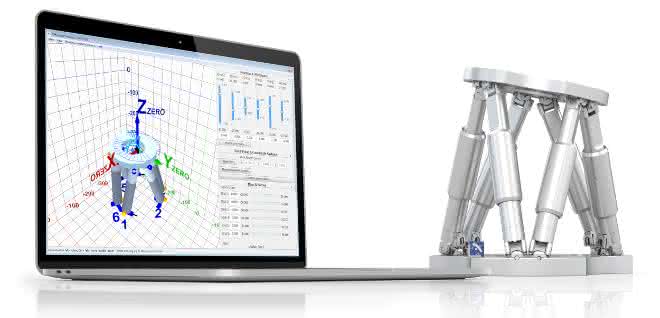
The user can simulate e.g. workspace, mechanical loads caused by masses or external forces, reference coordinate systems or pivot points conveniently and without in-depth specialist knowledge.
For multi-axis positioning applications, parallel kinematic hexapods are often used instead of stacked individual axes. They are more compact, achieve high dynamics in all axes and are available in many versions for different loads and travel distances.
Are the working range and load suitable?
In order to clarify the question of which hexapod is suitable for a particular application, data sheet information is only of limited help. Although they provide detailed information about the maximum travel of the individual axes, for example, the limits of the working space of a parallel kinematic system vary depending on the current position (translation and rotation coordinates), the current pivot point coordinates (pivot point) and the selected reference coordinate system. With the simulation tool, these limits can now be calculated for standard hexapods in Cartesian coordinates, displayed graphically and adapted to the application. Mechanical problems that could occur in the application can thus be localized and solved without a hexapod or controller.
The same applies to the load limit value of the Hexapod, which also varies depending on various factors. These include the installation position of the Hexapod, the planned load and, above all, the position of the center of mass, the respective position of the movement platform (translation and rotation coordinates) as well as the forces and moments acting on the movement platform of the Hexapod and on the individual legs. These influencing factors can also be simulated with graphical support, for example using a slider, in order to clarify which hexapod design might be suitable. This makes it much easier to get started with parallel kinematic positioning solutions. as


You might also be interested in
Further simplify assembly processes
In addition to the proven racks with a length of one meter, Wittenstein alpha now offers optional two-meter racks for linear systems. They are particularly suitable for use in short axes, for example, in order to simplify assembly even further.
 read more...
Hiwin manufactures its own shaft gearboxes
Have you ever waited several months for an urgently needed corrugated gearbox? Hiwin has too. That's why the Offenburg-based drive specialist has decided to produce its own space and weight-saving reduction talent.
read more...Human-robot interaction at the trade fair
Sumitomo Drive Technologies is presenting its drive solutions for automation and robotics at Automatica 2023 together with the Lafert Group. The company will be showcasing two different applications of the Tuaka drive system for robot applications...
read more...Partial automation with robots
At Automatica, Promess will be showcasing its modular individual workstations and how these can be partially automated with robot support. The servo press manufacturer will also be providing information about the latest features of its Revolution X...
read more...A new benchmark for collaborative robots
At this year's Automatica, Denso Robotics will be showcasing its innovations in the field of robotics. The collaborative Cobotta Pro product family will be the focus of the presentations. Visitors to the trade fair can see all variants in various...
read more...Clamping system for a new milling machine
Investments in machinery often lead to further purchases - as is the case at Joma-Maschinenbau, whose modern production facility has recently been supplemented by a 5-axis milling machine.
read more...Schunk wants to simplify processes in automated production
The declared aim of automation specialist Schunk is to make its customers' processes comprehensible, simple and efficient. Data transparency plays an important role in this. It enables reliable processes and provides the basis for resource-saving...
read more...Festo and Hahn Automation develop battery tester for greater safety
The success and reputation of electric vehicle manufacturers depend on the safe and flawless functioning of batteries. Hahn Automation has therefore developed a battery tester that performs a fully automated 100% test of mobile energy storage...
read more...SPN Schwaben Präzision presents gearbox solutions for automation and industrial robotics
Short cycle times, robust technology, wear-free surfaces and compact designs have always been relevant for automation and robotics solutions. This year's Automatica trend topics include "Sustainable production" and "Digitalization and AI". SPN aims...
read more...