
Industrial Analytics
Preventive maintenance in the high-performance compressor
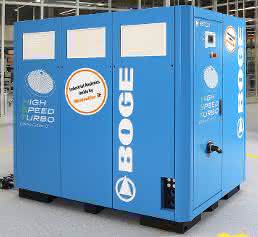
Boge has upgraded its HST 220 high-performance compressor with Weidmüller's Industrial Analytics software to detect faults and operating anomalies. The analysis software is part of Boge Analytics, a 4.0 service package for the intelligent evaluation of operating data.
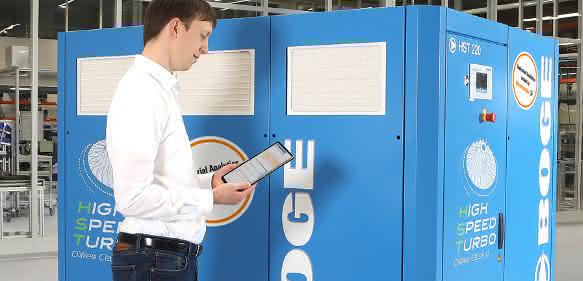
According to the manufacturer, the new HST (High Speed Turbo) compressors represent a milestone in the further development of Class 0 oil-free compressed air generation. Applications for the compressors include the pharmaceutical and food industries, industrial paint stores and semiconductor production. In all areas of application, machine downtimes have fatal consequences. Preventive fault avoidance is a prerequisite for increased process reliability and optimum energy management for the customer. This is why Boge is continuing to drive forward its Compressed Air 4.0 strategy in the area of service and maintenance.
Boge relies on predictive maintenance software from Weidmüller to detect potential faults and operating anomalies before they occur. This software solution is part of Boge Analytics, the Industry 4.0 package for intelligent data evaluation and use. The software package also includes the Boge airstatus remote monitoring solution, the Continuous Improvement Program and 24-hour recovery.
The predictive maintenance software detects faults and critical deviations in technological parameters at an early stage. The operational experience of all Boge compressed air solutions is incorporated into the data evaluation. This allows predictions to be made about future maintenance requirements during operation and service calls to be optimally planned. Boge then replaces affected components before any predicted damage occurs. Cost-intensive aftercare and long downtimes are therefore a thing of the past. With predictive maintenance, the company is focusing on a key value driver for a competitive and continuous compressed air supply in accordance with Industry 4.0 standards.
Boge as a user was at the center of the analyses - his know-how is very important. Although the software can predict an error with a certain probability, the prerequisite for this is always that it has previously been classified as relevant by an application expert. Only the user can assess whether an anomaly should actually be classified as a critical error.
Data patterns are crucial
The recorded data all comes from measurement technology components that are already present in the compressor. No new sensors had to be retrofitted. The following data was included in the evaluation and analysis: Engine temperature, air pressure, engine speed. The data quality was carefully assessed and a decision was made together with Boge as to its relevance. Non-relevant data sources were then sorted out. It is important to note how the measured values interact with each other, as it is not the individual value that is decisive, but the existing data pattern. This results in a complex data model of normality, which can be used to precisely predict the case of damage if the values deviate from the learned model in a certain way.
One decisive factor is that the system is constantly learning. The model changes with every new error message and based on feedback from the operator. This produces the following analytics results: What is the current and past status of the compressor, when will the status change to a critical fault and how efficient has the compressor been, how much compressed air has it delivered in the last few days. The analytics solution is designed in such a way that it can also learn about faults that are not yet known - calculated predictions about compressor failure therefore become increasingly precise over the entire operating time of the compressor. as


You might also be interested in
Conrad continues to grow
Conrad Electronic now generates 80% of its sales with business customers and has successfully developed from a traditional technology retailer into a B2B procurement platform. The company aims to become Europe's leading procurement platform for...
 read more...
AI finds its way into automotive customer service
In addition to computer solutions for vehicle diagnostics, Getac now also offers AI-based digital tools that support customer contact in service operations.
read more...SMC: "Preferred Supplier" from Bosch
The technology and service company Bosch has recognized SMC for the performance of its automation technology in factory and process automation and awarded it the status of "Preferred Supplier" in the material group "Standardized Pneumatic Devices".
read more...Combined ERP forces
The medium-sized ERP providers Step Ahead Software, Godesys and Informing merge to form the Step Ahead Group.
read more...Cybersecurity for asset-intensive companies
Forge Cybersecurity Platform, the new software platform from Honeywell, has been developed for the cybersecurity of asset-intensive companies and critical infrastructures. The platform is available in three versions.
read more...Automated machine tool as a success factor
Industry 4.0 is the hot topic of the moment. For small and medium-sized companies and contract manufacturers, it holds great potential for increasing production efficiency step by step. The focus here is on efficient and user-specific automation...
read more...Nemo hand vacuum lifts all materials
A new addition to the Eurotech portfolio is the battery-operated Nemo vacuum cleaner, which is suitable for handling almost all surfaces.
read more...Future-oriented cobot projects
Three pillars of successful cobot initiatives
What is important if cobot projects are to be future-oriented? Automation and robotics expert Omron has identified three aspects for human-machine collaboration.
read more...Short-stroke linear actuator instead of pneumatic cylinders
The new short-stroke linear actuator from Ketterer Antriebe and halstrup-walcher is characterized by high dynamics and a large stroke in a compact size. Thanks to the integrated electronics, the drive is easy to control compared to pneumatic...
read more...