
electronica
New narrowband IoT test system
Endrich is presenting an NB-IoT test system at electronica. This solution is a new, cell-based LPWAN technology based on the existing LTE infrastructure.
It enables the connection of a large number of simple devices within a radio cell, whereby only a data rate between 600 bit/s and 250 kbit/s is supported as a compromise. The solution is mainly intended for the occasional transmission of small amounts of (sensor) data and is characterized by low energy consumption.
In addition to a specific sensor, networked objects such as smart devices also contain a communication module that establishes the connection with the Internet of Things. The right network is particularly important for such applications.
When it comes to short transmission distances, local networks such as LAN, Wi-Fi or other WLAN solutions (e.g. Bluetooth, ZigBee or even near-field technologies) can be used to connect devices. For longer distances, however, only LoRaWAN or mobile networks can be considered.
Using existing mobile networks (e.g. GPRS, UMTS or LTE) to transmit low data rates from common smart devices would be too expensive. What is needed instead is a solution that offers an optimum balance between technical capabilities and cost efficiency.
The advantages of NB-IoT technology come into play outdoors and indoors, where traditional modules consume more energy due to the weaker signals. The small data packets transmitted at long intervals require a minimum of energy, which is crucial for the main feature of NB-IoT technology, namely the extremely long battery life. The broadband GSM, 3G and 4G modules offer functions such as mobile voice communication, messaging and data transmission at high data rates.
There are clear trends on the market that indicate a growing demand for NB-IoT applications. Endrich, together with its radio module manufacturer Fibocom, wants to be a pioneer in this technology.
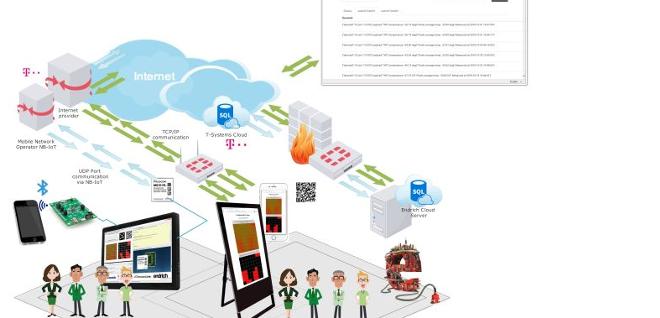
The company presented a functional NB-IoT application at electronica to illustrate how to set up a corresponding infrastructure.
The GridEye sensor from Panasonic, which consists of a thermal column array, detects people approaching the stand. The sensor's thermal image consisting of 64 pixels is transmitted to various cloud services via T-Systems' NB-IoT network using an M910-GL LTE CAT-NB1 module from Fibocom.
The average temperature of the sensor pixels and the ambient temperature are stored in one of the cloud servers. Endrich has also set up a cloud server to which all pixel temperatures are sent via the UDP port and stored in a database. The transmitted thermal image can then be displayed on the smartphones of trade fair visitors and on a large terminal display.


You might also be interested in
ESTIA aims to strengthen Europe's cloud
New tech alliance for EU sovereignty
Twelve companies, including Dassault Systèmes, are founding the European Sovereign Tech Industry Alliance (ESTIA). The initiative aims to strengthen Europe's technological independence and define requirements for sovereign cloud services. The start...
 read more...
Deutsche Telekom and Nvidia launch one of Europe's largest AI factories
With the Industrial AI Cloud in Munich, Deutsche Telekom and NVIDIA are creating one of the largest AI factories in Europe. Companies can train AI models, carry out simulations and access 10,000 GPUs.
read more...Leveraging data potential with AI and streaming
Huge data treasures are still lying dormant in many manufacturing companies. And yet it is high time that these treasures were unlocked. There is often a lack of resources and capacity to make data usable in real time. Streaming production data can...
read more...More awareness of noise
Dematic offers solutions that are tailored to different cloud environments and reduce environmental impact through reduced material consumption and improved energy efficiency.
read more...Generative AI in the automation environment
The mechanical engineering and automation industry is undergoing profound change. This transformation is being driven by more volatile global trade, geopolitical crises and increasing market pressure, which demands greater agility, technological...
read more...Rigid data structures have had their day
The traditional data center is no longer the center of data. A hybrid cloud storage approach enables manufacturing companies to both meet the current requirements of data-intensive processes and future-proof their infrastructure.
read more...Software as a service in three stages
CIM Database Cloud is a new out-of-the-box solution from Contact for end-to-end digital product development.
read more...How production can benefit from AI
Together with AI technology, IIoT networking makes it possible to better control machine parameters and optimize quality with predictive quality. Downtimes and set-up times can also be further minimized. Cloud platforms also make these technologies...
read more...More expertise for digital engineering
Altair, a computational science and artificial intelligence (AI) company, has acquired OmniV, a technology from Michigan, USA-based software company XLDyn.
read more...