
Networking
Bridge between ERP and production
In order to digitalize a company holistically, it is fundamental to network the office level with the production level. The challenge lies in linking the individual systems.
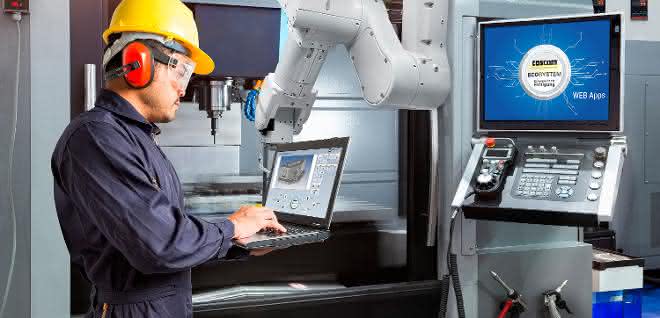
With the introduction of CAx systems, internal technical IT in production companies has gained enormously in importance over the last few decades. In the wake of Industry 4.0, holistic networking strategies for store and top floors and service concepts in production, IT departments are facing new challenges.
Organizationally, a manufacturing company is usually divided into business and technical business processes, which in turn lead to work areas such as marketing, design, work preparation, production and dismantling. Computer technology with CA techniques such as CAE, CAD, CAP, CAM and CAQ is anchored in wide areas of discrete manufacturing in the "top floor" (engineering and office applications) and "store floor" (production). The term "virtual machining" is used in the production environment. This refers to a bundling of processes relating to the deep integration of CAD with CAM, machine simulation and subsequent processes, such as post-processing with NC code creation. For some years now, companies have been focusing on interoperability and services in the context of the Industrial Internet of Things (IIoT) on their shopfloor. All in all, the influence of IT in manufacturing companies has continued to grow in importance over time, and the relocation of individual IT systems is at the forefront of the minds of those responsible.
Networking on the store floor with links to the top floor
The successful implementation of an end-to-end digitalization project right down to the store floor requires a deep understanding of the process worlds of IT and production in addition to the ability to cooperate. Due to the technical nature and heterogeneous infrastructure of production, dovetailing a common understanding is difficult in itself. The physical separation of the top and store floor also adds to the complexity. These challenges can be overcome by introducing an "intermediate layer" as the connecting link. Even if the terms for this are still quite unspecific, it seems clear that the goal is a new kind of "process excellence". The department that deals with these issues is often referred to as "shopfloor IT". These are usually highly trained experts.
The wave of digitalization with its specific requirements for ever greater flexibility also means that manufacturers of monolithic IT systems are having to open up under the impact of "standardization", whether driven by ERP or PLM projects, for example. It is therefore assumed that the trend towards the emergence of new process platforms will intensify. The end-to-end digitalization of store floor processes such as paperless production is still in its infancy compared to the successes on the top floor, which is also due to the heterogeneous infrastructure there and the associated process diversity. The potential in terms of process optimization, greater efficiency and efficient use of resources is huge, so it is understandable that digitalization is now a central IT topic.
IT expertise and process know-how for successful digitalization
One example is the link between engineering and production: the complete tool and NC program for manufacturing the product are created from ERP data and CAD drawings, and the collision check of tool and blank can be carried out precisely using machine simulation. All relevant production data, including the modification service, can be transferred paperlessly to the machining center or machine tool. Ideally, the entire process is mapped in a process platform that interoperably integrates all IT systems involved in the process via a central database. This makes it possible, for example, to create a digital twin of the tool with all its advantages.
Store floor and top floor are growing together, many applications overlap. The clear demarcation between ERP, PLM and MES is fading into the background. The challenge for IT managers is to link the individual systems, both horizontally and vertically. The decisive factor here is not only IT competence, but also the corresponding process know-how and technical expertise, for example in the machining process. The seamless design of data processes and the use of synergies are essential components of digitalization projects in CNC production.
Coscom implements data networking strategies from the ERP system to the store floor of the machining manufacturing industry and supplements and relieves the burden on in-house IT departments. The Coscom specialists focus on the areas of data and information networking, the targeted use of a tool management and production information system and the optimal design of a CAD/CAM process chain through to a highly effective automation solution. The combination of process consulting, in-house developed software solutions and project implementation stands for a successful and timely implementation time, rapid productive use and economic amortization time of a digitization project.
Christian Erlinger, Member of the Management Board, Coscom


You might also be interested in
"We are clearly different from the competition"
The IT company 21unity offers a range of hardware and software services, as well as traditional services. Andreas Mühlbauer spoke to Managing Director Anja I. Gondolf about the company's appearance at the Hannover Messe, its services and future...
 read more...
Think digital, act local
When it comes to industrial damping technology, on-site advice is often very valuable for engineers and designers.
read more...Plagiarius 2024 negative prize
On January 26, 2024, the Plagiarius campaign awarded its dreaded "Plagiarius" negative prize for the 48th time to manufacturers and retailers of particularly brazen counterfeits and fakes.
read more...Spindel Full Service records second-best...
Maintenance as an economic success factor
Spindel Full Service, the spindle repair specialist from Baden-Württemberg, can look back on its second-best financial year in its history - with 15% growth compared to the previous year. And the further forecast also looks good.
read more...Thyssenkrupp and Novelis cooperate
Platform for the circular economy
With a platform for the circular economy in the automotive industry, the two companies Thyssenkrupp Materials Services and Novelis want to set new standards for the recycling of used materials. The open platform will enable access to larger...
read more...How production can benefit from AI
Together with AI technology, IIoT networking makes it possible to better control machine parameters and optimize quality with predictive quality. Downtimes and set-up times can also be further minimized. Cloud platforms also make these technologies...
read more...Marco Ghirardello takes the lead
Fanuc has appointed Marco Ghirardello (48) as the new President and CEO of Fanuc Europe. Ghirardello succeeds Shinichi Tanzawa, who has led the company since 2016 and will take on a new role at Fanuc's headquarters in Japan.
read more...Efficient robot monitoring
Microchips are installed almost everywhere - whether in smartphones, washing machines or cars. With increasing digitalization, the demand for semiconductors has been growing rapidly in all areas of the economy for years.
read more...Everything on one platform
Functional and powerful tools are essential for professional work on the construction site, in the workshop or when carrying out repairs.
read more...