
Machine visualization
Attractive in many ways
Communication via touchscreen. Monforts, a specialist in textile machinery, has worked with Lenze to develop an operator guidance system for a new generation of stenter frames. Lenze supported Monforts in this project throughout all phases of the engineering process. The pioneering visualization enables textile companies to increase the overall productivity of the system.
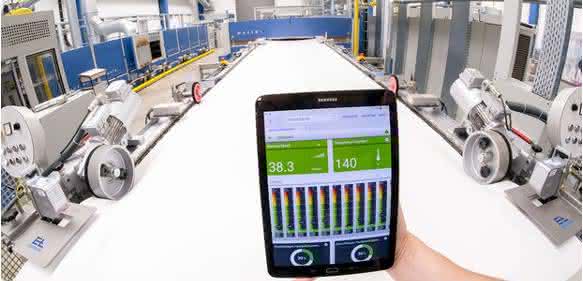
Today, finished textiles are more than just fluffy bed linen or impregnated clothing. Finished materials are also used in modern production processes in the aerospace industry. "The outer skin of the Airbus A380 consists of around 70 percent textiles," explains Klaus A. Heinrichs, authorized signatory at Monforts, the Mönchengladbach-based specialist for textile machines. Sophisticated automation, finely tuned processes and pioneering machine visualization meet the high-tech requirements. Monforts set up the project together with Lenze.
How can a system for finishing fabrics be controlled in practice, with webs that are often 1,000 or more meters long? How should human-machine interfaces be designed so that safe navigation with the best possible orientation is possible? What contribution do comprehensible information and helpful menu structures make to production control, including fast set-up times? "Swipe gestures are common practice for young people, for example. Digital natives are used to something different from what machines offer for operation today," Jan Bilke sums it up. The graduate engineer for automation technology at Monforts is the project manager for the visualization development launched jointly with Lenze and the Bremen Institute for Integrated Design (IID).
The composition of this triumvirate makes it clear how important the operability of complex machines is today. On the one hand, there is the OEM with in-depth process knowledge and process expertise. On the other is the partner for drive technology and automation with its own portfolio of solutions for motion control, operation and monitoring. Finally, the third partner is IID, the specialists for visual communication and interaction, who have taken on the graphic design. "Easy and user-friendly operation is a very topical issue," explains Jan Bilke. "Above all because unskilled and temporary workers are increasingly working in production. They need to find their way around the machine operation quickly and safely without extensive training."
This development also influences the way automation partners work. Monforts initially appreciated Lenze's drive technology and motion control expertise as well as the good cooperation in engineering. The task of equipping the new generation of Montex stenter frames with a newly conceived operator guidance system went beyond classic drive and control technology. "In the past, it was common practice to show as much information as possible on the display, regardless of how relevant it was for the operator," explains Klaus A. Heinrichs. Now the operator guidance has been completely rethought: Lenze has supported Monforts in this project throughout all phases of the engineering process. The Lenze team outlined initial implementation scenarios so that the idea became a concept that was realized in joint projects. Ultimately, it was the continuous close partnership that contributed to the implementation of this visualization solution.
Mechanical engineering projects, such as the new generation of clamping frames at Monforts, demonstrate Lenze's solution expertise: from the actuators and automation software to the human-machine interface. The hardware in the form of multi-touch-capable displays with diagonals of up to 24 inches is available - in addition, an HTML5-based visualization for web browsers has been developed. Operation is also possible on mobile devices and allows service personnel, for example, to view fault messages and diagnostic options from any location.
The visualization at Monforts is structured along the linear flow of the goods through the system. The main image shows a reduced, horizontally scrollable view of the entire system. It is then possible to zoom into the individual components on the Lenze multi-touch display and thus change the image. The screen grid and the size of the buttons and display elements are optimized for use with the hand or finger. The screen layout is divided into function and display areas for a quick overview and easy familiarization. The main navigation is the horizontally sliding lens, which takes users to the detailed view of the individual components. At the same time, there is a color coding system that clearly identifies system statuses.
Monforts decided early on to take a holistic approach to the issue with a view to the future. Initially, the aim was to modernize the old visualization and revise it accordingly in some areas. For Klaus A. Heinrichs, this decision was based on the clear strategy of viewing visualization as part of the overall productivity of a system. "If our stenter frames are easier to operate, especially with frequently changing machine operators, the textile company saves on set-up work and when running in new products. With a fast system set-up, I have maximum productivity right from the start." Just being five minutes faster at a web speed of 50 meters per minute means a saving of 250 meters of fabric. What's more, the new visualization system now also paves the way for fast teleservice via the Internet, says Heinrichs.
How the appearance ultimately looks in detail on site will in future also depend on the habits of each individual employee on a production shift. The new visualization from Monforts offers so many degrees of freedom that the user guidance can be individually adjusted using so-called widgets.
Bernd Wieners / as


You might also be interested in
Conrad continues to grow
Conrad Electronic now generates 80% of its sales with business customers and has successfully developed from a traditional technology retailer into a B2B procurement platform. The company aims to become Europe's leading procurement platform for...
 read more...
AI finds its way into automotive customer service
In addition to computer solutions for vehicle diagnostics, Getac now also offers AI-based digital tools that support customer contact in service operations.
read more...SMC: "Preferred Supplier" from Bosch
The technology and service company Bosch has recognized SMC for the performance of its automation technology in factory and process automation and awarded it the status of "Preferred Supplier" in the material group "Standardized Pneumatic Devices".
read more...Combined ERP forces
The medium-sized ERP providers Step Ahead Software, Godesys and Informing merge to form the Step Ahead Group.
read more...Cybersecurity for asset-intensive companies
Forge Cybersecurity Platform, the new software platform from Honeywell, has been developed for the cybersecurity of asset-intensive companies and critical infrastructures. The platform is available in three versions.
read more...Automated machine tool as a success factor
Industry 4.0 is the hot topic of the moment. For small and medium-sized companies and contract manufacturers, it holds great potential for increasing production efficiency step by step. The focus here is on efficient and user-specific automation...
read more...Nemo hand vacuum lifts all materials
A new addition to the Eurotech portfolio is the battery-operated Nemo vacuum cleaner, which is suitable for handling almost all surfaces.
read more...Future-oriented cobot projects
Three pillars of successful cobot initiatives
What is important if cobot projects are to be future-oriented? Automation and robotics expert Omron has identified three aspects for human-machine collaboration.
read more...Short-stroke linear actuator instead of pneumatic cylinders
The new short-stroke linear actuator from Ketterer Antriebe and halstrup-walcher is characterized by high dynamics and a large stroke in a compact size. Thanks to the integrated electronics, the drive is easy to control compared to pneumatic...
read more...