
IoT terminal from Weidmüller
Status monitoring of decentralized machines
New from Weidmüller is the IoT terminal, an open, secure and quickly integrated solution for the Industrial IoT. The solution collects data, transfers data to cloud services and also enables active data-driven interactions.
In the Industrial Internet of Things (IIoT), all components of a production environment are connected to each other via a digital infrastructure and thus become actors themselves. Five core functions form the basis for digital, data-based IoT solutions: Data collection, processing, communication and analysis as well as operator interaction. This results in new opportunities for generating added value, such as improving overall equipment effectiveness (OEE) or generating automated reports on energy consumption for the effective control of systems.
Although data is often collected and stored as a first step in companies today, it is often not yet used in a targeted manner. Weidmüller offers a comprehensive product portfolio for digitalization and intelligent networking from the sensor to the cloud. A new addition is the IoT terminal, an open, secure and quickly integrated solution for the Industrial IoT. The solution collects data, transfers data to cloud services and also enables active data-driven interactions. The solution is particularly suitable for fault detection and transferring configured fault messages to a cloud service.
Possible uses in industrial applications
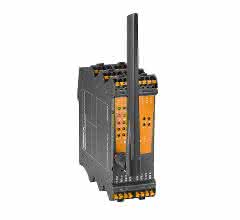
Weidmüller's solution has several digital and analog input and output ports. The input ports enable monitoring solutions for four digital signals simultaneously. Two additional voltage or current measurements and up to four temperature measurements can be carried out in parallel. Two ports are galvanically isolated, enabling AC voltage applications. During commissioning, the IoT terminal automatically registers in the cloud and is ready to transmit data. The IoT terminal is commissioned and configured via the BLE interface (Bluetooth Low Energy) using an app. After successfully logging into the cloud, the terminal can also be configured via the cloud. A configuration can be, for example, the determination of limit values with the corresponding reaction to them. If the defined limit value is exceeded, the user is notified directly.
These active data-driven interactions open up a wide range of industrial applications, for example in solar parks for power monitoring, in hydroelectric power plants or for monitoring charging stations for electric vehicles. At the same time, data can also be transferred to the cloud at regular intervals. All transfers are logged in the cloud and are available later as a history. By using the MQTT / COPA web transfer protocol, the data is available to the user as standardized protocols that can be easily integrated into their existing engineering systems. The MQTT protocol manages and administers all data traffic via the so-called MQTT Broker - messages are received and distributed directly. However, it is not only the standardized provision of data in the cloud that is useful for IoT applications. Simple and cost-effective data monitoring via cloud services is also a decisive factor for easy use in industrial IoT applications.
Communication via Narrow-Band IOT and LTE-M
To transmit data to the cloud, Weidmüller relies on communication via Narrow-Band IoT and LTE-M cat.1, among others. These are mobile radio standards that are intended for cost-effective, low-power and low-price IoT services. The special narrow-band modulations of Narrow-Band IoT and LTE-M increase radio signal penetration for long distances of up to ten kilometers in rural areas and overcome the attenuation caused by walls, machines and environmental obstacles. The solution also features Bluetooth Low Energy and ModBus. The solution is approved by several global and regional mobile network providers and is therefore available worldwide. This transmission standard is particularly suitable for transmitting status data at regular intervals in decentralized applications, as it consumes little energy.
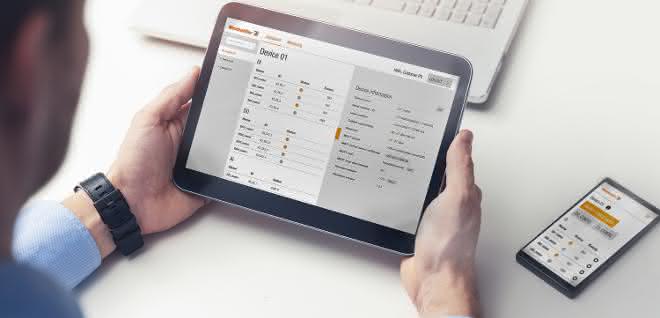
When designing the solution, the developers placed particular emphasis on quick and easy commissioning. An intuitive smartphone app supports the user through the entire set-up and maintenance process. After starting the app, the user logs in with their username and password. The IoT terminal can then be selected from the list of scanned BLE devices. Once the IoT terminal has been registered as a "device", data from the input and output ports can already be called up.
Simple retrofitting
One possible application of the terminal is the retrofitting of existing machines and industrial systems for energy metering. In this case, the basis can be a low-cost energy meter with just one Modbus RTU interface. The IoT terminal acts as a Modbus RTU master and offers a solution for adding the IoT function. All components are accommodated in a separate housing, the so-called Energy PnP Box, and are therefore ready for easy retrofitting. Additional external sensors such as flow switches or temperature measurement can also be connected via digital/analog inputs. All values are available directly in the cloud. All in all, this solution is designed to create cost-effective and simple IIoT solutions for digitizing production plants or infrastructure facilities for which this has not yet been economically viable.
Driving forward the vertical integration of IIoT
Both insight into and information from machine control systems and production processes are a key aspect of digitalization. Vertical integration, in which information from production systems is collected and forwarded for evaluation, makes an important contribution to this. Solutions from Weidmüller help to develop needs-based solutions for IoT applications and successfully integrate them into existing structures, for example for location-independent machine commissioning, improving overall equipment effectiveness (OEE) or generating automated reports on energy consumption. With industrial analytics and cloud-based services such as ResMa energy and resource management, Weidmüller already offers solutions that enable customers to benefit from the advantages. as


You might also be interested in
ESTIA aims to strengthen Europe's cloud
New tech alliance for EU sovereignty
Twelve companies, including Dassault Systèmes, are founding the European Sovereign Tech Industry Alliance (ESTIA). The initiative aims to strengthen Europe's technological independence and define requirements for sovereign cloud services. The start...
 read more...
Deutsche Telekom and Nvidia launch one of Europe's largest AI factories
With the Industrial AI Cloud in Munich, Deutsche Telekom and NVIDIA are creating one of the largest AI factories in Europe. Companies can train AI models, carry out simulations and access 10,000 GPUs.
read more...Leveraging data potential with AI and streaming
Huge data treasures are still lying dormant in many manufacturing companies. And yet it is high time that these treasures were unlocked. There is often a lack of resources and capacity to make data usable in real time. Streaming production data can...
read more...More awareness of noise
Dematic offers solutions that are tailored to different cloud environments and reduce environmental impact through reduced material consumption and improved energy efficiency.
read more...Generative AI in the automation environment
The mechanical engineering and automation industry is undergoing profound change. This transformation is being driven by more volatile global trade, geopolitical crises and increasing market pressure, which demands greater agility, technological...
read more...Rigid data structures have had their day
The traditional data center is no longer the center of data. A hybrid cloud storage approach enables manufacturing companies to both meet the current requirements of data-intensive processes and future-proof their infrastructure.
read more...Software as a service in three stages
CIM Database Cloud is a new out-of-the-box solution from Contact for end-to-end digital product development.
read more...How production can benefit from AI
Together with AI technology, IIoT networking makes it possible to better control machine parameters and optimize quality with predictive quality. Downtimes and set-up times can also be further minimized. Cloud platforms also make these technologies...
read more...More expertise for digital engineering
Altair, a computational science and artificial intelligence (AI) company, has acquired OmniV, a technology from Michigan, USA-based software company XLDyn.
read more...