

Digitization
Interfaces for late adopters
Is digitalization a risk for companies? With all the possible risks, do the opportunities outweigh the risks - or is digitalization the only way for many companies to remain competitive in the long term? A comparison with the arrival of the steam engine in industry comes to mind.

Manufacturers, operators and service providers in the mechanical engineering sector have established a consensus that there is no way around the ever-deepening digitalization of production systems in the long term. At the same time, however, statements such as the following from T-Systems often cause uncertainty among mechanical engineering OEMs: "Existing business models are being called into question by digitalization, and global markets are becoming increasingly volatile".
These correlations, as well as the resulting transformations of business models and the associated risks, must be viewed in a very differentiated manner. The mechanical engineering sector in particular, with its typical structure of SMEs and "hidden champions", is in a very good position worldwide to perceive digitalization not as a threat but as an opportunity to expand existing business models and, in the long term, to open up new markets using new technologies. Ultimately, it is clear to all business players that digitalization will secure the long-term competitiveness of OEMs in the mechanical and plant engineering sector.
What are the arguments in favor of this approach? Firstly, the path to digitalization can only be successfully taken in many individual steps. For those involved, it cannot be about all-encompassing collective functionalities, as described under the terms "IIoT", "Industry 4.0", "digital engineering" and the like. Rather, it is about concrete approaches that can be used to increase the efficiency and cost-effectiveness of machines along the entire life cycle with as little effort as possible. And because automation in mechanical engineering has been driven primarily by digitalization for decades, it is primarily the relevant OEMs that can successfully implement these approaches based on their core competencies. Only OEMs can implement specific measures that combine existing functionalities and systems with the most promising new control and data transmission technologies in a targeted manner.
On the other hand, digitalization in industry is often mentioned in the same breath as "Industry 4.0". This term stands for the 4th industrial revolution: the disruptive potential of current technological developments is equated with the effects of the industrial use of steam engines, electricity and computers. Successful players such as Amazon, Microsoft and Google are often cited as striking examples of the force of change. For medium-sized mechanical and plant engineering companies, on the other hand, the development is at least partially perceived as a threat. The protagonists of digitalization are trying to put a stop to this. Hans Beckhoff, the founder and CEO of Beckhoff Automation, explained very aptly at an IHK event in 2017 that the change represents an opportunity for industrial production and that the pace of change is slower than initially assumed: "From today's perspective, the introduction of the steam engine seems like a revolution. However, it took more than half a century before its use in industry led to serious changes on a massive scale." The effects of digitalization on industrial production today should be viewed in a similar way. It is triggering an evolutionary development at all levels and in all processes. At the same time, Beckhoff emphasizes that this insight does not mean that we should sit back and relax. According to Beckhoff, the courageous in particular will be rewarded if they creatively develop new business models for production systems.
Sustainably successful digitalization
Harting has analyzed the implementation strategies of its customers and can only confirm Beckhoff's theses. In order to achieve sustainable success with digitalization projects, it is therefore advisable above all not to want to achieve everything immediately. Whether the development is revolutionary or evolutionary: Those involved agree that data forms the basis of more streamlined processes - all types of data, in fact. The slogan "Data is the new oil" originally referred to "big data" or the storage and availability of consumer data. However, this characterization can certainly be applied to data in industry. However, to stay with the image, functioning "pipelines" and other structural elements are still needed for the "new oil". "Data is the new oil" describes not least the current situation of many machine and plant manufacturers who are in the process of revising the creation, processing and transmission of data for their products.
The OEM's "data view" of production systems can be described as follows:
- OEMs are experts for many existing technological, machine-related data, for the use of this data in proprietary machine functions and for extended automation functions
- The increased use of the "internal intelligence" of automation components such as drives, smart sensors, actuators or HMI systems with all the associated data transitions is also part of an OEM's standard tool today
- In addition, there are all possible data transmission layers at the machine network or line level that use known data creation, machine, user and process models, which are also considered proprietary know-how
- However, in terms of digitalization, not all of the aforementioned data structures and transmission layers that are part of the control and automation systems can simply be "torn down" and replaced with new ones. This is because almost the entire functionality of modern production systems is based on software and suitable specific interfaces; these functionalities have been developed with an enormous amount of material and engineering effort.
An initial conclusion is therefore: In order to drive digitization forward with as little effort as possible and to cope with the growing volumes of data that come with it, machine and plant manufacturers must be able to continue using existing data structures and interfaces.
Tapping into new market shares
In line with the data-oil analogy, proven and sufficiently functional "pipeline structures" must continue to be used and expanded to include new "pipelines". This enables companies to improve their own competitiveness and gain new market shares in their own segment or in other segments of production technology. To put it in terms of control technology for industrial systems: an OEM in mechanical engineering needs its proven field buses and interfaces for evolutionary digitalization. At the same time, suitable physical interfaces are advantageous for the expansion of new systems and services in the edge area as well as for the most seamless possible connection to the world of big data. If you master both disciplines, you are optimally equipped to cope with the growing and in some cases still unknown future requirements of machine users.
The trend-setting requirements for developments in connection with digitalization, which are presented in the following section, are based on the experience of the Harting Technology Group. The company provides solutions for all types of data interfaces for modern drive, control, HMI and communication technology in mechanical engineering production systems. Harting is also a pioneer in many groundbreaking developments for power and signal transmission in the industrial environment. In the field of Industrial Ethernet, Harting plays a key role in shaping various standards on the physical layer: For example, it is actively involved in solutions for so-called single-pair Ethernet technology.
Decades of experience in the field of interfaces for factory automation combined with the expertise of a trendsetter in the latest data transmission technologies (including the world of "big data") make it possible from Harting's point of view to always find an optimal solution on the physical layer for every specific interface design. With the help of the right interfaces, OEMs can decisively drive forward the migration to digitalization that is so important to them. The respective application with its mechanical, environmental and EMC conditions and other requirements must remain the uncompromising leader in every solution.
"What is the simplest and most effective way to design the interfaces for data transmission in production systems - at all conceivable levels of the factory and into the cloud?" This question often causes headaches in the R&D and engineering departments of machine manufacturers who want to gradually develop specific aspects of digitalization in their projects. The requirements that need to be met are as follows:
- It should be possible to implement all types of data interfaces, both tried and tested as well as the latest innovations.
- The range of interfaces must be scalable, meaning that the same interface type can be designed in the required normative version, IP protection class or for the required environmental conditions (EMC, resistance to dirt, UV radiation, mechanical loads such as shock & vibration and compliance with hygiene requirements).
- For the transitions between locations or sections, it must be possible to use interfaces that function reliably and conform to standards
- There must be product variants that are designed for different manufacturing and assembly processes at the OEM, for example for tool-free assembly if flexibility is required, or for automatic assembly if higher quantities are to be manufactured with high process reliability
- The data interfaces must be combinable with each other and be able to be placed with other signal and power interfaces in one housing or even together in one insulator in order to save space and costs and simplify processes.
The outlined approach allows developers and project managers to concentrate on the central tasks for their respective application during the design phase - without having to spend time on the "marginal criteria" of interfaces. At the same time, they can be sure that there is a suitable interface for every expansion stage of a machine module or data transmission path. The corresponding solutions are both cost- and function-optimized and scalable. A cost-efficient, technically simple expansion of services and system extensions at all levels of factory automation and beyond can be implemented at the machine user's premises at any time, even retrospectively.
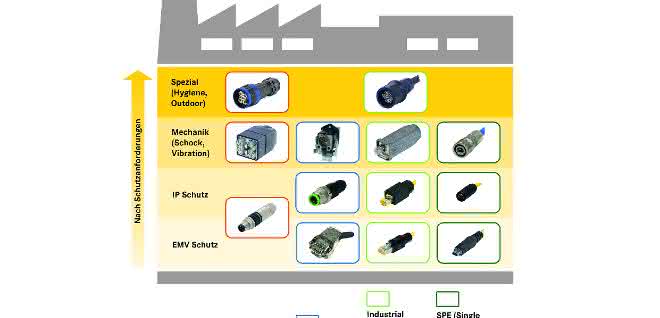
Figure 1 shows the approach in condensed form: It provides an overview of the best-known network systems for industrial data transmission and describes selected real Harting solutions, which are shown as product families. It becomes clear how great the freedom in the design of the data interfaces actually is: For practically every type of field bus or Industrial Ethernet, there are several options for designing the physical layer. This means that it is (almost) always possible to find a solution that is precisely tailored to the application - even for requirements that are still unknown today and/or for digitization requirements that grow with them.
Dipl.-Ing. Jakob Dück, Global Industry Segment Manager, Harting


You might also be interested in
Hebotec at the Hannover Messe 2025
Connecting consumers without tools
Additional robots, control cabinets, control panels or other consumers can be easily integrated into the EMC concept of an existing production line using the PAK 25 equipotential bonding terminal from Hebotec.
 read more...
Motion controller for small drives
Medium power range covered
Faulhaber has another housing-less and compact motion controller in its range, which is particularly suitable for integration in device construction and medical technology applications.
read more...Safe solutions for cable installations
From thick power cables to thin sensor lines, cables and lines must be routed safely through systems and machines. A challenge that should not be underestimated, explains Jörg Sokat, Head of Product Management at Pflitsch.
read more...Displacement measuring systems
Economic positioning
The integrated position measuring system IMS from Bosch Rexroth is now also available as IMS-compact for absolute measurement. The non-contact solution with magnetic measuring principle enables robust and economical position detection for linear...
read more...Economic positioning
The integrated position measuring system IMS from Bosch Rexroth is now also available as IMS-compact for absolute measurement. The non-contact solution with magnetic measuring principle enables robust and economical position detection for linear...
read more...Sensors with IO-Link for extruders
The melting pressure always in view
Macchi, a manufacturer of blown film extrusion lines, optimized its extruders for Industry 4.0 by integrating melt pressure transmitters with digital IO-Link output for precise recording of the melt pressure and magnetostrictive displacement...
read more...Vision with good visitor response
6505 visitors and 378 exhibitors attended the machine vision trade fair in Stuttgart.
read more...Würth Elektronik at the embedded world
Würth Elektronik, manufacturer of electronic and electromechanical components, is presenting itself as a partner to developers at embedded world. At stand 110 in hall 2, the company will be presenting its portfolio and the associated services.
read more...Die-cast electronics housing
CTX Thermal Solutions manufactures cost-effective die-cast housings in application-specific geometries.
read more...