
Human-machine communication
"I'm done, it's your turn!"
Gigaset is a provider of telephony and smart home solutions as well as smartphones. The parent company, Gigaset Communications, is based in Bocholt. Production there is highly automated and digitalized. The Refa apprenticeship played a major role in this from the very beginning.
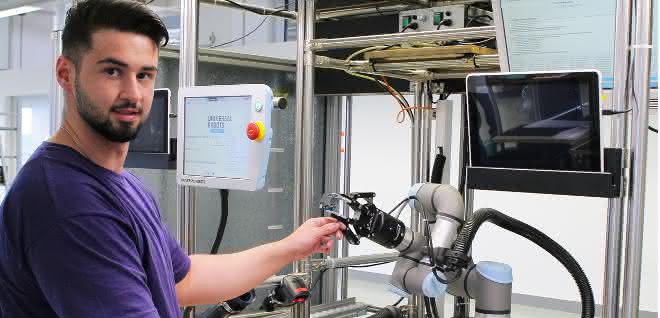
At Gigaset, large parts of production have been partially or fully automated for 20 years. The decision-makers have been working on the basis of the Refa doctrine for at least as long. The set of rules contains methods and calculation tools that can be used to organize and improve processes. As a result, work is adapted to human needs and becomes more effective at the same time.
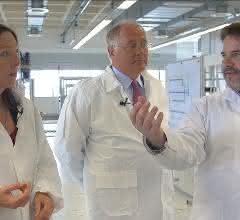
CEO Klaus Weßing has been with the company since 1983. He has been Chairman of the Executive Board of Gigaset since 2015 and has long been associated with Refa. He looks back: "All my bosses also had a Refa background. So when I joined the company, it was clear which direction we were going in." From Weßing's point of view, clear structures are needed before digitalization processes, which were created at Gigaset with the help of the Refa apprenticeship.
Weßing: "It all starts with a thorough analysis of all process steps." Because processes play a major role at Refa. "We know exactly which work steps are required to create a product. And we know exactly how the work is distributed to the employees. We have based an optimal production concept on this."
Set-up-related interruptions reduced by 90 percent
He gets specific: "Back then, we used measurements and calculations to identify and eliminate time wastage in the set-up area." Each line is currently set up once every hour to switch from job A to job B. "We have reduced the resulting interruption time from around 38 minutes to the current three to four minutes." This has been achieved through clever work organization and the use of many robots - for example in smartphone production.
Robots have changed
In many production areas at Gigaset, robots take over parts of production and interact with people. Acceptance of the machines by the workforce has been a long road, emphasizes CEO Weßing. That's because the old robots from 20 years ago were dangerous: "Their strength and enormous speeds were simply too high." He remembers: "A cell with a safety fence was installed above each robot to protect the employees so that no one could interfere with what was happening."
Head of Automation Technology Wißing builds a bridge to the present: "If the same people are now to work with improved robots, a rethink must first take place." Fear must be overcome - and even more: "Ultimately, employees should be happy to touch a machine that was dangerous 20 years ago."
Step by step to the new technology
To achieve this, the robots were introduced to the production employees very gently over the course of six months. "We first put a robot in place. Gradually, every employee was allowed to familiarize themselves with it," says Wißing, describing the procedure. The robot took a part, processed it and presented it to the employee. "In this way, we managed to introduce 90 percent of the workforce to the new technology." He emphasizes that the interaction between humans and machines now works "really well" and cites smartphone production as an example.
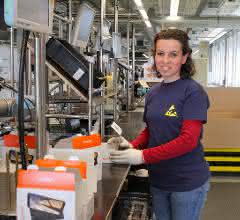
In smartphone production, there are six U-lines that produce the same number of different products. And because packaging is six times faster than production, a packing station with one or two employees can process six U-lines in shifts. At a production control station located in the room, the employees put the customer orders in the right order. And they plan the associated personnel deployment. If fewer U-lines are active, shifts and the number of employees are reduced.
Assembly and testing
At the beginning of each U-line there is a station where communication between humans and robots takes place via gestures. There are postures and actions on both sides that mean "I'm done, please continue". The robot first waits in a certain pose while the employee removes a film from a part. It then touches the machine so that it can continue. This is made possible by sensors that allow the robot to register every impact on its arm.
Once a smartphone module is fully assembled with camera acceleration sensors, headset and lighting, the employee performs further preliminary work. He pushes plugs into the device. Then he hands it over to the robot for checking. The robot repeats the same test steps over and over again. Once it has finished, it hands the device back to the human if it is found to be good. Faulty smartphones are automatically sorted out at this point.
People can intervene
All appliances are stowed at an extra packing station outside the U-Line, in the same type of box using the same design concept. As with the U-Line, the employee accompanies the product during the packaging process. The robot takes the carton and places an insert made of folded cardboard inside. This suspension is necessary to prevent the accessories from rattling around in the box.
Otherwise, buyers assume that components are. This is followed by the smartphone with all the additional components. If the robot makes a mistake, such as dropping a box, employees can safely intervene in the process. This is a major improvement compared to previous technologies, where intervention was only possible after the entire process had been completed.
Gigaset wants to automate further
Gigaset's production concept is based on the fact that the robots always do the same thing and rarely make a mistake. The humans, on the other hand, are better able to carry out delicate and complicated work steps. CEO Klaus Weßing is very satisfied with this: "This means that the process conforms to the Refa doctrine of zero errors. We will continue in this direction."


You might also be interested in
Intelligent sensor technology for the packaging industry
At Interpack 2026, Sick will be showcasing its portfolio of sensor, automation and AI-supported solutions for secure and digitally networked packaging processes in the consumer goods, healthcare and pharmaceutical industries.
 read more...
Sales growth in a turbulent market environment
Thanks to innovations and a focus on strategic industrial markets, Sick was able to moderately increase its sales in the 2025 financial year. In a turbulent market environment, the company was able to maintain its position and gain market share with...
read more...Photonic microchips with 3D connector
How a 3D system makes photonic chips industrially viable
A research team from Heidelberg is developing a 3D-printed "connector" for photonic microchips. The solution promises a low-loss, standardized coupling of glass fibre and chip - and could fundamentally simplify the production of photonic integrated...
read more...Advanced material retrieval system
Steute shows nexy wireless network with extended connectivity
Steute's Leantec division is presenting an enhanced version of the nexy wireless network with improved connectivity and additional cybersecurity functions. The background to the further development is the increasing use of automated guided vehicles...
read more...Detecting air bubbles in liquids
EBE is launching a capacitive bubble sensor on the market that reliably detects air bubbles and liquid breakages, regardless of the liquid and the condition of the hose.
read more...Miniature acceleration sensors
Structural tests on printed circuit boards
The Z22198 family consists of very small triaxial accelerometers from Kistler that measure vibrations in three orthogonal axes.
read more...Positive development in sensor and measurement technology
In the first quarter of 2025, the sensor and measurement technology industry recorded sales growth of three percent compared to the previous quarter - according to the results of the quarterly member survey conducted by the AMA Association for...
read more...Sick extends contract with CEO
The Supervisory Board of Sick has extended the contract of CEO Dr. Mats Gökstorp by 5 years. The company also announced that Feng Jiao has resigned from his position as Chief Sales Officer at his own request. Markus Scaglioso has been appointed to...
read more...Kistler and Keller Pressure deepen partnership in China
The Kistler Group is intensifying its cooperation with Keller Pressure. By signing the agreement, the two companies are reaffirming their commitment to strengthening synergies and developing the Chinese market in a targeted manner.
read more...