
Embedded IoT hardware
Embedded hardware for the IoT
The Internet of Things (IoT) offers many opportunities, especially when it comes to industrial IoT applications. Intel has made no secret of the fact that it is trying to broaden its horizons and support innovation drivers, developers, manufacturers and entrepreneurs in tapping into the new and rapidly growing applications from the world of IoT.
Intel has therefore selected RS Components as an important channel to offer a wide range of Intel products. These products specifically target computing and embedded development in numerous applications and IoT-based projects. Among them are two NUC single-board computers based on the Atom processor E3815 and the Core i5 processor 5300U. There is also the Intel Edison development platform, the Intel Compute Stick and the Arduino Genuino 101.
The NUC Core i5 5300U is a compact single-board computer that combines a dual-core i5 5300U processor with 2.9 GHz and a 3 MB cache memory. Other features include integrated graphics, Gigabit Ethernet connectivity and four USB 3.0 ports for high data throughput. The processor is suitable for demanding digital signal processing (DSP) applications and for developers working on IoT applications that require powerful resources. An example of such a project is presented on the RS DesignSpark blog site. The post describes the development of a self-contained software-defined radio (SDR) application running on Linux. Other projects based on the open source SDR frameworks can also be found here. A key feature of the NUC is that it also offers an M.2 SSD connection. This enables the integration of high-performance solid-state storage.
Small but versatile
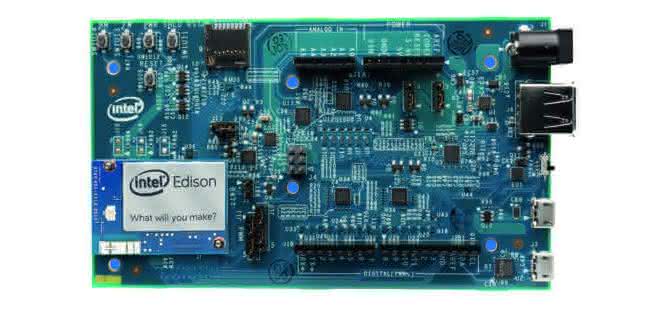
Intel Edison, on the other hand, is a suite of tools for open source development aimed at the Internet of Things and wearable computing products. The platform is based on the ultra-small Edison Compute Module, which works with the Edison Breakout Board for rapid prototyping and the Edison Board for Arduino. The Intel Edison Module is a highly miniaturized compute module that is ready for immediate incorporation into a product. It offers a system-on-chip (SoC) based on advanced 22nm process technology. The SoC combines a dual-core and dual-thread 500MHz Atom processor and a 100MHz 32-bit Quark microcontroller. The platform also offers dual-band WLAN (2.4 and 5 GHz) and low-power Bluetooth smart connectivity as well as device-to-device and device-to-cloud connectivity as an ideal framework for application development in the Internet of Things area.
The Edison expansion board interfaces to a wide range of Arduino Uno R3 shields, enabling connection to quick and easy prototyping hardware via open source software and the Arduino development environment. The input/output and interface options on the board include 20 digital I/O pins, including four pins as PWM outputs, six analog inputs, UART and SPI six-pin headers. The Edison breakout board is only slightly larger than the actual module and exposes the Edison board's native 1.8V I/O module. It provides a 0.1" grid I/O arrangement of solder pads for through-hole mounting.
Education is not neglected
RS has also added the Genuino 101 to its product range as an offer for the education sector as well as for makers and embedded developers. It is an entry-level learning and development board based on the very popular Arduino platform with Intel technology. In addition to being a powerful learning tool, the Genuino 101 offers experienced developers the opportunity to develop concept ideas for the Internet of Things such as wearables and smart consumer devices up to the prototype stage.
Powered by an Intel Curie module, which combines the 32-bit Intel Quark SoC with a 384 kB flash memory and 80 kB SRAM, the board has Bluetooth Smart wireless connectivity and a six-axis combo sensor that combines the features of an accelerometer and a gyroscope. This makes the board ideal for sensor hub-based applications. The board runs an RTOS (Real-Time Operating System) and an open-source based software framework developed by Intel to provide access to the Arduino development environment while allowing compatibility with Windows, MAC OS and Linux operating systems.
According to documents from RS Components / am


You might also be interested in
ESTIA aims to strengthen Europe's cloud
New tech alliance for EU sovereignty
Twelve companies, including Dassault Systèmes, are founding the European Sovereign Tech Industry Alliance (ESTIA). The initiative aims to strengthen Europe's technological independence and define requirements for sovereign cloud services. The start...
 read more...
Deutsche Telekom and Nvidia launch one of Europe's largest AI factories
With the Industrial AI Cloud in Munich, Deutsche Telekom and NVIDIA are creating one of the largest AI factories in Europe. Companies can train AI models, carry out simulations and access 10,000 GPUs.
read more...Leveraging data potential with AI and streaming
Huge data treasures are still lying dormant in many manufacturing companies. And yet it is high time that these treasures were unlocked. There is often a lack of resources and capacity to make data usable in real time. Streaming production data can...
read more...More awareness of noise
Dematic offers solutions that are tailored to different cloud environments and reduce environmental impact through reduced material consumption and improved energy efficiency.
read more...Generative AI in the automation environment
The mechanical engineering and automation industry is undergoing profound change. This transformation is being driven by more volatile global trade, geopolitical crises and increasing market pressure, which demands greater agility, technological...
read more...Rigid data structures have had their day
The traditional data center is no longer the center of data. A hybrid cloud storage approach enables manufacturing companies to both meet the current requirements of data-intensive processes and future-proof their infrastructure.
read more...Software as a service in three stages
CIM Database Cloud is a new out-of-the-box solution from Contact for end-to-end digital product development.
read more...How production can benefit from AI
Together with AI technology, IIoT networking makes it possible to better control machine parameters and optimize quality with predictive quality. Downtimes and set-up times can also be further minimized. Cloud platforms also make these technologies...
read more...More expertise for digital engineering
Altair, a computational science and artificial intelligence (AI) company, has acquired OmniV, a technology from Michigan, USA-based software company XLDyn.
read more...