
Ethernet switches
Communication in small networks
Continuous Ethernet communication. Weidmüller provides Ethernet switches especially for smaller industrial networks. They offer secure communication between Ethernet-based machines and systems as well as the connection of Ethernet devices to a higher-level network.
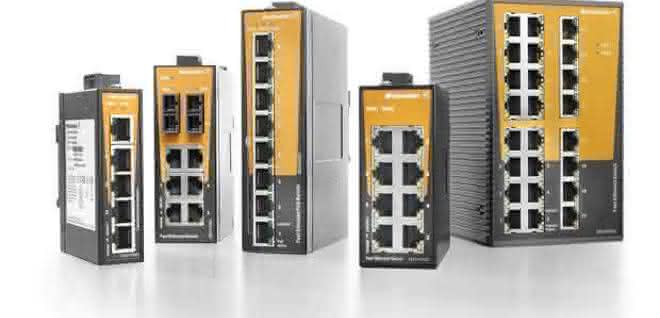
The future of industrial communication lies in a holistic approach - in a network. This creates end-to-end communication right down to production with its systems and machines. It is important to connect devices in networks and to forward data as efficiently as possible. End-to-end Ethernet communication simplifies service and speeds up processes, creates transparency and reduces costs.
The new Ethernet switches from Weidmüller have been specially developed for smaller industrial networks. With the unmanaged plug-and-play switches, network connections can be extended directly to several devices. The switches with five to 24 ports make the advantages of standardized Ethernet communication as well as industrial automation technology available.
Depending on the version, the switches are equipped with several combinable interfaces - copper or fiber optic - so that different media can be used and long distances can be bridged. All switches have an industrial IP30 metal housing with an integrated latching foot for easy mounting on the mounting rail (TS35). Thanks to the robust housing design and the high port density with particularly small dimensions, the space in the control cabinet can be used optimally. This applies in particular to the five-port switch, one of the smallest switches in terms of packing density, which is suitable for confined spaces in control cabinets. In the largest configuration, 24 ports are available. The switches can be used in environments from minus 40 to plus 75 degrees Celsius. This enables operation both in production and in the field.
Flexible thanks to SFP slots
Multimode or singlemode, 500 meters or up to 20 kilometers - the SFP slots allow flexible use. SFP stands for Small Form Factor Plug-In and enables the connection of network components such as switches with optical cables. In this way, it converts electrical gigabit signals into optical signals and vice versa. All you have to do is plug in the appropriate transceiver. A subsequent technology change is therefore also possible.
The wirespeed-capable switches support autonegotiation, a process in which two interconnected Ethernet ports independently exchange and configure the maximum possible transmission speed. The integrated autocrossing also simplifies installation and avoids sources of error, as crossover cables are no longer necessary. The switches with this standard recognize the transmit and receive cable pair and automatically assign it correctly internally. Thanks to international approvals and CE and UL certificates of conformity, the Ethernet switches are suitable for industrial applications around the globe. as


You might also be interested in
Housing and inserts for plenty of power
Lapp presented the expansion of its Epic Power series at SPS 2023: four new M23 circular connector inserts and three new M23 housings. The special feature: all housings can be combined with any of the four inserts.
 read more...
News and product updates from Smartgas
Portable gas analyzers for outdoor use
Smartgas is starting the second half of the year with a series of updates to existing products and a number of new products. Portable analyzers expand the range of applications, while new accessories such as protective housings and heating modules...
read more...Everything accurate in switch cabinet construction
To ensure smooth work processes, tools for processing enclosures and housings must function flawlessly and reliably. Häwa rounds off its punching range with the Multi-Press 500.
read more...Shafts and conversion parts
The Rodriguez range includes ball bushings including matching housings, shaft brackets, crossbars and supports.
read more...Cooling and temperature control units
Hygienic packaging sells safely
In few industries are the requirements for hygiene in the production process as strict as in the food sector - the health of consumers has top priority. This results in enormous challenges for all machines and components involved, especially in...
read more...Simple tool change in seconds
With the CMS, Schunk is launching a user-friendly, manual change system for quick component replacement. In addition to its simple and convenient operation, the CMS also stands out with its extensive range of optional modules and complementary end...
read more...Motion controller for small drives
Medium power range covered
Faulhaber has another housing-less and compact motion controller in its range, which is particularly suitable for integration in device construction and medical technology applications.
read more...Welding solutions in the name of resource efficiency
At the Welding & Cutting trade fair in Essen (September 11-15), Fronius will be focusing on the major drivers in welding technology. Quality requirements are increasing in all industries, but the required welding specialists are scarce. In...
read more...Safe solutions for cable installations
From thick power cables to thin sensor lines, cables and lines must be routed safely through systems and machines. A challenge that should not be underestimated, explains Jörg Sokat, Head of Product Management at Pflitsch.
read more...