
Fraunhofer platform
Augmented reality as a service in the cloud
With the 3D visualization platform Instant3Dhub and the AR tracking technology Visionlib, it is possible for the first time to run augmented reality applications in a "software as a service" infrastructure in the cloud. The CAD data remains stored in the company infrastructure; only the data relevant to the visualization is transferred to mobile devices in real time.
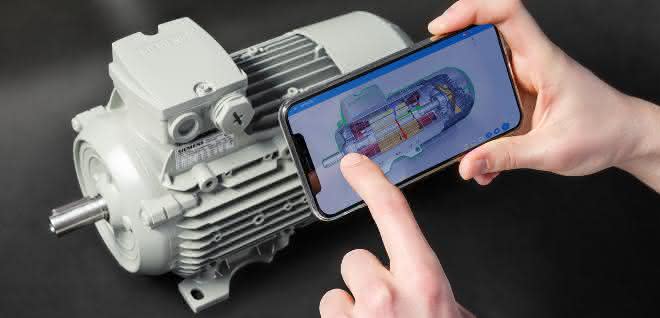
The use of augmented reality in industry is no longer a dream of the future. From assembly and quality assurance to maintenance and repair, industrial AR applications offer enormous potential for process optimization. The focus is on the digital twin as the digital replica of every real existing object. In addition to CAD data, this also contains various other information, metadata on the properties of individual components or materials used. Access to this data is extremely important and can be used profitably at many stages of the process.
However, the enormous volume of data associated with the use of the digital twin is not easy to handle. For the visualization of 3D models, the amount of data is therefore reduced many times over, and stored metadata is lost in the process. In addition, the creation of 3D visualizations has so far required special software and computers set up specifically for this purpose. Visual processing for industrial applications also requires not only specialist knowledge, but also long processing times. Those who would gain real added value for their day-to-day work by accessing the planning data - the fitters, inspectors or purchasers - are denied access.
Fraunhofer platform accelerates visualization of 3D models
With the new release of Instant3Dhub, the Fraunhofer Institute for Computer Graphics Research IGD is providing a platform that accelerates the visualization of 3D models based on original CAD data. Based on the platform, immense amounts of data can be visualized automatically and in real time, regardless of the device used - AR glasses, tablet or smartphone. A new feature is the integration of Visionlib, an AR tracking library licensed by Visometry, a Fraunhofer IGD spin-off.
It is already a powerful tool for capturing objects in 3D and preparing them for AR visualization. Tracking, i.e. determining the exact position of objects in the camera image, is the decisive basis for AR applications, as this is the only way that additional information and superimposed information can be precisely superimposed. Precise positioning of this information in relation to the object visible in the camera image is essential when it comes to projecting welding points onto an object. The model-based tracking technology works directly on the basis of the customer's original CAD data, which is also used to visualize the 3D models. A complex and interactive reduction of the data by IT experts, which often results in valuable additional semantic information being lost, is therefore not necessary.
Siemens is already testing the advantages of using Instant3Dhub and Visionlib together in the field of electric drive technology. The drive systems are manufactured on a customer-specific basis and each drive is backed by an individual CAD data set, the digital twin with all product specifications. AR technologies will be used throughout the entire product life cycle at Siemens in the future. This also applies to quality assurance, such as checking whether a manufactured component matches the CAD design.
Fraunhofer IGD is also currently researching data transformation in preparation for 3D printing directly from the application, for example for required spare parts. The establishment of greater collaboration options, which allow several end devices to participate in the same AR session, is intended to facilitate remote maintenance scenarios. Another vision for the future is the integration of recognition of previously unknown objects using artificial intelligence. as


You might also be interested in
ESTIA aims to strengthen Europe's cloud
New tech alliance for EU sovereignty
Twelve companies, including Dassault Systèmes, are founding the European Sovereign Tech Industry Alliance (ESTIA). The initiative aims to strengthen Europe's technological independence and define requirements for sovereign cloud services. The start...
 read more...
Deutsche Telekom and Nvidia launch one of Europe's largest AI factories
With the Industrial AI Cloud in Munich, Deutsche Telekom and NVIDIA are creating one of the largest AI factories in Europe. Companies can train AI models, carry out simulations and access 10,000 GPUs.
read more...Leveraging data potential with AI and streaming
Huge data treasures are still lying dormant in many manufacturing companies. And yet it is high time that these treasures were unlocked. There is often a lack of resources and capacity to make data usable in real time. Streaming production data can...
read more...More awareness of noise
Dematic offers solutions that are tailored to different cloud environments and reduce environmental impact through reduced material consumption and improved energy efficiency.
read more...Generative AI in the automation environment
The mechanical engineering and automation industry is undergoing profound change. This transformation is being driven by more volatile global trade, geopolitical crises and increasing market pressure, which demands greater agility, technological...
read more...Rigid data structures have had their day
The traditional data center is no longer the center of data. A hybrid cloud storage approach enables manufacturing companies to both meet the current requirements of data-intensive processes and future-proof their infrastructure.
read more...Software as a service in three stages
CIM Database Cloud is a new out-of-the-box solution from Contact for end-to-end digital product development.
read more...How production can benefit from AI
Together with AI technology, IIoT networking makes it possible to better control machine parameters and optimize quality with predictive quality. Downtimes and set-up times can also be further minimized. Cloud platforms also make these technologies...
read more...More expertise for digital engineering
Altair, a computational science and artificial intelligence (AI) company, has acquired OmniV, a technology from Michigan, USA-based software company XLDyn.
read more...