
Pilot project
AI helps save resources
The success of a company will soon depend on the use of artificial intelligence. The Schorisch Group has launched a pilot project called "Schorisch1920.io" to optimize the use of resources in SMEs.
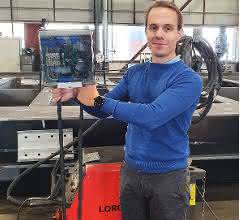
Whether in production or on a construction site: "Wherever data can be evaluated today, a competitive advantage is created," says initiator Emil Schlumberger, Managing Director of Schorisch Elektronik.
Using the regionally collected data, which is merged in the cloud, the sister company Schorisch Magis, for example, creates usage profiles for welding systems, which can be used to better control the dimensioning of the devices for the respective tasks and predict their ideal operating status.
Other initial surveys concern the ventilation system and improving the lighting profile in the production halls. The potential applications of the microcomputers used for this are enormous.
The two Schorisch managing directors Emil Schlumberger (Electronics Competence Center in Wentorf) and Detlef Möhr (Steel Construction Competence Center in Karstädt) presented the joint project for the first time at the Technology Day in Perleberg, Brandenburg. They presented practical examples as part of a workshop that showed how Industry 4.0 can be integrated into everyday workflows and production processes.
Although the first concepts have already been developed for large industrial companies, Emil Schlumberger emphasized, they are generally far too complex for SMEs to deliver pragmatic results. This is not the case with the service developed by Schorisch, which will be offered on site in future and which, in addition to data analysis, also provides a concept for action. "We make data visible that is contained in every machine and can be evaluated immediately," says Schlumberger, who sees great potential for this niche offering.
In addition to the many possible uses of microcomputers on every construction site, the steel construction and electronics centers also provide two demo factories where customers can see the successes on site. The approach even goes so far as to allow systems to be tailored to the respective operator, for example in welding, and data to be analyzed with foresight. The idea behind this is to measure the performance spectrum of machines of all kinds and predict potential faults and maintenance requirements in a similar way to a car, explains Tobias Wolter. "This can save customers immense costs in the long term," the business IT specialist at Schorisch Magis is certain.
In the future, it will even be possible to collect and analyze data from the drive technology of water gates and other technical equipment in order to draw conclusions about their functionality and preventive maintenance. The possible applications can be expanded at will.
In this case, the group of companies benefited from the fact that specialist knowledge from the day-to-day production of steel manufacturers can be welded together with cutting-edge technologies from electronics specialists in the IoT (Internet of Things) to create modern concepts, says Schorisch CEO Kirsten Schönharting. "Schorisch1920" stands for the technical knowledge of the group of companies founded 100 years ago, while the extension ".io" stands for the input-output analysis of collected data. as


You might also be interested in
ESTIA aims to strengthen Europe's cloud
New tech alliance for EU sovereignty
Twelve companies, including Dassault Systèmes, are founding the European Sovereign Tech Industry Alliance (ESTIA). The initiative aims to strengthen Europe's technological independence and define requirements for sovereign cloud services. The start...
 read more...
Deutsche Telekom and Nvidia launch one of Europe's largest AI factories
With the Industrial AI Cloud in Munich, Deutsche Telekom and NVIDIA are creating one of the largest AI factories in Europe. Companies can train AI models, carry out simulations and access 10,000 GPUs.
read more...Leveraging data potential with AI and streaming
Huge data treasures are still lying dormant in many manufacturing companies. And yet it is high time that these treasures were unlocked. There is often a lack of resources and capacity to make data usable in real time. Streaming production data can...
read more...More awareness of noise
Dematic offers solutions that are tailored to different cloud environments and reduce environmental impact through reduced material consumption and improved energy efficiency.
read more...Generative AI in the automation environment
The mechanical engineering and automation industry is undergoing profound change. This transformation is being driven by more volatile global trade, geopolitical crises and increasing market pressure, which demands greater agility, technological...
read more...Rigid data structures have had their day
The traditional data center is no longer the center of data. A hybrid cloud storage approach enables manufacturing companies to both meet the current requirements of data-intensive processes and future-proof their infrastructure.
read more...Software as a service in three stages
CIM Database Cloud is a new out-of-the-box solution from Contact for end-to-end digital product development.
read more...How production can benefit from AI
Together with AI technology, IIoT networking makes it possible to better control machine parameters and optimize quality with predictive quality. Downtimes and set-up times can also be further minimized. Cloud platforms also make these technologies...
read more...More expertise for digital engineering
Altair, a computational science and artificial intelligence (AI) company, has acquired OmniV, a technology from Michigan, USA-based software company XLDyn.
read more...