
Correct component fitted?
RFID optimizes automotive production
The pressure to optimize in the production halls of car manufacturers is great: the variance is constantly increasing and costs must remain within limits. Fraunhofer researchers are now using RFID technology to bring more transparency to logistics and production processes at car manufacturers. This means less effort and greater efficiency.
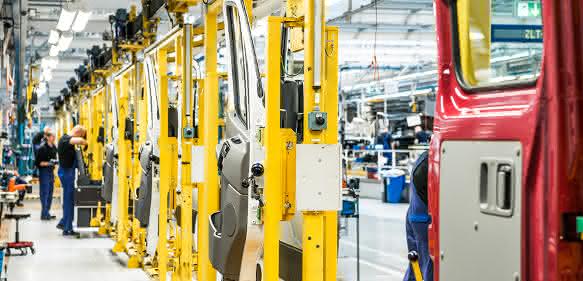
Anyone who has ever ordered a new car knows that the list of extras is long and the number of variants is constantly increasing. For car manufacturers, this individuality comes with major challenges. This is because many components are virtually indistinguishable from the outside - for example, a seat belt for German cars looks very similar to one for non-EU cars. Safety-relevant components are therefore provided with a barcode that has to be scanned manually. In the course of digitalization, RFID relieves employees of this routine task and at the same time gives them the certainty that they have installed the right parts by automatically checking them.
Researchers from the Fraunhofer Institute for Factory Operation and Automation IFF in Magdeburg are now equipping production and logistics processes for digitalization and Industry 4.0. "RFID tags on components, short for Radio Frequency Identification, can significantly increase process reliability and efficiency," says Marc Kujath, researcher at the IFF. "We have proven this both through feasibility studies and radio tests that we carried out together with Mercedes-Benz Vans at the Ludwigsfelde plant near Berlin." Such RFID systems consist of the RFID tag on the component and a scanner that reads the information without contact. In a first step, the researchers investigated which of the numerous components of a vehicle are best suited - and identified up to 40 parts. For further developments, the experts initially focused on mirrors and seats.
Inspection during or after installation
The RFID tags are attached to each individual safety-critical component - such as the individual mirrors. A serial number is stored on the tags, similar to a barcode. The big differences: While the barcode only stores information on what type of mirror it is, the RFID tag number provides a wealth of information, such as which vehicle the mirror is to be installed in. While the barcodes have to be read one by one manually with a hand scanner, the RFID tags can all be scanned at the same time automatically and contactlessly - even if the parts have already been installed.
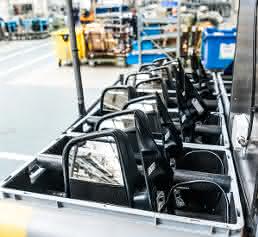
This means that the information can be retrieved at any time in a matter of seconds via the RFID tags. This is a decisive advantage for production. For example, during the assembly of the front or rear axle, it is possible to check whether all the required components have been installed. Previously, this was only recorded in the final inspection - by employees using visual inspection and paper lists. "The RFID tags allow us to increase transparency," explains Kujath.
The researchers from the IFF took care of both the technology and the operating concept. "This required several steps, which we tackled together with our partner Mercedes-Benz Vans. For example, we reduced the blind spots in production planning. This means that the project managers now know where the pitfalls of the process lie - and can ask the right questions at the right time. We have also thought through the various roles, as the project manager needs different information to the technician," adds Kujath. The next step is to carry out series tests at Daimler. as


You might also be interested in
Plagiarius 2024 negative prize
On January 26, 2024, the Plagiarius campaign awarded its dreaded "Plagiarius" negative prize for the 48th time to manufacturers and retailers of particularly brazen counterfeits and fakes.
 read more...
Ivalua honors winners of the Generative AI...
AI-supported "add-ons" for buyers within 48 hours
Ivalua, provider of cloud-based spend management solutions, announced the winners and innovations of the first Generative AI Innovation Cup. The competition took place in December 2023. It was open to all Ivalua partners and employees - more than...
read more...Efaflex celebrates 50 years of high-speed...
The emphasis is on "fast"
Since day one, Efaflex has wanted to use new technologies as early as possible and drive progress in the industry. This year, the family business is celebrating its 50th anniversary under the motto "Fast Forward".
read more...Security of supply even during power outages
In the winter of 2022, Germany was worried about energy shortages. The drugstore retailer dm did not paint any horror scenarios, but nevertheless saw the possibility of controlled, temporary, regional power cuts (brownouts).
read more...Safety technology in mechanical engineering
Modules with new functions
Euchner's product highlights at EMO 2023 include the communication-capable solenoid interlocks.
read more...Transforming the paper industry towards climate neutrality
Together with partners from industry and research, Voith is developing a project for the optimization of energy and material flows in paper production. The aim of the research project is to develop a digital framework that enables effective process...
read more...Up to 95 percent less flue gas thanks to direct extraction
The requirements for occupational safety measures and safety technology are also constantly increasing in welding technology. The Technical Rules for Hazardous Substances (TRGS) stipulate that welding fumes and harmful substances must be extracted...
read more...Competitive advantages with large machines
Whether 3D-printed components for machines and systems, prototypes or aids for design: additive manufacturing is almost indispensable for modern companies in mechanical and plant engineering and automation if they want to play in the premier league.
read more...Transport technology from the modular system
Many transport tasks can be realized with the help of linear technology. Pre-configured solutions are available to simplify the interaction between the linear unit, motor, gearbox and controller. This minimizes the effort required for research and...
read more...