
Mobile labeling
The rolling laser comes to the component
If large workpieces made of steel or plastic are to be marked individually or retrospectively, mobile laser stations such as the mobile fiber laser from Bluhm are used. This workstation includes the marking unit and the controller of the e-Solarmark FL fiber laser as well as an integrated extraction system.
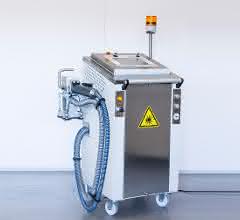
Operators can roll the workstation through production. For marking, the marking unit is simply removed from its transport device and pressed onto the workpiece to be marked. Thanks to active suction cups, a vacuum is created that closes the safety circuit for the marking process.
Laser marking at the touch of a button
Marking can be triggered directly on the laser head at the touch of a button. The laser marks in a maximum marking field of 70 x 70 millimetres. After marking, the vacuum is released and the marking unit can be placed back on its fixture.
The control unit with its clearly laid out touch panel enables quick adjustment of print content and layouts. The print data can be transferred either via USB, Ethernet or RS232 interface.
At the heart of the workstation is the e-Solarmark FL fiber laser with an output of 20 watts. The fiber laser technology guarantees the highest beam quality and energy density. At rapid marking speeds, permanently abrasion-resistant, clearly legible and precise markings are created. This makes the e-Solarmark particularly suitable for marking stainless steel, plastic (ABS), plastic films and numerous other materials. As a mobile fiber laser, it can be used in particular in special type construction, for example.
The e-Solarmark FL operates profitably, reliably and safely. Its average life expectancy is up to 100,000 operating hours. The system is also easy to program: Real time, current date, consecutive numbering or best-before date can be set quickly.
Advantages of the fiber laser
The fiber laser is a special form of solid-state laser. The doped core of a glass fiber forms the active medium. The long fiber length amplifies the laser light that is guided through the fiber. Fiber lasers have two mirrors at their end faces. They form a resonator that enables controlled laser operation.
The advantages of fiber laser systems are the high beam quality of the generated light, the high efficiency of the conversion process (depending on the doping, optical-optical efficiency of over 85 percent can be achieved), the good cooling due to the large surface area of the fiber, the robust design and the effective production technology through the use of fiber-integrated components. as


You might also be interested in
Plagiarius 2024 negative prize
On January 26, 2024, the Plagiarius campaign awarded its dreaded "Plagiarius" negative prize for the 48th time to manufacturers and retailers of particularly brazen counterfeits and fakes.
 read more...
Ivalua honors winners of the Generative AI...
AI-supported "add-ons" for buyers within 48 hours
Ivalua, provider of cloud-based spend management solutions, announced the winners and innovations of the first Generative AI Innovation Cup. The competition took place in December 2023. It was open to all Ivalua partners and employees - more than...
read more...Efaflex celebrates 50 years of high-speed...
The emphasis is on "fast"
Since day one, Efaflex has wanted to use new technologies as early as possible and drive progress in the industry. This year, the family business is celebrating its 50th anniversary under the motto "Fast Forward".
read more...Security of supply even during power outages
In the winter of 2022, Germany was worried about energy shortages. The drugstore retailer dm did not paint any horror scenarios, but nevertheless saw the possibility of controlled, temporary, regional power cuts (brownouts).
read more...Safety technology in mechanical engineering
Modules with new functions
Euchner's product highlights at EMO 2023 include the communication-capable solenoid interlocks.
read more...Transforming the paper industry towards climate neutrality
Together with partners from industry and research, Voith is developing a project for the optimization of energy and material flows in paper production. The aim of the research project is to develop a digital framework that enables effective process...
read more...Up to 95 percent less flue gas thanks to direct extraction
The requirements for occupational safety measures and safety technology are also constantly increasing in welding technology. The Technical Rules for Hazardous Substances (TRGS) stipulate that welding fumes and harmful substances must be extracted...
read more...Competitive advantages with large machines
Whether 3D-printed components for machines and systems, prototypes or aids for design: additive manufacturing is almost indispensable for modern companies in mechanical and plant engineering and automation if they want to play in the premier league.
read more...Transport technology from the modular system
Many transport tasks can be realized with the help of linear technology. Pre-configured solutions are available to simplify the interaction between the linear unit, motor, gearbox and controller. This minimizes the effort required for research and...
read more...