
Component labeling
Laser marks flywheels without distortion
When it comes to marking components, laser marking technology has now overtaken conventional marking methods. The Isselguss foundry therefore relies on the i103L-G marking laser from Sic Marking for marking flywheels.
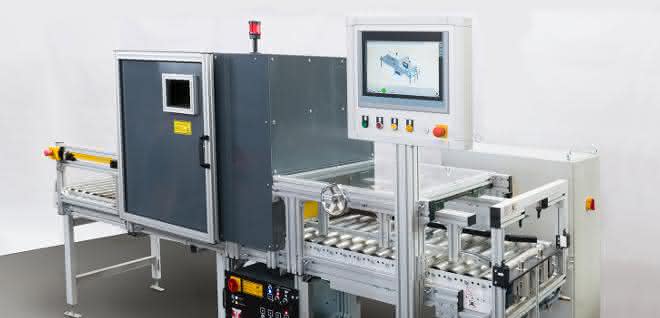
Isselguss Gießereierzeugnisse from the Borken district produces, among other things, flywheels for well-known engine manufacturers, which also need to be permanently marked. Isselguss therefore turned to marking specialist Sic Marking to mark its flywheels.
The Isselguss application is not a standard application. It quickly became clear that a special design was needed for marking the flywheels. Isselguss's customer requires that all cast flywheels, which are produced in a three-shift operation, are marked with a Data Matrix code.
The challenge here was the size of the flywheels of up to 500 millimetres and the heavy weight of up to 50 kilograms. Components of this size and weight are not easy to handle, which makes marking difficult. In addition, the marking laser must be robust so that it can withstand the harsh environmental conditions in a foundry. This is why the powerful laser is installed in an individual housing device.
After Isselguss had outlined its requirements, visited the site and clarified all technical questions and details, it only took a short twelve weeks for Sic Marking to install the special marking system in the foundry. The i103 L-G laser was selected because it writes alphanumeric characters, barcodes and data matrix codes, graphics and logos with precision and high contrast.
Laser marks almost all surfaces
Laser marking technology is mainly used for direct markings on metal or plastic parts, regardless of whether the markings are straight, curved or curved. The hardness and surface quality of the material are irrelevant, making it ideal for the stable flywheels.
The laser technology is based on a powerful laser beam generated in a laser source, which is amplified and guided to the workpiece via mirrors. The energy transmitted by the laser beam causes a surface change on the workpiece at the focal point, depending on the material. Some materials vaporize and thus allow a deeper marking, others become discolored, such as the flywheels.
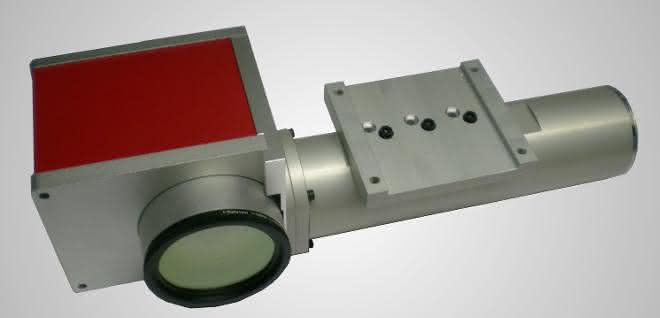
The marking window of the laser marker has a size of 100 x 100 millimetres or optionally up to 170 x 170 millimetres. The i103L-G fiber laser consists of a galvonometer head and a controller unit, known as the fiber unit, in which the laser source is located. The complete power electronics are housed in a black box underneath the housing. The beam is generated and amplified in the laser source.
The beam then passes through the fiber cable to the collimator, which aligns the beam before it reaches the galvanometric head. The galvo head has two mirrors, each measuring around 15 by 15 millimeters, which are attached to stepper motors and deflect the laser beam for fast and precise markings.
Finally, a lens concentrates the beam to 30 micrometers. Sic Marking uses a ytterbium-doped fiber laser for its laser marking systems because it is reliable and offers low operating costs. Fiber laser-based marking technology is currently the most efficient. Modern fiber laser marking systems are also low-maintenance and have around 50,000 to 100,000 operating hours.
Power variants and frequency spectrum
The i103L-G laser operates in a stand-alone mode that does not require a PC for control. However, a PC can be used with the Sic Laser Advanced software, which is included in the scope of delivery. The software can be used to create a so-called marking file, which contains all the parameters required for the specific marking. These parameters are the marking speed, the power and the frequency. The marking speed can vary between zero and 4,000 millimeters per second.
The marking laser is available in two power variants, 20W and 50W, and has a wavelength of 1,064 nanometers. The third parameter is the frequency at which the laser is pulsed. The frequency of the laser varies between 20 and 200 kilohertz, depending on the material of the workpiece. The software also controls the laser's optics and offers additional database functions such as date and time information.
Automatic component recognition
After production, the Isselguss flywheels run onto a roller conveyor for marking (image), which delivers the components to the housing device on the input side. There they run against a stopper and stop briefly. The system uses a light barrier to detect the component to be marked, opens the housing, picks up the flywheel and closes again to carry out the marking process. If the flywheel is not centered on the roller conveyor, the components can be opened and closed manually using a handwheel.
After the marking process, the flywheel is extended again on the other side and the system picks up the next flywheel. The special design completes the entire process, from delivery to marking and rejection, in 40 to 50 seconds. The actual marking process for the 28-character Data Matrix code, consisting of component name, date and serial number, only takes a short ten seconds.
After the component has been marked, the Data Matrix code is read with a scanner at the customer's request. This ensures that the marking contains all the required information and at the same time that the quality of the marking is flawless.
Once the component has been successfully read, it is moved out onto the conveyor belt behind the laser housing and finally packaged for the customer. In 99.9 percent of all cases, the marking is as desired. In rare cases, however, there are impurities on the component and the marking is not perfect for these reasons. If this is the case, the system's NOK strategy (not OK strategy) takes effect. In this case, a red signal lamp on the system informs the operator by flashing. The machine then interrupts the marking process and the operator must control the system via the touch display. The component is then lifted out of the housing by crane due to its heavy weight. After a brief acknowledgement on the display, the system resumes operation. as


You might also be interested in
Housing and inserts for plenty of power
Lapp presented the expansion of its Epic Power series at SPS 2023: four new M23 circular connector inserts and three new M23 housings. The special feature: all housings can be combined with any of the four inserts.
 read more...
News and product updates from Smartgas
Portable gas analyzers for outdoor use
Smartgas is starting the second half of the year with a series of updates to existing products and a number of new products. Portable analyzers expand the range of applications, while new accessories such as protective housings and heating modules...
read more...Everything accurate in switch cabinet construction
To ensure smooth work processes, tools for processing enclosures and housings must function flawlessly and reliably. Häwa rounds off its punching range with the Multi-Press 500.
read more...Shafts and conversion parts
The Rodriguez range includes ball bushings including matching housings, shaft brackets, crossbars and supports.
read more...Cooling and temperature control units
Hygienic packaging sells safely
In few industries are the requirements for hygiene in the production process as strict as in the food sector - the health of consumers has top priority. This results in enormous challenges for all machines and components involved, especially in...
read more...Simple tool change in seconds
With the CMS, Schunk is launching a user-friendly, manual change system for quick component replacement. In addition to its simple and convenient operation, the CMS also stands out with its extensive range of optional modules and complementary end...
read more...Motion controller for small drives
Medium power range covered
Faulhaber has another housing-less and compact motion controller in its range, which is particularly suitable for integration in device construction and medical technology applications.
read more...Welding solutions in the name of resource efficiency
At the Welding & Cutting trade fair in Essen (September 11-15), Fronius will be focusing on the major drivers in welding technology. Quality requirements are increasing in all industries, but the required welding specialists are scarce. In...
read more...Safe solutions for cable installations
From thick power cables to thin sensor lines, cables and lines must be routed safely through systems and machines. A challenge that should not be underestimated, explains Jörg Sokat, Head of Product Management at Pflitsch.
read more...