

Labeling
Labeling is everywhere
cab specializes in automated labelling and is a manufacturer of label printing systems. The possible applications of label printers, labelers, label dispensers or marking lasers are versatile and cross-industry.
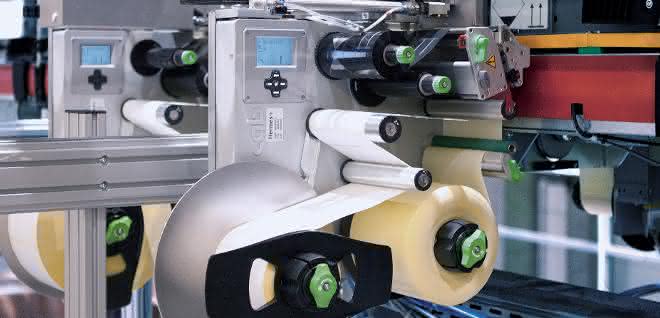
Logistics: Labeling hazardous goods in the warehouse
In Landsberg, the drugstore chain Rossmann uses cab's Hermes+ printing and labeling systems on its conveyor systems. Equipped with stroke applicators, they apply the limited quantity labels prescribed by law to picking containers - automatically and with a quality rate of 99 percent.
Instead of labeling the containers on the conveyor belt as they pass through, the decision was made to convert the existing conveyor technology so that the containers are stopped at the labeling station by a locking flap. The label is pressed onto the container by a pressure stamp. The container then continues on the conveyor belt at an accelerated speed.
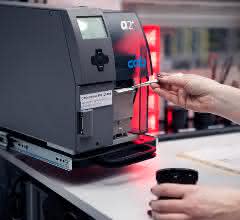
Signalling technology: Typing of products
If you enter the workshop or warehouse of a machine manufacturer or a company in the automation industry, there is a good chance that signal towers or lights will visually indicate the operating status of machines or production lines. Alternatively, horns, sirens or buzzers provide acoustic alerts to faults or overloads. Werma plans and manufactures over 3,500 variants of these products at the company headquarters in Rietheim-Weilheim. The printing of nameplate and packaging labels plays a key role in the production and assembly of signaling devices. Since 2012, this has been realized with cab printers of the types A+, EOS and MACH4.
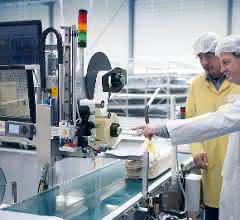
Textile management: continuous labeling of laundry packages
Around 80,000 items of laundry and 20,000 items of workwear and protective clothing are processed every day at Geiger Textil's headquarters in Bad Säckingen. RFID enables automated textile management. Integrated into the radio-based identification process, cab Hermes+ systems print customer labels and label laundry packages fully automatically as they pass through.
One requirement is to dynamically label different package heights, widths and geometries within the conveyor line. The parcels are soft-packed and sometimes arrive at the labeling station one after the other on the conveyor belt at a very fast rate.
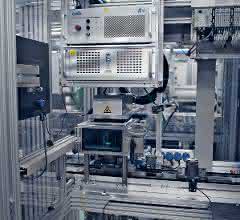
Automotive supply: Fiber lasers encode gas generators
ZF TRW develops and manufactures gas and micro gas generators for airbag modules. High demands must be met during their production in Aschau am Inn. Data recorded during quality assurance must be evaluated and made available for later documentation. The coding must make it possible to trace where the gas generator was manufactured and which value creation or logistics chains it has passed through. In the fully automated assembly lines, the controls of the FL marking lasers, including the beam source, are installed in 19-inch housings. A code is lasered onto the metal body of the generator. The laser communicates with the system controller on the basis of digital input and output signals.
Food packaging: labeling fruit and vegetables
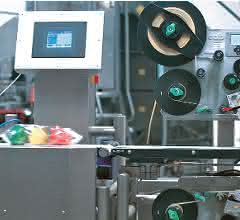
Tomatoes, peppers, lemons, zucchinis, packed in nets or portioned and shrink-wrapped in plastic trays are classic displays in retail and wholesale. Pakstation in Venlo ensures that organic produce is packaged. Here, fruit and vegetables from our own cultivation areas in the surrounding area as well as from Belgium, Spain and Israel are delivered loose, sorted by machine and packaged. It leaves Venlo on trucks to customers, preferably in Germany.
Fully automatic goods labeling systems with Hermes+ printers are used to label the packaged goods. The printers were expanded to include modules for label transfer and integrated into the packing lines for specific applications. Two printing and labeling systems are installed on each line: one classic, the other upside down. This means that passing goods can be labeled from above and below.
Book labeling: Giving books an identity
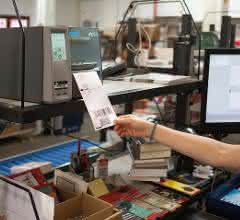
Goods handling for all Osiander bookstores is handled on an area of 3,000 square meters. In addition, books ordered online, in the stores or by telephone are shipped directly to end customers. Since 2011, the goods have largely been labeled with cab label printers.
The first Osiander stores had already been equipped with devices from the EOS series two years earlier. In the goods center in Tübingen, EOS printers also process labels with fanfold folding at the workstations for customer orders. as


You might also be interested in
Housing and inserts for plenty of power
Lapp presented the expansion of its Epic Power series at SPS 2023: four new M23 circular connector inserts and three new M23 housings. The special feature: all housings can be combined with any of the four inserts.
 read more...
News and product updates from Smartgas
Portable gas analyzers for outdoor use
Smartgas is starting the second half of the year with a series of updates to existing products and a number of new products. Portable analyzers expand the range of applications, while new accessories such as protective housings and heating modules...
read more...Everything accurate in switch cabinet construction
To ensure smooth work processes, tools for processing enclosures and housings must function flawlessly and reliably. Häwa rounds off its punching range with the Multi-Press 500.
read more...Shafts and conversion parts
The Rodriguez range includes ball bushings including matching housings, shaft brackets, crossbars and supports.
read more...Cooling and temperature control units
Hygienic packaging sells safely
In few industries are the requirements for hygiene in the production process as strict as in the food sector - the health of consumers has top priority. This results in enormous challenges for all machines and components involved, especially in...
read more...Simple tool change in seconds
With the CMS, Schunk is launching a user-friendly, manual change system for quick component replacement. In addition to its simple and convenient operation, the CMS also stands out with its extensive range of optional modules and complementary end...
read more...Motion controller for small drives
Medium power range covered
Faulhaber has another housing-less and compact motion controller in its range, which is particularly suitable for integration in device construction and medical technology applications.
read more...Welding solutions in the name of resource efficiency
At the Welding & Cutting trade fair in Essen (September 11-15), Fronius will be focusing on the major drivers in welding technology. Quality requirements are increasing in all industries, but the required welding specialists are scarce. In...
read more...Safe solutions for cable installations
From thick power cables to thin sensor lines, cables and lines must be routed safely through systems and machines. A challenge that should not be underestimated, explains Jörg Sokat, Head of Product Management at Pflitsch.
read more...