
Integrated laser application
Welding and marking on an island
A company in Eberding uses a laser system from Mobil-Mark to mark truck axle shafts that are manufactured using the friction welding process. Now up to 500 parts can be welded and marked in a single shift.
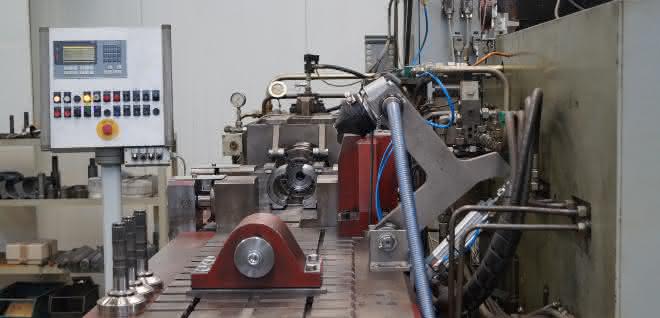
Lasers are used in various branches of industry to clearly mark workpieces and thus guarantee their traceability. However, the workpieces to be marked often have to be laboriously transported to a laser station first - this requires additional logistical and time expenditure and is also impractical in everyday working life.
A contract manufacturer based in Eberdingen near Ludwigsburg, which produces steel parts and components of various sizes on behalf of customers, wanted to optimize this process and integrated a laser system from Mobil-Mark for marking truck axle shafts, which are manufactured using the friction welding process. The advantage: The fact that the friction welding and marking process can be carried out simultaneously on one production island saves a considerable amount of time. Within one shift, up to 500 parts can be welded and marked in the same work step.
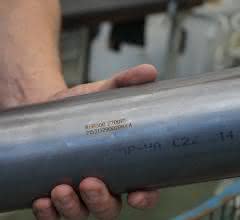
Installation in ongoing production
For the application, the customer paid particular attention to a laser that can be precisely adapted to the product, is user-friendly and can also be installed in the existing production environment without complications. The Ulm-based laser specialist Mobil-Mark was able to fulfill all of these requirements: The laser head could be adapted to the curvature of the axle shaft thanks to the individual attachment. Thanks to its small footprint, the laser could also be installed during ongoing production with the help of a special holder. Commissioning was completed quickly after a short training session: All employees quickly became accustomed to the new tool, which requires no additional safety precautions thanks to laser protection class 1.
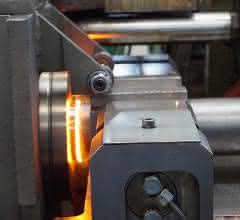
The Eberdingen-based company pioneered the friction welding process back in 1974: in that year, the company founder purchased the first friction welding machine from a leading Japanese manufacturer at the time. Today, the process is essential for the company and is part of the company's core business alongside the production of welded constructions and mechanical engineering. Among other things, it is also used for the production of truck axle shafts.
Under the effect of pressure, a rotating joining part is pressed against a stationary part and the resulting friction induces heat. By slowing down the rotation, the parts are welded over their entire surface - a fast and reliable process. The end product is also less prone to warping due to the low temperature. Friction welding is used in particular for rotationally symmetrical parts, such as truck axle shafts.
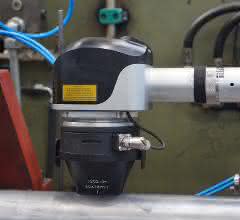
The marking process, which was developed by Mobil-Mark, also works according to a simple yet clever principle: the laser unit was attached to the system using a holding device that automatically raises and lowers the laser. In the first work step, the operator must first fix the pipe to be welded at the production island. He then operates a lever that lowers the laser head directly onto the pipe. Now the operator simply has to press a start button on the laser unit and the engraving process can begin. At the same time, the operator can now initiate the friction welding process. After a few seconds, during which the welding and marking processes take place simultaneously, the component can be removed and inspected.
Résumé after three years
After almost three years of use, the company is more than satisfied with the laser system from Mobil-Mark. In addition to the precise engraving results, the laser scores points with its mobility and the associated flexibility as well as its ease of use. The compact format, stability and reliability of the laser in continuous operation are also convincing. The company is currently using the Mobil-Mark not only to mark truck axle shafts, but also to mark type and inventory plates as well as other machine components. as


You might also be interested in
Plagiarius 2024 negative prize
On January 26, 2024, the Plagiarius campaign awarded its dreaded "Plagiarius" negative prize for the 48th time to manufacturers and retailers of particularly brazen counterfeits and fakes.
 read more...
Ivalua honors winners of the Generative AI...
AI-supported "add-ons" for buyers within 48 hours
Ivalua, provider of cloud-based spend management solutions, announced the winners and innovations of the first Generative AI Innovation Cup. The competition took place in December 2023. It was open to all Ivalua partners and employees - more than...
read more...Efaflex celebrates 50 years of high-speed...
The emphasis is on "fast"
Since day one, Efaflex has wanted to use new technologies as early as possible and drive progress in the industry. This year, the family business is celebrating its 50th anniversary under the motto "Fast Forward".
read more...Security of supply even during power outages
In the winter of 2022, Germany was worried about energy shortages. The drugstore retailer dm did not paint any horror scenarios, but nevertheless saw the possibility of controlled, temporary, regional power cuts (brownouts).
read more...Safety technology in mechanical engineering
Modules with new functions
Euchner's product highlights at EMO 2023 include the communication-capable solenoid interlocks.
read more...Transforming the paper industry towards climate neutrality
Together with partners from industry and research, Voith is developing a project for the optimization of energy and material flows in paper production. The aim of the research project is to develop a digital framework that enables effective process...
read more...Up to 95 percent less flue gas thanks to direct extraction
The requirements for occupational safety measures and safety technology are also constantly increasing in welding technology. The Technical Rules for Hazardous Substances (TRGS) stipulate that welding fumes and harmful substances must be extracted...
read more...Competitive advantages with large machines
Whether 3D-printed components for machines and systems, prototypes or aids for design: additive manufacturing is almost indispensable for modern companies in mechanical and plant engineering and automation if they want to play in the premier league.
read more...Transport technology from the modular system
Many transport tasks can be realized with the help of linear technology. Pre-configured solutions are available to simplify the interaction between the linear unit, motor, gearbox and controller. This minimizes the effort required for research and...
read more...