
Inline coding solution
Variable data printing with drop-on-demand technology
Despite long set-up times, poor legibility and occasional reworking, mechanical embossing processes are still the predominant technology for printing variable data on blister packs.
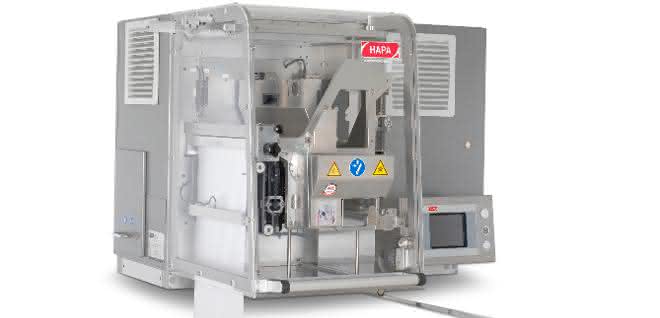
Because this dramatically reduces overall equipment effectiveness (OEE) and also jeopardizes patient safety, pharmaceutical companies are desperately looking for solutions. With the new Variable Data Printer VDP 827, Hapa shows how Drop on Demand (DOD) inkjet technology can make marking and coding more efficient and reliable - inline.
Thanks to its highly compact design, the VDP 827 can be easily integrated into blister machines. The concept of the VDP was developed in consultation with the leading suppliers of blister machines. As it is based on the proven Hapa Webjet technology, it is an accepted standard. Moreover, details regarding mechanical and electrical integration have already been defined together with all major manufacturers.
The VDP 827 is therefore an excellent technology choice for new investments in blister lines. "In order to achieve this standardization, we worked closely with a number of blister machine manufacturers during the development phase," says James MacKenzie, Sales Director at Hapa. "Pharmaceutical companies thus receive printing processes that are optimally matched to the blister machines and benefit from standardized spare and wear parts that are available worldwide." Designed for very different installation situations, the printer is also ideal for converting existing blister systems to DOD printing with UV ink. The Swiss company Hapa is the global technology and market leader in inline and "on demand" printing solutions for the pharmaceutical industry.
"The entry into the most advanced technology"
Compared to the traditional embossing process, for example, the advantages of variable data printing with UV DOD technology are enormous. The razor-sharp 360 dpi print, which is completely independent of the speed of the blister foil, optimizes readability by control cameras and helps to minimize waste. The VDP 827 is able to utilize the entire web width of up to 288 mm and apply serialization or another form of coding anywhere on the blister film. It supports all common symbologies and barcodes.
In addition, UV DOD printing is equally legible for humans and electronic systems. The automated workflow makes it possible to drive forward the digital transformation in this area too. The time-consuming and error-prone retooling of mechanical parts is a thing of the past. UV DOD printing also has advantages over other alternative printing processes. In contrast to ablative lasers, the VDP 827, for example, does not produce any dust or dirt and does not require any specially coated and therefore more expensive films.
There are also no restrictions in terms of format size and printing speed. In contrast to thermal inkjet, UV-curing DOD printing is completely solvent-free. The ink is nevertheless immediately ready for the next inline process step and is both extremely durable and abrasion-resistant. In addition, the DOD ink can be refilled during operation, i.e. without machine downtime. There is no need to tediously change cartridges. "The VDP 827 is a simple, cost-effective introduction to what is probably the most advanced inline printing technology for this application," summarizes James MacKenzie from Hapa. "It improves patient safety, reduces complexity in production, lowers costs and increases OEE."


You might also be interested in
Plagiarius 2024 negative prize
On January 26, 2024, the Plagiarius campaign awarded its dreaded "Plagiarius" negative prize for the 48th time to manufacturers and retailers of particularly brazen counterfeits and fakes.
 read more...
Ivalua honors winners of the Generative AI...
AI-supported "add-ons" for buyers within 48 hours
Ivalua, provider of cloud-based spend management solutions, announced the winners and innovations of the first Generative AI Innovation Cup. The competition took place in December 2023. It was open to all Ivalua partners and employees - more than...
read more...Efaflex celebrates 50 years of high-speed...
The emphasis is on "fast"
Since day one, Efaflex has wanted to use new technologies as early as possible and drive progress in the industry. This year, the family business is celebrating its 50th anniversary under the motto "Fast Forward".
read more...Security of supply even during power outages
In the winter of 2022, Germany was worried about energy shortages. The drugstore retailer dm did not paint any horror scenarios, but nevertheless saw the possibility of controlled, temporary, regional power cuts (brownouts).
read more...Safety technology in mechanical engineering
Modules with new functions
Euchner's product highlights at EMO 2023 include the communication-capable solenoid interlocks.
read more...Transforming the paper industry towards climate neutrality
Together with partners from industry and research, Voith is developing a project for the optimization of energy and material flows in paper production. The aim of the research project is to develop a digital framework that enables effective process...
read more...Up to 95 percent less flue gas thanks to direct extraction
The requirements for occupational safety measures and safety technology are also constantly increasing in welding technology. The Technical Rules for Hazardous Substances (TRGS) stipulate that welding fumes and harmful substances must be extracted...
read more...Competitive advantages with large machines
Whether 3D-printed components for machines and systems, prototypes or aids for design: additive manufacturing is almost indispensable for modern companies in mechanical and plant engineering and automation if they want to play in the premier league.
read more...Transport technology from the modular system
Many transport tasks can be realized with the help of linear technology. Pre-configured solutions are available to simplify the interaction between the linear unit, motor, gearbox and controller. This minimizes the effort required for research and...
read more...