
Pumps
Submersible pumps from Bungartz
Explosive mixtures, hazardous mixtures or toxic liquids are among the critical application media for pumps. When safety is the top priority and system planners and operators must increasingly take safety, environmental protection and legal regulations into account when selecting pumps, economic aspects also count. Low operating and maintenance costs and the avoidance of failures and their consequential damage are relevant for operators right from the start of use.
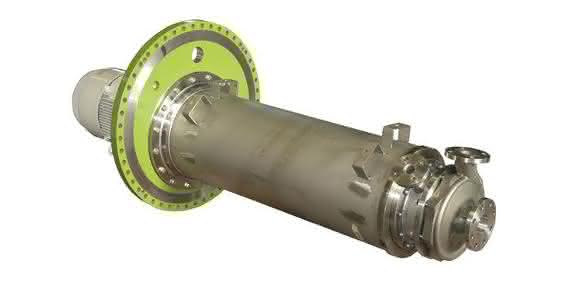
Important regulations such as the Explosion Protection Directive (ATEX) or the Technical Instructions on Air Quality Control (TA-Luft) set standards that must be observed and complied with. TA-Luft stipulates the use of technically sealed pumps when selecting pumps. This also includes magnetically coupled pumps. These have a containment shell that is hermetically sealed to the outside. This transmits the torque from the motor to the pump shaft. "The bearing is located inside the robust pump," explains Frank Bungartz, Managing Director of the centrifugal pump manufacturer of the same name. In standard centrifugal pumps, the medium to be pumped is used to lubricate the bearings and cool the containment shell. If gas particles enter the pump or accumulate in the bearing area during standstill, dry running damage can occur in the plain bearings. Solids in the medium can block the cooling channels to the containment can. In order to achieve the required dry-running protection, filters with differential pressure monitoring, minimum volume flow and temperature monitoring on the sleeve bearings and containment can are necessary. A costly and time-consuming affair.
There is another way
Bungartz self-regulating and intrinsically safe pumps are used in many chemical and petrochemical plants around the world. The MPCTAN submersible pump has proven its worth in pumping mixtures of boiling, solids-laden or toxic liquids from pits or closed, unpressurized containers such as slop tanks. Its design is already equipped for high safety standards. The vertical pump from the V-AN series has a hydrodynamic seal: an impeller with back vanes counteracts the inlet pressure with an equally high pressure. The pumped liquid is thus conveyed away from the shaft gap. A dry-running magnetic coupling seals hermetically to the atmosphere through a ceramic containment shell. A sealing gas is used to create an immersion bell effect, which protects the bearing and sealing unit from product contact.
Practical examples show how the pump masters the pumping of extreme media. In a sump tank, crude oil with water and sand poses a challenge due to the solid content and the explosiveness of the crude oil due to its volatile components. To make matters worse, the pump is only put into operation temporarily.
The pit is located in ATEX zone 0, where there is a constant risk of explosion. Only pumps approved for this zone may be used. The dry-run safe submersible pump - like the other pumps from this manufacturer - is specially designed and built for this application. It must first undergo the usual type testing at the PTB (Physikalisch-Technische Bundesanstalt). The vertical design of the MPCTAN prevents the seal from coming into contact with the product - even in the event of a sealing gas failure. Another advantage of the dry-running pump that pays off immediately is that all the required monitoring equipment can be installed outside the pit. The highly corrosive and abrasive medium was also taken into account in the design. It requires a resistant material with increased strength. The super-duplex material used has also proven its worth here. The submersible pump has been in trouble-free operation for years.
In another company, it is a coalescence separator in which the MPCTAN operates at an immersion depth of 5.5 meters. The inlet is very low and must not obstruct the neighboring oil separator. The medium: surface water (hydrocarbon phase) is at the boiling point. This makes the pump with an NPSH value <0.1 the right choice. The environment corresponds to ATEX zone 1, the delivery head is 45 m and the flow rate (Q) is 15 m³/h. "The MPCTAN works here with a semi-open impeller. Pressure equalization at the impeller inlet prevents vapour formation. The pump does not suck, so the flow rate decreases with the inlet head, and an NPSH value of 0 m is possible," explains Frank Bungartz, who is the third generation to manage the company. There is no need for safety precautions that kick in if the pump fails. There have not been any incidents since commissioning, even though the pump is only in temporary use. ee


You might also be interested in
Atlas Copco takes over long-standing sales partner
Atlas Copco has taken over Heide-Pumpen. The specialist for mobile pumps has been working closely with Atlas Copco in sales and service for a long time, especially for surface pumps for construction site dewatering and wastewater detour or in the...
 read more...
Lutz Pumpen at the Achema 2024
New mobile drum pump with battery drive
The new B3 Battery from Lutz Pumpen promises mobile and safe working with aggressive liquids without having to compromise on pumping performance compared to wired versions. The battery-powered drum pump will be on display at Achema, the world's...
read more...Maintenance and Pumps&Valves in February
Final preparations are underway in Dortmund: On February 21, 2024, maintenance will start as the leading trade fair for industrial maintenance and with it Pumps&Valves as the trade fair for industrial pumps, fittings and valves.
read more...Liquid separator keeps pumps dry
Vacuum clamping minimizes distortion and enables five sides to be machined in one clamping operation. The use of cooling lubricants poses a challenge: If they get into the vacuum generator, they can cause serious damage.
read more...Spring clutches for construction machinery
Spring clutches from Torsion Control Products (TCP) are ideal for use in construction machinery where modern diesel engines are used.
read more...Protection against cooling lubricant
Liquid separator from Schmalz keeps pumps dry
Anyone clamping with a vacuum during CNC machining must protect the pump from cooling lubricant. The NLS liquid separator from Schmalz separates the cooling lubricant and returns it to the running process - without interrupting the vacuum.
read more...Which clutch for what?
Mechanical engineering and its applications are multifaceted. Every application is special and requires a perfect machine design. Individual components in the system must also be optimally designed.
read more...Energy efficiency needs electrical engineering and IT
The energy crisis makes one thing clear: it is not enough to simply screw a photovoltaic system onto your roof or purchase green electricity. Industry is faced with the challenge of reducing consumption in order to counter the rise in energy prices,...
read more...Solutions for a networked and climate-neutral industry
At the world's leading trade fair for industry, around 4,000 companies from the mechanical engineering, electrical and digital industries as well as the energy sector will be showcasing solutions for the production and energy supply of the future.
read more...