
Vacuum gripper
Small gripper with great power
The differences between cobot vacuum grippers also lie in the generation of negative pressure and the resulting vacuum flow. The vacuum flow determines the load capacity of the gripper and thus decides whether the capacity of the cobot can be fully utilized. A new system allows a significantly increased vacuum flow and thus a high efficiency of the cobot. By Andrea Bodenhagen
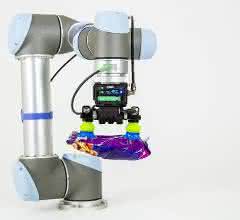
Collaborative robots, or cobots, are designed to work alongside humans. Equipped with grippers, sensors and optical technologies, this latest generation of robots is safe and easy to operate in almost any environment. No wonder they have quickly become a familiar sight in industry.
Plug-and-play models, which are specifically aimed at small workshops or companies where work was previously only carried out manually, are offered by various manufacturers. However, depending on their design, the capacity and performance potential of these cobots and end effectors can vary considerably. In fact, some vacuum end effector grippers have several times the payload capacity of other grippers.
Vacuum flow - the determining factor
The secret behind a successful cobot vacuum gripper is the vacuum flow. Without a strong and continuous vacuum flow, the cobot vacuum end effector cannot safely lift and hold what the application requires of it. A cobot with insufficient lifting capacity is both frustrating and unsafe. A "weak" cobot will drop and damage parts, impact the work environment and increase the risk of workplace accidents. For this reason, it is important to check how the vacuum is created in the cobot and gripper unit.
In engineering, vacuum is usually generated with a vacuum pump, and although there are different types of vacuum pumps, two main types are used in cobot vacuum end effectors: miniature electromechanical pumps and air-driven pumps or ejectors.
Vacuum pumps are rated according to their ability to generate a vacuum flow. Vacuum flow is the air drawn into the pump body from the atmosphere. This figure is usually expressed as standard liters per minute (Nl/min) or cubic feet per minute (cfm).
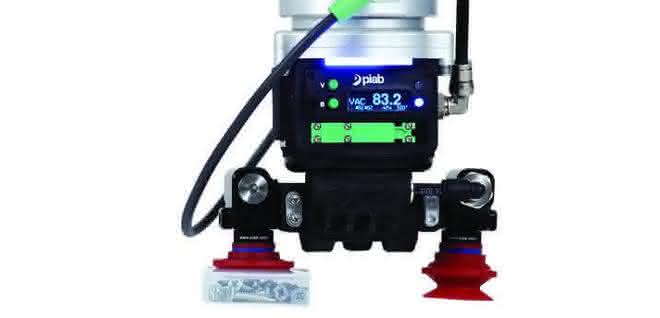
Some of the plug-and-play vacuum grippers for cobots on the market today use miniature electro-mechanical vacuum pumps. This can be an alternative if there is no access to compressed air or if the cobot is intended for use on a mobile platform. However, miniature electro-mechanical vacuum pumps offer a significantly lower vacuum flow compared to compressed air driven vacuum pumps.
Higher load capacity with compressed air
Since the lifting capacity depends on the vacuum flow, cobots with air-driven vacuum pumps offer several times the payload capacity of cobots that use miniature electromechanical pumps. The simplest type of air-driven vacuum pump is known as a single-stage ejector.
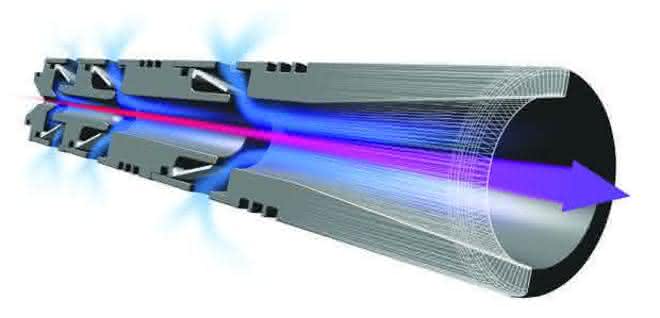
Vacuum is created by forcing compressed air at very high speed through a small opening or an ejector nozzle, causing negative pressure to build up in the system. From the outside of the system, atmospheric pressure attempts to equalize this negative pressure and restore equilibrium. This creates the vacuum flow or induced air flow.
In so-called multi-stage ejector pumps, compressed air enters the pump and is passed through a system of ejector nozzles and chambers of different sizes, which act as "pressure boosters". Multi-stage vacuum ejectors make optimum use of the energy stored in the compressed air through specially developed air nozzles in a series of increasingly larger ejectors that can expand the compressed air flow in controlled stages. Multi-stage ejector vacuum pumps also offer many other advantages over single-stage ejectors and mechanical or electromechanical vacuum pumps. They are quiet, have few moving parts and generate neither heat nor vibration, resulting in virtually maintenance-free operation.
Increased vacuum flow with multi-stage technology
Cobot plug-and-play vacuum grippers using multi-stage vacuum ejectors provide the optimum vacuum flow, resulting in the highest lifting capacity and the ability to handle a variety of products, including hard-to-grip objects such as flexible packaging. For this reason, choosing an air-powered "strong" cobot vacuum end effector is a good choice for demanding lifting requirements.
The piCobot gripper from Piab uses "Coax" multi-stage vacuum technology. Coax ejectors are based on Piab's multi-stage technology and are smaller, more efficient and more reliable than conventional ejectors, allowing the development of a flexible, modular and efficient vacuum system. Such a system provides three times more vacuum flow than conventional systems and offers the possibility to increase speed with high operational reliability while consuming less energy. The technology ensures high performance at both low and high feed pressure.
The piCobot is equipped with two Coax Micro Ti05-2 ejectors, which achieve a high suction power even at low vacuum levels. The piCobot achieves a maximum vacuum flow of 38.4 NI/min compared to 12 NI/min for comparable grippers that use an electromechanical pump. This means that the piCobot can also handle difficult materials that are easily permeable to air, as in the case of cardboard, or flexible materials, such as bags, where the suction cups do not close completely. This is not possible with grippers with an electromechanical pump.
The pump unit of the piCobot is compact and lightweight due to the small space requirement of the ejectors. It is only 76 mm high and weighs 0.51 kg - 0.71 kg with the standard suction cup unit. This means that taller and heavier objects can be moved. Companies that have invested in a Cobot can therefore make full use of its capacity and thus achieve a shorter amortization period and a correspondingly higher return on investment.
Andrea Bodenhagen, Marketing Director Europe, Piab / am


You might also be interested in
Atlas Copco takes over long-standing sales partner
Atlas Copco has taken over Heide-Pumpen. The specialist for mobile pumps has been working closely with Atlas Copco in sales and service for a long time, especially for surface pumps for construction site dewatering and wastewater detour or in the...
 read more...
Lutz Pumpen at the Achema 2024
New mobile drum pump with battery drive
The new B3 Battery from Lutz Pumpen promises mobile and safe working with aggressive liquids without having to compromise on pumping performance compared to wired versions. The battery-powered drum pump will be on display at Achema, the world's...
read more...Maintenance and Pumps&Valves in February
Final preparations are underway in Dortmund: On February 21, 2024, maintenance will start as the leading trade fair for industrial maintenance and with it Pumps&Valves as the trade fair for industrial pumps, fittings and valves.
read more...Liquid separator keeps pumps dry
Vacuum clamping minimizes distortion and enables five sides to be machined in one clamping operation. The use of cooling lubricants poses a challenge: If they get into the vacuum generator, they can cause serious damage.
read more...Spring clutches for construction machinery
Spring clutches from Torsion Control Products (TCP) are ideal for use in construction machinery where modern diesel engines are used.
read more...Protection against cooling lubricant
Liquid separator from Schmalz keeps pumps dry
Anyone clamping with a vacuum during CNC machining must protect the pump from cooling lubricant. The NLS liquid separator from Schmalz separates the cooling lubricant and returns it to the running process - without interrupting the vacuum.
read more...Which clutch for what?
Mechanical engineering and its applications are multifaceted. Every application is special and requires a perfect machine design. Individual components in the system must also be optimally designed.
read more...Energy efficiency needs electrical engineering and IT
The energy crisis makes one thing clear: it is not enough to simply screw a photovoltaic system onto your roof or purchase green electricity. Industry is faced with the challenge of reducing consumption in order to counter the rise in energy prices,...
read more...Solutions for a networked and climate-neutral industry
At the world's leading trade fair for industry, around 4,000 companies from the mechanical engineering, electrical and digital industries as well as the energy sector will be showcasing solutions for the production and energy supply of the future.
read more...