
Measuring couplings
Safely monitor hydraulic systems
Measuring couplings in hydraulic systems have a variety of functions. They are used for monitoring as well as maintenance. Their use can help to detect malfunctions in good time and thus prevent the entire system from coming to a standstill or becoming defective.
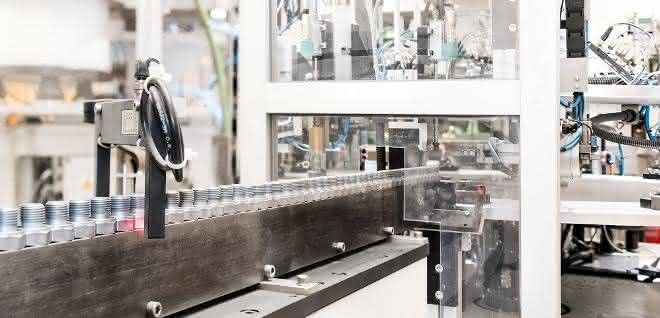
In mobile and stationary hydraulics, pressure control plays a very important role in the functional testing of a system. Here, test couplings are indispensable for pressure testing and monitoring a hydraulic system, but also for lubrication, venting and oil removal. In addition to construction and agricultural machinery and rail vehicles, the couplings can also be used in the mechanical engineering, automotive, energy and environmental technology sectors.
Test couplings are not only suitable for the original equipment of hydraulic systems, but also for retrofitting. During initial testing, test couplings can be used to determine whether a hydraulic system is being operated in accordance with the intended specifications and parameters, for example the necessary operating pressures. In existing systems, they are used for maintenance, troubleshooting and repair. With their help, service staff and users of hydraulic applications can easily and safely monitor the system pressure, bleed the hydraulic system, analyze the degree of contamination and take representative fluid samples. The couplings can be used both temporarily and permanently. If the measuring couplings are equipped with an integrated non-return valve, it is even possible to work under pressure of up to 630 bar without having to shut down the system.
Testing during operation
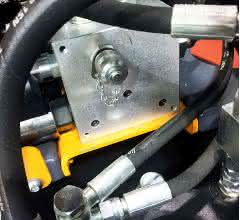
Measuring couplings are usually installed upstream of the actuators in a hydraulic system. They can be installed directly in the oil-carrying pipes or on control blocks, for example, which regulate the oil flow between pumps and actuators or between hydraulically operated components and consumers in a system. In addition to the measuring coupling, a measuring device or pressure gauge and, if necessary, a micro hose fitted with appropriate fittings are required for pressure testing. By screwing on fittings or pressure gauges, the inner valve of the measuring coupling is opened to ensure the flow of fluid in the direction of the measuring device, which indicates the operating pressure present at this point.
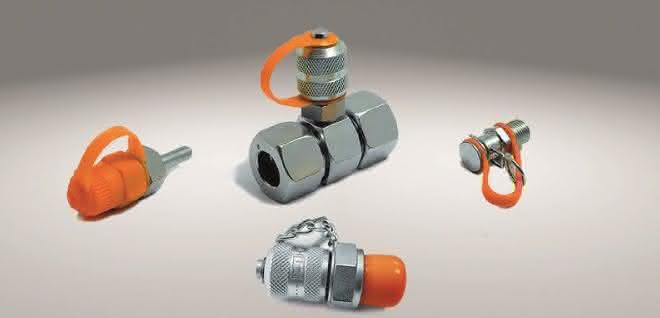
Measuring couplings are available in various materials such as stainless steel. They are suitable for all hydraulic and mineral oils. Special versions are available for other media. In order to meet the most diverse requirements or prevent oil leaks, seals are available in various designs and materials, for example seals made of nitrile rubber NBR, which are characterized by high resistance to mineral oils and are suitable for a temperature range of -30 to 125 °C, or seals made of the fluoroelastomer Viton, which have high thermal and chemical resistance and can be used from -25 to 230 °C.
Depending on the respective application, test couplings have different threads and are available in different versions, for example with a riser tube, union nut, pipe fitting, as a bulkhead test coupling for pipe connection or as a non-return coupling. Test couplings are suitable for any mobile or stationary hydraulic system. Any malfunctions can be detected and evaluated using a diagnostic test procedure with the aid of test couplings. In this way, costly repairs are often not even necessary. At the same time, test couplings make a significant contribution to increasing the quality and performance of a hydraulic system.
Timo Weber (M.Sc.), General Manager & Head of Sales and Björn Kreuels, Regional Sales Manager Europe, R+L Hydraulics / am


You might also be interested in
Atlas Copco takes over long-standing sales partner
Atlas Copco has taken over Heide-Pumpen. The specialist for mobile pumps has been working closely with Atlas Copco in sales and service for a long time, especially for surface pumps for construction site dewatering and wastewater detour or in the...
 read more...
Lutz Pumpen at the Achema 2024
New mobile drum pump with battery drive
The new B3 Battery from Lutz Pumpen promises mobile and safe working with aggressive liquids without having to compromise on pumping performance compared to wired versions. The battery-powered drum pump will be on display at Achema, the world's...
read more...Maintenance and Pumps&Valves in February
Final preparations are underway in Dortmund: On February 21, 2024, maintenance will start as the leading trade fair for industrial maintenance and with it Pumps&Valves as the trade fair for industrial pumps, fittings and valves.
read more...Liquid separator keeps pumps dry
Vacuum clamping minimizes distortion and enables five sides to be machined in one clamping operation. The use of cooling lubricants poses a challenge: If they get into the vacuum generator, they can cause serious damage.
read more...Spring clutches for construction machinery
Spring clutches from Torsion Control Products (TCP) are ideal for use in construction machinery where modern diesel engines are used.
read more...Protection against cooling lubricant
Liquid separator from Schmalz keeps pumps dry
Anyone clamping with a vacuum during CNC machining must protect the pump from cooling lubricant. The NLS liquid separator from Schmalz separates the cooling lubricant and returns it to the running process - without interrupting the vacuum.
read more...Which clutch for what?
Mechanical engineering and its applications are multifaceted. Every application is special and requires a perfect machine design. Individual components in the system must also be optimally designed.
read more...Energy efficiency needs electrical engineering and IT
The energy crisis makes one thing clear: it is not enough to simply screw a photovoltaic system onto your roof or purchase green electricity. Industry is faced with the challenge of reducing consumption in order to counter the rise in energy prices,...
read more...Solutions for a networked and climate-neutral industry
At the world's leading trade fair for industry, around 4,000 companies from the mechanical engineering, electrical and digital industries as well as the energy sector will be showcasing solutions for the production and energy supply of the future.
read more...