
Predictive maintenance
Odin sees everything ahead
Europe's leading brake disc manufacturer Buderus Guss relies on condition-based maintenance with the Odin service package from Bosch Rexroth. The timely detection of potential hydraulic failures during casting avoids production downtime and reduces spare parts costs. Compared to an emergency repair, pump replacement can be planned and carried out in a much shorter time.

Automotive suppliers are under enormous pressure. Unscheduled production downtimes cause high costs. This is all the more true when production processes are as closely interlinked as they are at Buderus Guss. The European market leader for car brake discs produces 20 million cast parts a year in Breidenbach, Hesse, which have to arrive just-in-time at the international manufacturers.
High system availability is a must
The first link in the Buderus Guss production chain is formed by the five highly automated molding lines. If their hydraulic drive fails, costs of several thousand euros are incurred every hour. It becomes significantly more expensive if the buffer of blanks for further mechanical processing of the brake discs runs empty. To prevent this, the forming systems must achieve the highest possible availability. Until now, the company has only been able to achieve this with regular maintenance work. "The pump, which weighs around 70 kg and is installed at a height of 3.50 m, was regularly replaced as a preventative measure," explains Thomas Heck, Head of Technical Maintenance at Buderus Guss. "In the event of an unplanned breakdown, the emergency repair, including scaffolding and special lifting tools, would have resulted in production downtime of up to eight hours."
In order to better assess the risk of pump failure and thus reduce it in the future, Buderus Guss initially implemented various measures for local condition monitoring with the help of Bosch Rexroth. For example, sensors were installed in the filter system to continuously monitor the fluid flow. However, the preventive pump replacement every six months and the high spare parts costs remained, even though the service life of the pump could be significantly longer depending on the utilization. "This problem could only be solved by a predictive warning system, which made it possible to schedule a planned replacement during the non-production maintenance window at the weekend if action was required," reports Thomas Heck. "However, the necessary warning time until the next planned shutdown was not feasible with the previous methods."
The decisive step towards a condition-based maintenance strategy that maximizes the service life of the motor and pump while minimizing the risk of failure was only achieved with the help of the Online Diagnostics Network (Odin). The service package uses the interaction of sensor technology, cloud-based applications and machine learning methods to detect critical faults or significant changes to the normal operating status in advance and warn of a probable failure in good time. At Buderus Guss, the sensor system installed by Bosch Rexroth now also records the vibration of the pump and the oil quality. The latter also serves as an indicator for the condition of the valves and for precisely scheduling the filter change.
Self-learning algorithms and expert knowledge
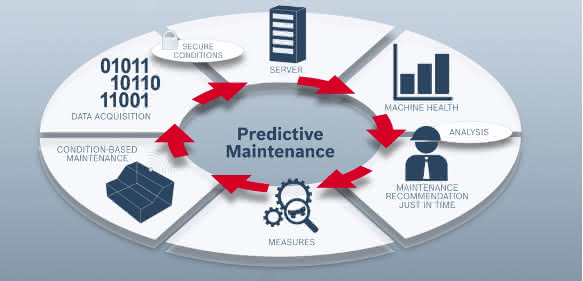
With this solution, the user has opted for a comprehensive service package. The services included range from the initial consultation to the design and installation of the measurement technology, including the control cabinet and optimum cabling. The measurement data is recorded in real time and transmitted via mobile communications to a highly secure Bosch Cloud data center in compliance with legal security regulations, where it is evaluated using self-learning algorithms and big data analyses. Using the data-based model, which is first concretized during a learning phase, the service package creates a separate "health index" (Machine Health Index) for each monitored system. The experts use this index, along with detailed analyses, to assess the expected service life, warn the customer in the event of irregularities and make maintenance recommendations. "The sensors must be positioned in the system in such a way that the system can differentiate precisely between the normal and critical states," explains Buderus account manager Werner Reinhardt from Bosch Rexroth. "In view of the wide range of pump types and the individual design of the systems, the sensors and data collection must be precisely adapted in order to filter out the pump vibration from the rest of the production environment, for example. The learning and working phase is not the end of the process. Odin is constantly learning."
The results at Buderus Guss show the potential of predictive maintenance when condition monitoring is ensured by a powerful system and a competent partner. Compared to emergency repairs including scaffolding and lifting equipment in the event of an unplanned breakdown, the planned pump replacement is reduced by at least 50 percent from around eight to four hours. "Thanks to Odin, we can finally assess the current condition of the system regardless of location," says Thomas Heck happily. ee


You might also be interested in
ESTIA aims to strengthen Europe's cloud
New tech alliance for EU sovereignty
Twelve companies, including Dassault Systèmes, are founding the European Sovereign Tech Industry Alliance (ESTIA). The initiative aims to strengthen Europe's technological independence and define requirements for sovereign cloud services. The start...
 read more...
Deutsche Telekom and Nvidia launch one of Europe's largest AI factories
With the Industrial AI Cloud in Munich, Deutsche Telekom and NVIDIA are creating one of the largest AI factories in Europe. Companies can train AI models, carry out simulations and access 10,000 GPUs.
read more...Leveraging data potential with AI and streaming
Huge data treasures are still lying dormant in many manufacturing companies. And yet it is high time that these treasures were unlocked. There is often a lack of resources and capacity to make data usable in real time. Streaming production data can...
read more...More awareness of noise
Dematic offers solutions that are tailored to different cloud environments and reduce environmental impact through reduced material consumption and improved energy efficiency.
read more...Generative AI in the automation environment
The mechanical engineering and automation industry is undergoing profound change. This transformation is being driven by more volatile global trade, geopolitical crises and increasing market pressure, which demands greater agility, technological...
read more...Rigid data structures have had their day
The traditional data center is no longer the center of data. A hybrid cloud storage approach enables manufacturing companies to both meet the current requirements of data-intensive processes and future-proof their infrastructure.
read more...Software as a service in three stages
CIM Database Cloud is a new out-of-the-box solution from Contact for end-to-end digital product development.
read more...How production can benefit from AI
Together with AI technology, IIoT networking makes it possible to better control machine parameters and optimize quality with predictive quality. Downtimes and set-up times can also be further minimized. Cloud platforms also make these technologies...
read more...More expertise for digital engineering
Altair, a computational science and artificial intelligence (AI) company, has acquired OmniV, a technology from Michigan, USA-based software company XLDyn.
read more...