
Diaphragm pump
Dilute emulsifiers precisely
Emulsifiers are often used when immiscible components need to be mixed together. To achieve a suitable mixture, the pure emulsifier is diluted to working strength. Diaphragm pumps, for example, ensure the correct mixing ratio.
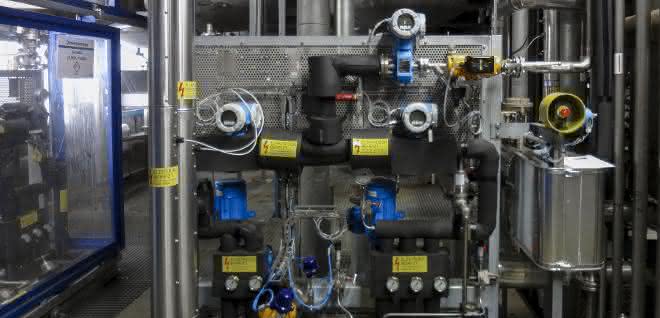
Due to their property of being soluble in different substances, emulsifiers are often used when immiscible components are to be mixed together. In order to achieve a suitable mixture, for example in food production, the pure, highly concentrated emulsifier is diluted to working strength in advance. Mixing systems for the production of a suitable emulsifier must above all have a high dosing accuracy in order to ensure an exact degree of dilution and to avoid incorrect mixing or fluctuations in the individual batches.
The dosing systems from Lewa GmbH are equipped with flow meters that continuously check the required dilution level of 20 percent; in the event of any deviations, incorrect mixtures can be avoided thanks to the short adjustment time and the quick reaction of the control system. The mixing module also helps to minimize logistics costs: By stockpiling highly concentrated emulsifier, which is only diluted with water later, there is no need for additional tanker trucks to deliver already diluted concentrate mixture.

"When it comes to emulsifier dilution, accuracy and compliance with safety standards are particularly important when it comes to correct dosing," explains Volker Kirschbauer, Sales Engineer at Lewa GmbH. As the additives are primarily used in the food sector, the dilution systems used must meet high operating requirements. "Among other things, this means that the modules must be robust and wear-resistant in order to prevent leaks and - in the case of a hydraulically operated pump - any contamination of the emulsifier with the lubricants," says the expert. At the same time, the system must also work as precisely as possible so that the dilution levels required by the customer can be maintained without deviations.
Conventional piston pumps, such as those used by the chemical company to dilute its emulsifiers, were not ideal for this purpose. "In a first step, the concentrated emulsifier liquid was manually fed into the tank. Once the required quantity was reached, the valve was closed and a second valve was opened to add the process water for dilution," reports Kirschbauer. "An agitator then had to be put into operation for half an hour to produce a homogeneous mixture." This time-consuming and labor-intensive process had a negative impact on the user's production efficiency and also meant that the correct mixture was occasionally only achieved to a limited extent. "The human error rate is high due to influences such as stress or distraction," says Kirschbauer. "If the pump stop is activated too late, for example, the strength of the emulsifier mixture can change significantly and result in more water having to be added in order to restore the originally required concentration. However, this in turn means additional time is required."
High dosing accuracy thanks to optimized control
An internationally operating chemical group therefore contacted the pump manufacturer Lewa and commissioned the Leonberg-based company to build a pump system for diluting a 70 percent emulsifier. The user decided on a metering system with ecodos metering diaphragm pumps, which were to be used to dilute the emulsifier to 20 percent.
"The system consists of two pump trains: One conveys the emulsifier, the other the dilution water," says Kirschbauer, explaining the design. "Both contain a flow meter that monitors the current volume flow before the two liquids flow into a static mixer where they are mixed." Finally, a third measuring device in the tank shows the sum of the two volume flows for control purposes, thus providing the user with redundant safety - the sum of the partial flows must ultimately be equal to the measured value of the sensor. "If the measured partial flows do not correspond to the desired mixing ratio, the control system integrated in the system automatically readjusts them. The operator only has to specify the desired mixing ratio beforehand," says Kirschbauer. It is helpful that the LEWA smart control technology only requires a short adjustment time and can therefore counteract incorrect mixtures in a more targeted and faster way than conventional controls - this shortens the transition times with inaccurate mixture strengths. "According to the user's specifications, the emulsifier mixture was only allowed to deviate by 1 percent from the required 20 percent," explains Kirschbauer. "Thanks to the optimized control system, we can meet this requirement without any problems."
Space-saving storage through the use of dosing systems
Another requirement of the British chemical company was to use the same sizes as in a previous project when planning the dosing system. "If necessary, individual components should be able to be exchanged quickly and easily between the mixing units to avoid production bottlenecks," explains Kirschbauer. As the diaphragms and valves for both systems are of the same type, it is also easier to procure and stock wearing parts.
In addition, the LEWA dilution module ensures more efficient, space-saving storage. For example, if the user wants to process the emulsifier in three different concentrations, the conventional procedure requires the use of three tanker trucks to deliver the required quantities in the desired dilution levels. Thanks to the possibility of mixing the emulsifier continuously over a wide concentration range, only one tanker truck filled with a high concentration is required. 20,000 kg of mixing volume per day flow through the dilution system, which has been in operation since summer 2018.
According to documents from Lewa.


You might also be interested in
Atlas Copco takes over long-standing sales partner
Atlas Copco has taken over Heide-Pumpen. The specialist for mobile pumps has been working closely with Atlas Copco in sales and service for a long time, especially for surface pumps for construction site dewatering and wastewater detour or in the...
 read more...
Lutz Pumpen at the Achema 2024
New mobile drum pump with battery drive
The new B3 Battery from Lutz Pumpen promises mobile and safe working with aggressive liquids without having to compromise on pumping performance compared to wired versions. The battery-powered drum pump will be on display at Achema, the world's...
read more...Maintenance and Pumps&Valves in February
Final preparations are underway in Dortmund: On February 21, 2024, maintenance will start as the leading trade fair for industrial maintenance and with it Pumps&Valves as the trade fair for industrial pumps, fittings and valves.
read more...Liquid separator keeps pumps dry
Vacuum clamping minimizes distortion and enables five sides to be machined in one clamping operation. The use of cooling lubricants poses a challenge: If they get into the vacuum generator, they can cause serious damage.
read more...Spring clutches for construction machinery
Spring clutches from Torsion Control Products (TCP) are ideal for use in construction machinery where modern diesel engines are used.
read more...Protection against cooling lubricant
Liquid separator from Schmalz keeps pumps dry
Anyone clamping with a vacuum during CNC machining must protect the pump from cooling lubricant. The NLS liquid separator from Schmalz separates the cooling lubricant and returns it to the running process - without interrupting the vacuum.
read more...Which clutch for what?
Mechanical engineering and its applications are multifaceted. Every application is special and requires a perfect machine design. Individual components in the system must also be optimally designed.
read more...Energy efficiency needs electrical engineering and IT
The energy crisis makes one thing clear: it is not enough to simply screw a photovoltaic system onto your roof or purchase green electricity. Industry is faced with the challenge of reducing consumption in order to counter the rise in energy prices,...
read more...Solutions for a networked and climate-neutral industry
At the world's leading trade fair for industry, around 4,000 companies from the mechanical engineering, electrical and digital industries as well as the energy sector will be showcasing solutions for the production and energy supply of the future.
read more...