

Compressed air
Intelligent sensor detects leaks
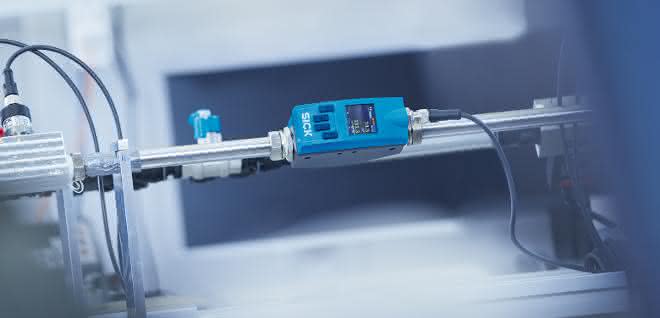
The tedious search for leaks in compressed air systems could soon become much easier: Fraunhofer IPA is working with Sick to develop an additional leakage service for an intelligent flow sensor. Self-learning algorithms evaluate the measurement data and thus detect leaks.
However, up to 30 percent of the energy used escapes unused through tiny leaks. However, detecting these holes, kinks or leaking connectors has so far involved a great deal of effort. "The products and methods available on the market for detecting leaks are not worthwhile for many users," says Christian Dierolf from the Industrial Energy Systems department at the Fraunhofer Institute for Manufacturing Engineering and Automation IPA. "To use them, you either have to repeatedly detect leaks with an ultrasonic device or retrofit new valves for individual monitoring of the pneumatic actuators." Many companies are therefore forced to live with waste.
Flow sensor teaches itself
In future, however, there will no longer be any reason to allow compressed air to escape unnecessarily and miss out on potential energy savings. Researcher Dierolf is working closely with Sick to develop an additional leakage service for their intelligent flow sensor. It continuously records pressure, temperature and flow rate and generates seamless curves. These curves are evaluated by a self-learning algorithm. "The key feature here is clustering: leaks are reflected in characteristic curves. The algorithm recognizes these and sounds the alarm," explains Dierolf.
Implementation should be extremely simple: The sensor, which Fraunhofer IPA and SICK are jointly developing from concept to series production, does not need to be connected to the machine control of the compressed air system or to an industrial PC. Instead, the flow sensor itself has a small display and other interfaces such as MQTT and OPC-UA, which allow automated notification of the user. The user can also access the sensor via a web interface. The algorithm will also teach itself. With this so-called unsupervised machine learning, a human only has to check at the end whether the algorithm has drawn the right conclusions from the available information.
Clustering is set to become standard
"For us, the results from the joint development project are reason enough to make clustering available to our customers as an intelligent service as standard in future generations of flow sensors," says Thomas Weber, Head of Development in the Industrial Instrumentation division at Sick.
However, it will be some time before this is achieved. This is because the additional leakage service for the intelligent flow sensor is still a prototype. A compressed air demonstrator system was recently built at the company's headquarters in Waldkirch and delivered to the Fraunhofer IPA in Stuttgart. It contains the sensor prototype, which is now being tested and further developed.


You might also be interested in
E-scooter with customizable damping
The startup Scuddy has significantly improved the flexibility, performance, customizability and ergonomics of its second-generation foldable e-scooter of the same name - thanks in part to damping technology from ACE.
 read more...
Hurdles on the road to success
Welding is one of the most complicated processes in the manufacturing process, and it is becoming increasingly difficult to find suitable personnel. Can this problem be solved by automating processes? Can or should the robot colleague replace the...
read more...New plug-and-play solutions for the warehouse
Exotec announces a new Skypath conveyor system, the optimized Skypicker picking robot and Deepsky, another proprietary storage software. All three products can be seamlessly integrated into the manufacturer's Skypod system.
read more...Production automation
At Motek, Weiss will be presenting solutions for the linear and rotary movement of workpieces that can be easily integrated into the overall system of hardware and software.
read more...Solutions for surface hardening
Many industrially used components require a combination of a tough core and a hard surface layer so that they can better withstand the stresses of use. Hardening is achieved by rapidly heating the surface and then cooling it quickly.
read more...Wheel bearings and wheel bearing sets
Low-friction rolling behavior
Hecht Kugellager offers a wide range of bearing technology for use in the automotive industry, commercial vehicles and mobile machinery.
read more...Simulation in product development
The Munich-based start-up Spyra significantly shortens the development time of its production by using Solidworks simulation solutions.
read more...Doubling production capacity by 2026
Nabtesco is investing in a third production site, doubling its production capacity to two million precision gearboxes per year by 2026.
read more...Counterbalance trucks with lithium-ion technology
Clark has relaunched the GEX and GTX series.
read more...