
Compressors
Energy-efficient thanks to heat recovery
Compressors and the compressed air they generate are used in industry for many different applications. However, it is often forgotten that the waste heat from the compressors can also be used.

Up to 96% of the compressor drive energy is available for heat recovery. This saves energy and costs and reduces theCO2 footprint.
All of the drive energy supplied to a compressor is converted into heat. Air-cooled and fluid-cooled screw compressors are ideally suited to recovering and further utilizing this energy as much as possible. With them, around 76 % of the energy used is found as heat in the cooling fluid and is extracted from it in the fluid cooler. A further 15 % of this energy can be recovered as heat via the compressed air aftercooler. The electric motor gives off up to 5 % in the form of heat. Fully encapsulated screw compressors make it possible to recover even this proportion of energy with targeted cooling. This means that up to 96 % of the originally supplied drive energy is available for secondary use. Only around 2 % is lost through heat radiation and a further 2 % remains as heat in the compressed air.
Of course, the heat can simply be dissipated. However, there are other ways of using this existing energy source. The simplest and most efficient way is to use the cooling air heated by the compressor directly. For example, as heating air for adjoining rooms. An air duct system directs the warm air from the compressed air station into neighboring warehouses or workshops instead of discharging it outside. If there is no need for heating air, the heated exhaust air is directed outside by simply moving a swing flap or louvre. A thermostatically regulated louvre control allows the warm air to be precisely dosed and constant temperatures to be achieved.

Investments quickly amortized
In addition to full or additional heating for operating rooms, the warm exhaust air from the compressor can also be used, for example, to support drying processes, to set up warm air locks or to preheat the burner air of heating systems. The corresponding investments often pay for themselves within just one year.
In addition, the compressor waste heat can also be fed into existing hot water heating systems and domestic hot water systems. Depending on the intended storage capacity, water temperatures of 70 °C and more can be generated. The most cost-effective way to do this is with a plate heat exchanger that is integrated into the compressor. It is connected to the cooling fluid circuit of the compressor and transfers the energy from the heated cooling fluid to the water to be heated. Depending on whether the hot water is to be used for very sensitive production and cleaning processes, as shower and washing water or for heating purposes, special safety heat exchangers or standard plate heat exchangers are used. In this way, around 70 to 80 % of the installed compressor output can be used for heat recovery without additional energy input. This variant of heat recovery is also possible with primary water-cooled screw compressors. In general, the use of heat recovery methods makes sense if the compressors required for compressed air generation have an output of at least 5.5 kW.
Determine the real need
Before installing a compressed air system, it is advisable to carry out a compressed air audit. This is because very few operators know their exact compressed air requirements. This audit, which can be carried out quickly and easily using modern analysis tools such as the ADA/KESS (Analysis of Compressed Air Utilization/Kaeser Energy Saving System Service), determines the exact demand data for a project. The web-based system not only transports the measurement data, but also the system data of the audited station and quickly provides the operator with a report for initial information. The data can then be transferred to the KESS system, for example. This is used to determine planning steps for the operator of the compressed air station as well as the investment costs and potential energy savings. In the event of a completely new installation, optimum solutions are offered from the outset. Independent comparisons of different system variants are possible so that the most economical one can be selected. In the case of building services, it is advisable to carry out a heat audit at the same time as this compressed air audit in order to determine the development of the heat balance in parallel with the air consumption.
In addition to the characteristic data for compressed air, the data for heat should also be requested. Once these are known, it is possible to determine what percentage of the waste heat from the compressors can be used for the project's normal heating requirements. This can be used to calculate how large the storage tanks need to be and how high the temperature levels are. In the optimum case, 96 % can be used.
What you should look out for
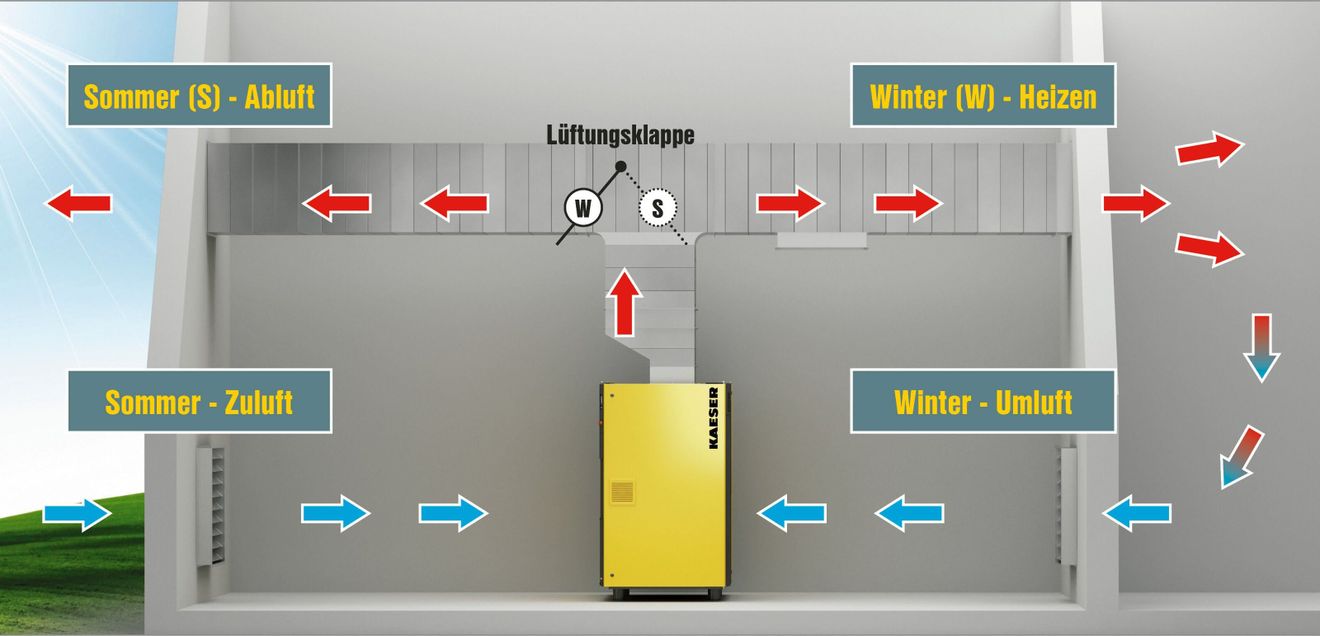
There are a few points to consider when planning or optimizing the compressed air station. Compressors and heaters should not be located in the same room, as they have different requirements in terms of the room climate for optimum use and the compressor must not draw in any hazardous impurities. The compressor room should be well ventilated, but the heating room should not. Ideally, there should be two separate rooms, but they should be located next to each other to keep the distance between the compressors and the heating system as short as possible. Even if the two systems are positioned separately, the heat from the compressors can be used to heat the burner intake air of the heating system.
Since the amount of heat generated and the heat consumption are rarely the same, it is also important to provide sufficiently large heat storage facilities to ensure an optimum supply even if generation and consumption are temporarily not the same.
Air- or water-cooled compressors?
Once the design has been determined, it is important to choose the right compressors. There are generally two different cooling methods: Air cooling and water cooling. In the first variant, as described, air ducts with thermostatically controlled dampers direct the warm exhaust air from the compressors directly into neighboring operating rooms for heating, for example. In order to minimize losses, the exhaust air should not travel too far from the compressor to the place of use.
Today, air-cooled screw compressors with up to 315 kW are available. Even if it cannot be used all year round, this type of heat recovery is worthwhile. The investment for recovery with warm air routing is relatively low and usually pays for itself within a year. Systems that are also equipped with water heat recovery can supply water at temperatures of up to 70 °C all year round - or even higher. However, as this has an impact on the power requirements of the compressors, the cost-effectiveness of such use should be checked beforehand. In the case of water-cooled compressors, the on-site conditions and cooling water costs play an additional role. In principle, water heat recovery is also possible here via a second connected circuit.
Heat recovery can therefore significantly increase the efficiency of a compressed air system and protect the environment by avoiding greenhouse gas emissions. The level of investment required depends on local conditions, the intended use and the heat recovery process selected.
Dipl. Betriebswirtin Daniela Koehler, Press Spokeswoman Kaeser Kompressoren / am
EMO, Hall 12, Stand A26


You might also be interested in
Sustainability Through Simulation
Digital material selection reduces CO2 emissions by 40 percent
The use of digital material simulations can significantly reduce CO₂ emissions during the development and manufacturing of components. A real-world project by Schunk and Cadfem demonstrates how data-driven material selection can yield savings of up...
 read more...
Pro-K Publishes Template for EU Declaration of Conformity
Starting August 12, 2026, the PPWR will require manufacturers of various types of packaging to provide a formal EU declaration of conformity. Pro-K has now provided a sample template for this purpose. At the same time, the association warns that...
read more...When heat slows down production
Cooling concept for industrial halls with significantly reduced energy requirements
Infranorm is developing a cooling concept for industrial halls based on two-stage adiabatic cooling. According to the company, energy consumption can be reduced by up to 95 percent.
read more...Environmental technology as the industry of...
Ifat reports record figures for its 60th anniversary
Ifat Munich 2026 records record numbers with 3,400 exhibitors and 142,000 visitors The circular economy and water technologies are becoming key global industries.
read more...Sustainability needs decisions
To mark Earth Day, Nagarro is calling for a rethink: sustainability should no longer be documented, but actively managed - with artificial intelligence as a central lever. Because AI brings light into the darkness of global supply chains.
read more...Siemens Nanjing plant becomes Lighthouse Factory
The World Economic Forum has recognized the Siemens plant in Nanjing as a Lighthouse Factory. The factory was recognized for its AI-supported, fully digitalized production and significant improvements in productivity, quality and sustainability.
read more...Foundry modernizes plant park with continuous wire belt shot blasting system
The Spanish foundry Funosa is modernizing its equipment fleet with an RDGE 1250 wire belt continuous shot blasting machine from Rösler. Focus: sand removal from heavy iron castings, energy efficiency, ease of maintenance and ESG strategy.
read more...Maintenance instead of replacement
The circular economy starts with the machinery
Sustainability in industry starts with machines, says our guest author from Deguma: How maintenance, modernization and the 5R strategy save resources, energy and CO₂.
read more...Alpla continues to grow: 5.2 billion euros turnover
Alpla can look back on a successful financial year 2025 despite the difficult global economic situation. With revenue of 5.2 billion euros, the packaging and recycling specialist remains on course for growth.
read more...