

Yaskawa Motoman
New cobot handles loads of up to 20 kilograms
More payload capacity and greater reach: With the new Motoman HC20DT IP67, Yaskawa is expanding its portfolio of collaborative robots with a significantly larger model.
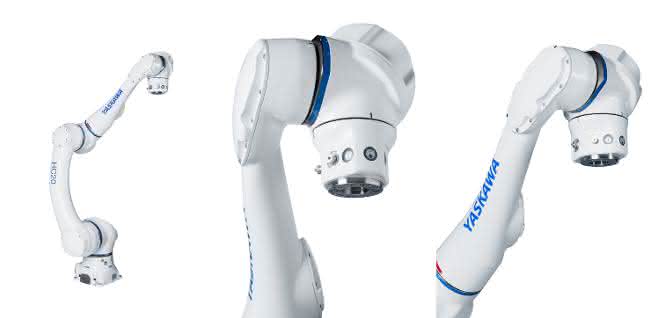
Until now, cobots have tended to be smaller robots that primarily covered payloads of up to ten kilograms with a reach of around 1,200 millimetres. The HC20DT IP67 now considerably expands the range of applications for HRC applications: the payload of 20 kilograms combined with a reach of 1,700 millimetres enables flexible use in many different applications.
Employees can be supported in physically demanding tasks in particular, such as palletizing large boxes, crates or other stackable goods. The robot lifts such heavy loads to improve workplace ergonomics and enable employees to perform cognitively demanding tasks.
Even in harsh environments, such as machine tool loading, where the robot frequently comes into contact with cooling emulsions, the Cobot impresses with its dust and waterproof IP67 protection class. The high payload capacity also enables the simultaneous handling of several heavy workpieces with a double gripper, which is standard in CNC automation. However, applications in the food and chemical industries are also possible thanks to easy-to-clean surfaces and the use of food-safe lubricating grease.
Safety in direct contact with the operator
The new development ensures the required safety in direct contact with the operator thanks to six integrated torque sensors, which enable flexible interaction between the robot and its environment. The robot arm is designed in such a way that there is no risk of crushing fingers, for example. In terms of German and European safety standards, the Motoman HC20DT IP67 - like the smaller HC10DT - can be used as a robot with power and force limitation in accordance with the ISO TS 15066 technical specification. Depending on the risk assessment, it does not require any additional protective measures, such as a safety fence, which saves space and costs.
The YRC1000 or YRC1000micro high-performance controllers with integrated FSU and PFL boards fulfill performance level PL d category 3 according to DIN EN ISO 13849-1 and can be used for both cobots and normal Yaskawa industrial robots.
To further increase the robot's performance, it can also be operated in hybrid mode by connecting external safety technology such as laser scanners. This allows the cobot to switch between collaborative, speed-reduced and full speed in order to achieve maximum cycle times depending on the distance to the employee.
Focus on user-friendly operation
Thanks to the six integrated torque sensors and the monitoring and evaluation of external forces, it is possible to guide and program the robot arm directly by hand (Direct Teach, DT). This saves time when creating robot programs. Programming is carried out using the "Move", "Teach" and "Tool Utility" buttons on the flange. However, the new Motoman HC20DT IP67 can also be easily programmed and operated in conjunction with the Smart Pendant programming device or with a conventional hand-held operating device (Teach Pendant).
In addition to the HC20DT IP67, four other HRC-capable robot models are available from Yaskawa: HC10, HC10DT, HC10DT IP67 and later HC10DTF for the food sector. as


You might also be interested in
Hamburg Regional Court issues preliminary injunction against Elite Robots Germany
In the copyright dispute between Teradyne Robotics and Elite Robots Germany, the Hamburg Regional Court has issued an interim injunction. The distribution of the software and products concerned is prohibited, and there is also a comprehensive...
 read more...
Schunk founds tech spin-off for humanoid robot hands
Schunk is bundling its activities in humanoid robotics by founding its own spin-off at the beginning of January. The aim of the new company is to develop modular humanoid robot hands for industrial applications.
read more...Partnership for humanoid robotics
Schaeffler and Neura Robotics jointly develop humanoids
Schaeffler and Neura Robotics will work together in the future to develop and supply key components for humanoid robots. The systems will also be integrated into Schaeffler's global production network.
read more...Yaskawa at the Automatica 2025
AI meets robotics
At this year's Automatica, everything at Yaskawa revolves around AI-based robotics solutions for the smart factory and beyond. As a trade fair highlight, the manufacturer is presenting its new Motoman Next product concept.
read more...Kassow Robots at the Automatica
7-axle vehicle in action
At Automatica, Kassow Robots will be presenting a wide range of industrial applications for production and logistics tasks that provide new impetus for efficiency and flexibility in industrial automation.
read more...Robotics and automation in six exhibition halls
From June 24 to 27, 2025, Automatica, the trade fair for intelligent automation and robotics, will bring industry and research together in six exhibition halls. Preparations are in full swing.
read more...Interview with Jörg Rommelfanger
Robotics in 25 years
The annual IFR report shows that the number of industrial robots is steadily increasing worldwide. They have already played an important role in ABB's portfolio for decades. In an interview with INDUSTRIAL Production, Jörg Rommelfanger, Head of...
read more...Reliable end effector for cobots
Collaborative robots are now widely used for a wide range of handling tasks. SMC offers three versions of the RMH pneumatic gripper for this purpose; it is compatible with cobots from a total of twelve companies.
read more...7-axis cobots with controller in robot base
With the Edge Edition, Kassow Robots has launched the world's first 7-axis cobots with a controller integrated into the robot base.
read more...