
VDMA figures
Robotics boom exceeds expectations
According to the VDMA, the robotics and automation industry in Germany achieved a record sales volume of 14.5 billion euros in 2017 - an increase of 13% compared to the previous year. Export sales to China in particular grew by around 60 percent.
"2017 was a very strong year for our industry," says Dr. Norbert Stein, Chairman of the Executive Board of VDMA Robotics + Automation. "We already raised our forecast significantly over the course of the year. The fact that our expectations have now been exceeded once again is testament to the extraordinary market momentum in automation. Between 2010 and 2017, the industry grew by an average of ten percent annually and almost doubled its turnover during this period."
China as the most important market
The main growth driver in 2017 was exports - particularly to Asia. Export sales to China grew by around 60% compared to 2016, significantly expanding China's position as the most important market for robotics and automation. Major investments in automation by the electronics industry ensured strong demand here. Exports to all other Asian countries also grew at an above-average rate of around 20%. The dynamic growth in North America also continued. Exports to other European countries increased only moderately - but still accounted for the largest share within the regions. The export ratio rose from 57% (2016) to 60% (2017).
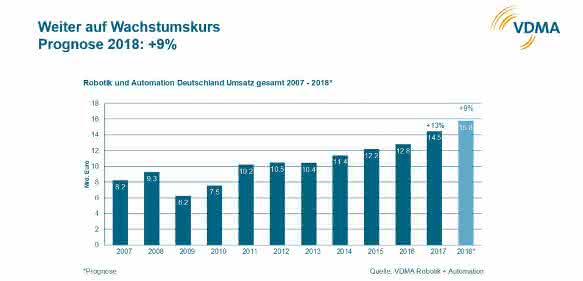
The global trend towards automation and the digitalization of production are providing sustained growth impetus. Car manufacturers and suppliers are increasingly investing in electric and hybrid drives. The necessary components, especially batteries, require new production facilities. Automation in the electronics industry will generate further growth momentum in 2018, according to the VDMA. The unusually strong demand for robotics and automation technologies in 2017 extended delivery times for systems and will continue to have a positive impact on sales well into 2018. Despite protectionist tendencies and macroeconomic risks, VDMA Robotics + Automation expects the industry to grow by nine percent to EUR 15.8 billion in 2018.
Standard for Industry 4.0 communication
Together with its member companies, VDMA Robotics + Automation is laying the foundations for interoperable communication in the smart factory: the Machine Vision, Integrated Assembly Solutions and Robotics departments have developed the first manufacturer-independent information models based on the OPC UA communication standard. This means that the machines will speak the same language in future and can communicate directly with each other - and with the workers.
Using an OPC UA demonstrator, the association and industry partners will be showing two use cases at Automatica in Munich: Firstly, the capability-based control of an assembly cell with components and systems from more than 20 manufacturers. The second is cloud-based condition monitoring of robots from different manufacturers and designs.
Man and machine in the factory of the future
The intelligent combination of the complementary strengths of man and machine is also an important topic for the future of automation. Instead of a manual process being replicated one-to-one by machines, processes are being rethought from the ground up to achieve better results. In so-called "fusion skills", the technologies used reinforce the skills of people, while people maintain, check and further develop the technologies.
At the Automatica special show "Man in the Smart Factory", these new interfaces between man and machine can be experienced in the digitally networked factory: gesture control, maintenance using augmented reality, mobile learning systems, digital assembly assistance systems, human-robot collaboration, technology mediation using gamification, the particularly ergonomic exoskeleton "Chairless Chair" and the intelligent glove - trade visitors can try all of this out for themselves. as


You might also be interested in
ESTIA aims to strengthen Europe's cloud
New tech alliance for EU sovereignty
Twelve companies, including Dassault Systèmes, are founding the European Sovereign Tech Industry Alliance (ESTIA). The initiative aims to strengthen Europe's technological independence and define requirements for sovereign cloud services. The start...
 read more...
Deutsche Telekom and Nvidia launch one of Europe's largest AI factories
With the Industrial AI Cloud in Munich, Deutsche Telekom and NVIDIA are creating one of the largest AI factories in Europe. Companies can train AI models, carry out simulations and access 10,000 GPUs.
read more...Leveraging data potential with AI and streaming
Huge data treasures are still lying dormant in many manufacturing companies. And yet it is high time that these treasures were unlocked. There is often a lack of resources and capacity to make data usable in real time. Streaming production data can...
read more...More awareness of noise
Dematic offers solutions that are tailored to different cloud environments and reduce environmental impact through reduced material consumption and improved energy efficiency.
read more...Generative AI in the automation environment
The mechanical engineering and automation industry is undergoing profound change. This transformation is being driven by more volatile global trade, geopolitical crises and increasing market pressure, which demands greater agility, technological...
read more...Rigid data structures have had their day
The traditional data center is no longer the center of data. A hybrid cloud storage approach enables manufacturing companies to both meet the current requirements of data-intensive processes and future-proof their infrastructure.
read more...Software as a service in three stages
CIM Database Cloud is a new out-of-the-box solution from Contact for end-to-end digital product development.
read more...How production can benefit from AI
Together with AI technology, IIoT networking makes it possible to better control machine parameters and optimize quality with predictive quality. Downtimes and set-up times can also be further minimized. Cloud platforms also make these technologies...
read more...More expertise for digital engineering
Altair, a computational science and artificial intelligence (AI) company, has acquired OmniV, a technology from Michigan, USA-based software company XLDyn.
read more...