
Vacuum gripper
The cobot takes hold
Cobots are helpers that really get to work. Different grippers are required depending on the situation. This article shows what is important for the different gripper units on cobots.
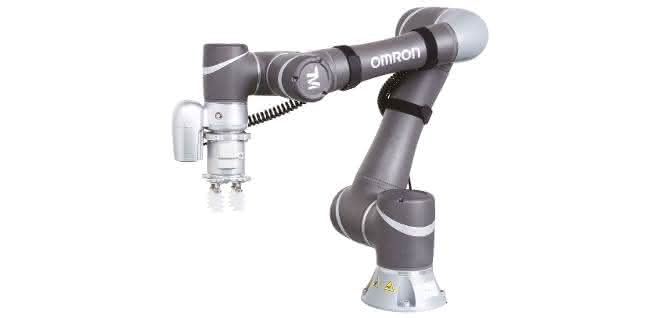
The days when hundreds of people populated factories and warehouses are long gone. According to the latest figures from the International Federation of Robotics (IFR), there are now almost three million industrial robots in use worldwide. To ensure that they are well equipped for pick-and-place applications, conveyor lines, labeling or palletizing as well as the general transport of workpieces, they require modern gripper units. Depending on the application, vacuum, parallel, finger or magnetic grippers can be used. These have different properties - but they should all meet the highest standards in terms of process reliability, productivity and energy efficiency. The solution provider SMC shows what designers need to pay attention to here.
The human hand is one of the most complex tools that nature has created. It can grasp powerfully, but also perform delicate movements with great precision. However, it and humans have clear physical limits. This is one of the reasons why industrial and collaborative robots have become established. Among other things, they safeguard production processes and support automation in numerous industrial sectors. In order for collaborative robots in particular to perform their tasks safely, precisely, productively and in an energy-saving manner, they need the right gripper units.
Fast and safe with vacuum
Whether in medical technology, the paper and packaging industry or the general automation and manufacturing industry, there are applications throughout the industry where sensitive workpieces need to be picked up particularly gently and at the same time safely and quickly. This applies, for example, to picking up stickers, film or bag packaging as well as packaging filled with liquids, powders or gases. "If cobots are used in such cases, designers should equip them with vacuum gripper units. This is because the vacuum used here ensures a secure hold and, in conjunction with a suitable suction cup, a wide range of applications can be realized," says Lisa Zille, Product Management at SMC. In order to be able to change over flexibly and quickly, the vacuum cups should be easy to connect, install and commission. If a vacuum safety valve can also be attached, this provides additional safety, as it maintains the vacuum even when the suction cups are not occupied during the transfer.
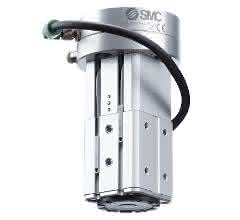
With the ZXP7-01-X1 series and extended series from SMC, vacuum gripper units are available for cobots from various manufacturers. All variants can be equipped with 1, 2 or 4 vacuum suction cups. The plug-and-play solutions are also particularly quick to connect and easy to maintain. Designers can also choose from different suction cup variants - from the shape of the suction cup to the material and diameter. In addition to compatibility with cobots from various manufacturers, this creates a high degree of flexibility for a wide range of applications. They can also be equipped with the ZP2V series vacuum safety valve from SMC.
Gripping with magnetic force
Some workpieces can push vacuum grippers to their limits. "If a surface is uneven or perforated, the vacuum cannot be built up effectively and, as a result, reliable suction is no longer possible. In the case of ferromagnetic workpieces such as pipes or sheet metal, this is when magnetic grippers come into their own," explains Lisa Zille. Thanks to the natural magnetic force, a firm hold is guaranteed even if the compressed air or power supply is interrupted, and energy is saved at the same time. When selecting a magnetic gripper, designers should make sure that the holding force of the magnet can be infinitely adjusted so that it can be precisely adapted to the process requirements. The holding force of the MHM-X7400A series magnetic gripper from SMC, for example, can be infinitely adjusted using an adjustment screw that changes the distance between the magnet and the workpiece.
Additional protection is provided by a damping ring made of fluororubber on the cylinder head, which can be replaced without tools and prevents direct metallic contact, making the mount more gentle. With up to 200 N, users can rely on a high holding force despite the compact design. The compressed air line and electrical wiring can be quickly connected to various cobots using an M8 or M12 plug connection. In addition to flexible mounting options in the standard version, several magnetic grippers can be arranged in parallel if required in order to transport parts with a large surface area.
For special geometries
From simple screw caps in the packaging industry to individual components in mechanical engineering and sensitive pipettes in the pharmaceutical industry: pick-and-place applications for small parts with different geometries place special demands on gripper units for cobots. Lisa Zille explains: "In such cases, parallel, 2-finger or 3-finger grippers are an ideal option. They hold a workpiece carefully yet securely in parallel or from several directions. They can also be used to process parts that are not ferromagnetic or do not have a smooth surface, meaning that neither magnetic nor vacuum grippers can be used." The distance between the gripper housing and the machine and the option of attaching electronic signal transmitters to the gripper to detect workpieces of different sizes are particularly relevant for safe handling.
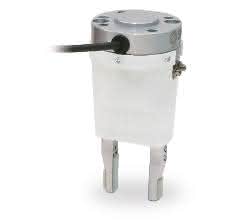
A parallel gripper such as the JMHZ2 series from SMC, for example, has a gripping point of up to 90 mm. The large distance to the housing prevents interference between the gripper housing and the machine. The repeat accuracy of the precision linear guide of ±0.01 mm ensures very precise handling, even with small piston diameters. The large opening/closing stroke makes it easier to pick up different workpieces, as does the holding force per finger. SMC also offers 2- and 3-finger grippers, which are suitable for the particularly sensitive handling of pipettes, for example.
Compactness is the trump card
When the first cobots were developed in the mid-1990s, the idea was to provide humans with an ideal assistant in production. In contrast to industrial robots, however, collaborative robots are usually smaller and must have appropriate sensors to ensure the safety of employees at all times. After all, they operate in their immediate vicinity. "However, their compact design is not just a safety aspect. Their application strength of being able to work flexibly, safely, quickly and in confined spaces is also closely linked to this. Consequently, attached components such as gripper units must be designed in such a way that they meet this requirement profile," explains Zille. In addition to the dimensions, this also includes the weight in particular. Every gram counts here in order to keep the mass moment of inertia low. This makes fast movements possible, which ensures high productivity.
The magnetic grippers of the MHM-X7400A series, the vacuum grippers of the ZXP-X1 series and the pneumatic parallel grippers of the JMHZ2-X7400B series from SMC have been designed to be space-saving and lightweight. For example, the basic version of the latter standard series JMHZ2 is up to 21.7 mm shorter and up to 7.6 mm thinner than its predecessor. As a result, almost half the weight has been saved, which is noticeable on the scales with 180 g less. By removing individual components and reducing the external dimensions, the ZXP-X1 series vacuum grippers also achieved a 5% weight saving.
Irina Hermann, Product Management at SMC


You might also be interested in
Housing and inserts for plenty of power
Lapp presented the expansion of its Epic Power series at SPS 2023: four new M23 circular connector inserts and three new M23 housings. The special feature: all housings can be combined with any of the four inserts.
 read more...
News and product updates from Smartgas
Portable gas analyzers for outdoor use
Smartgas is starting the second half of the year with a series of updates to existing products and a number of new products. Portable analyzers expand the range of applications, while new accessories such as protective housings and heating modules...
read more...Everything accurate in switch cabinet construction
To ensure smooth work processes, tools for processing enclosures and housings must function flawlessly and reliably. Häwa rounds off its punching range with the Multi-Press 500.
read more...Shafts and conversion parts
The Rodriguez range includes ball bushings including matching housings, shaft brackets, crossbars and supports.
read more...Cooling and temperature control units
Hygienic packaging sells safely
In few industries are the requirements for hygiene in the production process as strict as in the food sector - the health of consumers has top priority. This results in enormous challenges for all machines and components involved, especially in...
read more...Simple tool change in seconds
With the CMS, Schunk is launching a user-friendly, manual change system for quick component replacement. In addition to its simple and convenient operation, the CMS also stands out with its extensive range of optional modules and complementary end...
read more...Motion controller for small drives
Medium power range covered
Faulhaber has another housing-less and compact motion controller in its range, which is particularly suitable for integration in device construction and medical technology applications.
read more...Welding solutions in the name of resource efficiency
At the Welding & Cutting trade fair in Essen (September 11-15), Fronius will be focusing on the major drivers in welding technology. Quality requirements are increasing in all industries, but the required welding specialists are scarce. In...
read more...Safe solutions for cable installations
From thick power cables to thin sensor lines, cables and lines must be routed safely through systems and machines. A challenge that should not be underestimated, explains Jörg Sokat, Head of Product Management at Pflitsch.
read more...