
Transport robotics
FTS in the Duty Free Shop
Transport robotics in the security sector. Together with project partner EK Automation, Heinemann has installed a transport robot for a structurally restrictive and highly dynamic environment - at Oslo Airport. There, goods are transported in the security area using innovative scanner technology to prevent tampering.
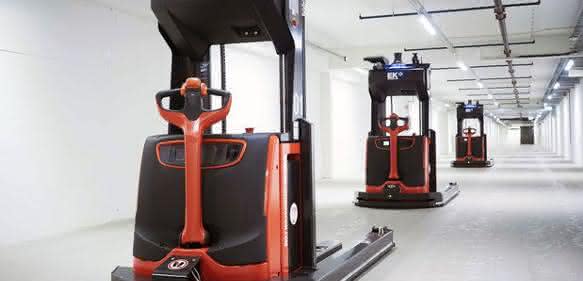
For many passengers today, a trip to a duty-free store is part of their journey. Naturally, they expect to find shelves full of spirits, cosmetics and confectionery. To achieve this, the flow of goods must function smoothly. This is a particular challenge for the operators, as every logistics concept in the security area of an airport must comply with strict regulations. The Hamburg-based company Gebr. Heinemann operates one of Europe's largest duty-free stores at Oslo Airport's new international terminal, which opened in 2017. The goods for this store are transferred from the central warehouse in Hamburg to the airport's incoming goods department. From here, they have to be transported to the duty-free stores as required.
First robotic transport system at an airport
The operators require an automated solution for the efficient supply of goods and decided to introduce the world's first automated guided vehicle system (AGV) at an airport in the duty-free area. Heinemann commissioned EK Automation from Rosengarten near Hamburg with the implementation. The company, which has around 180 employees worldwide, specializes in automated material flow and storage systems and is one of Europe's leading suppliers of automated guided vehicles - also known as transport robots. The specialists at EK Automation develop intelligent and efficient solutions with automated guided vehicles (AGVs) that are individually tailored to customer requirements.
Felix Schad, Project Manager at EK Automation, describes the particular challenges of this project: "At Oslo Airport, the pallets have to travel a distance in elevators over several floors and through long, narrow corridors. This takes place in different security areas of the airport. It must therefore be ensured that the goods cannot be manipulated during transportation by the AGV." To develop the ideal transport concept and determine the optimum number of transport robots, Gebr. Heinemann commissioned EK Automation to carry out a 3D simulation. This involves creating a model of the premises in which the process sequences are displayed and run through in different variants in order to arrive at the best solution. In this way, unexpected challenges, planning risks or bottlenecks can be identified at an early stage. In this way, the automatic transport system could be tailored precisely to the spatial conditions and maximum productivity.
Sensor light grid protects the goods
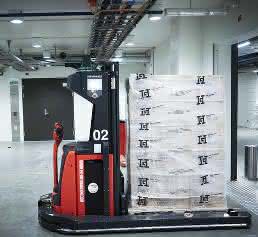
Based on the simulation created in advance, those responsible decided on the required number of AGVs to transport the flow of goods to the departure area automatically and as required along the route developed by EK Automation. The specialist from Rosengarten converted the corresponding standard forklift trucks for this purpose. These were supplemented by laterally mounted traverses and equipped with a system for automated control via laser navigation. The goods are transported on pallets from the airport's incoming goods area to the drop-off points. To collect the pallets, sensors transmit a signal to the vehicles, which automatically make their way to the stores with the desired products. The transport control system from EK Automation maintains constant contact with the vehicles at every point along the route.
The safety system with which the AGVs (Automated Guided Vehicles) have been equipped is unique. "The pallets that the transport robots move are protected by an innovative sensor solution. This stretches a light grid around the goods and immediately detects any access during transportation through the supply aisles. In this case, a message is sent and the transport robot moves to a checkpoint so that security staff can initiate the necessary measures," explains Felix Schad.
Tailor-made service plan, short response time
Another component of the project was a tailor-made service concept, which guarantees the duty-free store operators short response times in the event of service, including a rapid supply of spare and wear parts. EK Automation is available to the user from Oslo around the clock, seven days a week, via the hotline. If necessary, the specialists from Rosengarten are first called in via remote maintenance and decide whether they can help via a remote solution or whether a service technician is required on site. EK Automation uses a local partner for this, who can be on site within two to a maximum of four hours, depending on the time of day, to provide assistance. "It paid off that we involved and qualified this partner in the project at a very early stage. Initial use cases prove that our functional chain works smoothly in coordination with the customer and the local partner in the event of a service call," confirms Marco Bemmlotte, Head of Customer Relationship Management at EK Automation. pb


You might also be interested in
Conrad continues to grow
Conrad Electronic now generates 80% of its sales with business customers and has successfully developed from a traditional technology retailer into a B2B procurement platform. The company aims to become Europe's leading procurement platform for...
 read more...
AI finds its way into automotive customer service
In addition to computer solutions for vehicle diagnostics, Getac now also offers AI-based digital tools that support customer contact in service operations.
read more...SMC: "Preferred Supplier" from Bosch
The technology and service company Bosch has recognized SMC for the performance of its automation technology in factory and process automation and awarded it the status of "Preferred Supplier" in the material group "Standardized Pneumatic Devices".
read more...Combined ERP forces
The medium-sized ERP providers Step Ahead Software, Godesys and Informing merge to form the Step Ahead Group.
read more...Cybersecurity for asset-intensive companies
Forge Cybersecurity Platform, the new software platform from Honeywell, has been developed for the cybersecurity of asset-intensive companies and critical infrastructures. The platform is available in three versions.
read more...Automated machine tool as a success factor
Industry 4.0 is the hot topic of the moment. For small and medium-sized companies and contract manufacturers, it holds great potential for increasing production efficiency step by step. The focus here is on efficient and user-specific automation...
read more...Nemo hand vacuum lifts all materials
A new addition to the Eurotech portfolio is the battery-operated Nemo vacuum cleaner, which is suitable for handling almost all surfaces.
read more...Future-oriented cobot projects
Three pillars of successful cobot initiatives
What is important if cobot projects are to be future-oriented? Automation and robotics expert Omron has identified three aspects for human-machine collaboration.
read more...Short-stroke linear actuator instead of pneumatic cylinders
The new short-stroke linear actuator from Ketterer Antriebe and halstrup-walcher is characterized by high dynamics and a large stroke in a compact size. Thanks to the integrated electronics, the drive is easy to control compared to pneumatic...
read more...