
Education
The robot as a fellow student
The qualification requirements in the age of Industry 4.0 are increasing. Teaching complex interrelationships places new demands on training. Above all, sound knowledge of robotics and automation is essential. Karlsruhe University of Applied Sciences is preparing future engineers to meet these requirements.
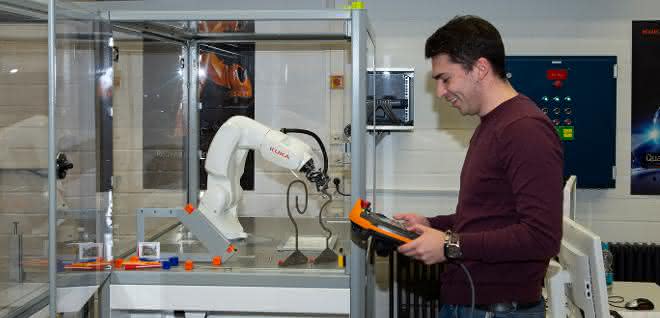
Since the 2018 winter semester, students at the university have had the opportunity to come into contact with state-of-the-art industrial robots in a cross-faculty robotics laboratory. In the newly created subject "Industrial Robot Lab", participants learn how to independently control and program Kuka robots. "The theory can be tested directly in practice and sound knowledge can be acquired, which is in great demand on the job market," says Prof. Dr. Christian Wurll from the Faculty of Economics at the Karlsruhe University of Applied Sciences - Technology and Economics.
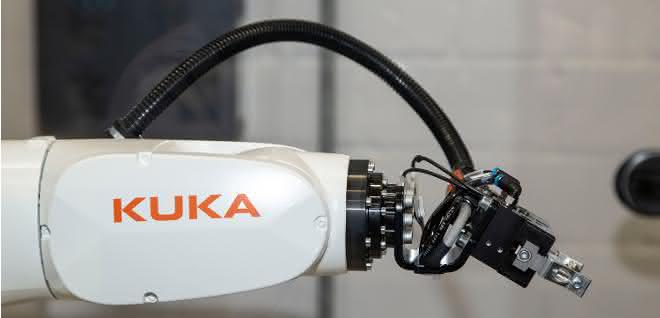
At the same time, the newly opened robotics laboratory will also maintain the attractiveness of the university. Training takes place on four ready2_educate training cells from Kuka. The mobile training cell is a complete package for teaching the basics of robotics and is aimed specifically at schools, universities and company training facilities. Each cell is equipped with the Kuka KR 3 Agilus small robot and the KR C4 compact controller. Thanks to its high flexibility and precision, the versatile robot is suitable for a wide range of tasks.
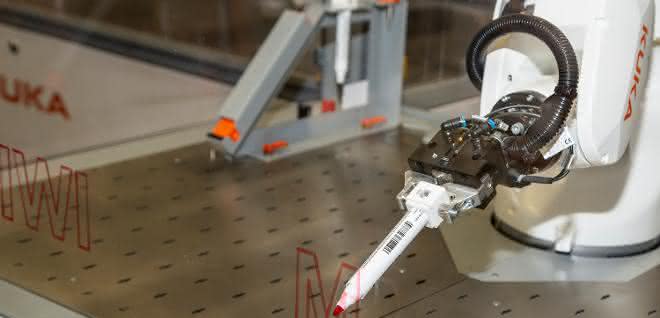
The robot is supplied directly with an integrated gripper and a range of workpieces such as cubes and pens. A selection of didactic training applications is also pre-programmed. The tasks in the available learning material are divided into three successive levels of difficulty.
Training cells promote collaboration
"Kuka's training cells make the complex technologies and processes of Industry 4.0 tangible," says Prof. Wurll. In a varied program of theoretical and practical units, students learn the basics of robot programming in small groups. In the last third of the semester, each group has to put what they have learned to the test in a project. Here, the students also have to contribute their specialist knowledge from other lectures, such as computer science or technical mechanics.
Every year, around 200 students from all faculties are given the opportunity to work on the training cells in robotics. The courses developed by Kuka to teach the basics of robot operation and programming enable students to carry out tasks such as palletizing and depalletizing cubes and tracing complex surfaces and contours. The control of external peripherals or the handling of events can also be implemented.
Based on these tasks, the students programmed the game "Four Wins" in the 2018/2019 winter semester, for example. In the game mode "Human vs. Robot", the robot moves all the game pieces according to the human's user input and the robot's game strategy implemented in Robot Language.
In addition to collecting points for the Bachelor's or Master's degree, the main focus is on the interdisciplinary exchange of knowledge. "By exchanging ideas with each other, students are introduced to working in an interdisciplinary team during their studies," says Prof. Wurll. In addition, after passing their exams, students have the opportunity to obtain an official training certificate from Kuka.
The great interest in the Kuka robots was already evident during the introductory event during the semester break. Convinced of the quality of the training cells, the feedback from the students was consistently positive. "The students were particularly enthusiastic about the wide range of tasks that enable a creative approach," says Prof. Wurll. There are already plans to expand the cells to include the topic of "industrial image processing" and to program the robots using the open source system "Robot Operating System". In the long term, not only the students and the university will benefit from the new training cells, but industry can also look forward to qualified and practically trained young engineers. J. Ratzka/as


You might also be interested in
Dr. Christina Franke is Engineer Powerwoman 2023
An independent jury, consisting of the members of the WomenPower congress advisory board, has chosen Dr. Christina Franke as Engineer Powerwoman. The announcement was made at the opening of the WomenPower career congress on April 21 in Hanover.
 read more...
Record sales and employee growth at Ziehl-Abegg
Ziehl-Abegg has published its annual figures for 2022. With a turnover of 873 million euros, the company increased by around 22 percent compared to the previous year. The number of employees rose to 5,100 globally and 2,800 in Germany.
read more...Turnover exceeds 4 billion euros for the first time
At the end of the 2021/22 financial year on June 30, 2022, the Trumpf Group recorded the highest turnover in the company's 99-year history with a strong increase in turnover of 20.5 percent to 4.2 billion euros.
read more...Companies have difficulties assessing their cyber risk
A new study by Trend Micro reveals that 54 percent of companies worldwide are dissatisfied with the maturity of their cyber risk assessment capabilities.
read more...New Head of Finance at Mapal
Matthias Cöster has 14 years of professional experience as CFO.
read more...Matthias Lapp becomes Chairman of the Management Board
The Lapp family business will be managed by the third generation from October 1. Matthias Lapp, grandson of company founder Ursula Ida Lapp, takes over as CEO of Lapp Holding.
read more...Compact computer for industry
As a versatile and compact computer, the Raspberry Pi is also interesting for industry. However, appropriate adaptations to the harsh production environment are necessary to bring the Raspberry Pi world into factories.
read more...Full power in a double pack
From September 22 to 26, 2021, the "EuroSkills", the European Skills Championships, will take place in Graz, Austria.
read more...Gregor Langer takes over the management of RK Rose+Krieger
Hartmut Hoffmann, who has managed the business of RK Rose+Krieger since 2008, is retiring on June 30. His successor from July 1 will be Dr. Gregor Langer.
read more...