

Robotics for SMEs
Network "Fence-less lightweight robotics" launches
SMEs often lack expertise in the use of cobots, and risk assessment is also complex. These challenges are being addressed by the expert network "Lightweight robotics without safety fences" at the Augsburg SME 4.0 Competence Center.
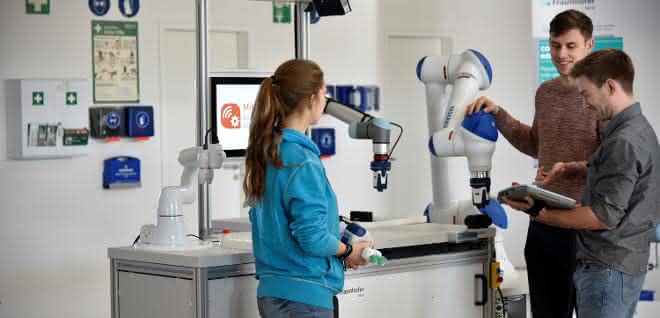
Thanks to their integrated sensor technology, lightweight robots can work together with employees as cobots without a safety fence, are comparatively small and can be easily moved to different workstations due to their low weight. Programming is also no longer as complex as it was a few years ago.
However, small and medium-sized companies often need support to be able to exploit this potential in their operations: after all, they often have less specific expertise in-house compared to larger companies. In particular, the application of standards and the associated pressure and force measurement (TS 15066) and risk assessment pose a major challenge. The CE marking of the entire application is currently still quite complex, and a change often requires re-certification.
Sometimes it is recommended to use a system integrator. There are hardly any useful guidelines on how the flexible use of lightweight robots can be implemented efficiently and is compatible with existing standards. Julia Berg, one of the initiators of the expert network, therefore has a particular focus on user companies: "Little has happened in recent years to ensure that lightweight robots can be used flexibly - which they already could technologically. That's why we in the expert network want to push ahead with a possible design of the risk assessment and the classification of tools and workpieces in order to enable a more uncomplicated use, especially for medium-sized companies."
Working groups draft recommendations for action
The first working group in the "Lightweight robotics without safety fences" expert network is now dedicated to the risk assessment of robot applications for mobile use. Issues such as the simplification of risk assessment procedures, the definition of when a change to the system is considered a change and more efficient measurements in accordance with TS 15066 play the main role here. Qualification profiles for the various roles and tasks and, for example, a checklist for the relocation of robots are also to be developed.
The second group on the certification and classification of components is developing a procedure for streamlining the risk assessment process with CE-certified components and classified parts. When can components be considered safe? Which components on the current market are suitable for this? Can workpieces be classified?
Answers are to be developed in coordination with the applicable standards. After a primary work phase until July 2021, recommendations for action are to be developed on how the standards and legal situation for lightweight robots can become more practical, how user companies can approach the use of cobots sensibly without losing heart in the certification jungle and how manufacturers can prepare for the implementation process. In addition, a demonstrator will be set up to illustrate the topics covered.
Join the expert network
In the working groups, manufacturers, research institutes and user companies from different sectors and of different sizes work together to utilize the experience of others and jointly address gaps. Contacts to the relevant DIN committees provide good connection points. Small and medium-sized companies can still participate, according to the press release. as


You might also be interested in
Protection against electrostatic discharge
StoFloor ESD KU 614 from StoCretec: dissipative flooring with the latest technology meets all ESD standards, is economical, extremely durable, mechanically and chemically resistant. The surface can be adjusted to be slip-resistant. The system is...
 read more...
Cables and wires from Helukabel
Food cultivation on a new level
Vertical farming - cultivation in multi-storey greenhouses - is considered one of the most exciting trends in food production. One of the pioneers in this field is the Romanian start-up Ultragreens. The company relies on solutions from Helukabel to...
read more...Further training for specialists to become security experts
With the "CESA - Certified Expert for Security in Automation" qualification, automation expert Pilz offers a two-day expert course designed to provide participants with compact security knowledge in line with the latest standards.
read more...Meaningful data on the service life of the seal
Seals prevent substances from penetrating or entering technical components. The intelligent seals from Freudenberg Sealing Technologies can significantly expand this core task in the future: the seal itself is also a sensor and becomes a "smart...
read more...Online stud configurator according to drawing
For standard bolts, with head, thread or hole
For standard bolts, with head, thread, bore or as a version with recess, mbo Osswald configurators map the standard specifications, are very easy to use, take a lot of work off the user's hands and save a lot of time.
read more...Safe palletizing with the Cobot
Verla-Pharm's medicinal products and food supplements have been available for decades. Ever-increasing throughputs result in ever-increasing logistics costs, whereby optimum utilization of the available production space is necessary.
read more...The tiger among processors
Since the move towards the Industrial Internet of Things (IIoT) and Industry 4.0 has picked up speed, processor boards and modules must be able to process exponentially growing amounts of data.
read more...VDWF publishes "Sustainability Compendium"
Nowadays, nobody can avoid "sustainability": In addition to a far-reaching presence in the media, it is also becoming increasingly important for companies in the tool and mold making industry to develop and implement appropriate concepts.
read more...More transparency and synergies with QM software
Weber, manufacturer of wood and metal sanding machines and extruders, has reorganized its quality management with ConSense IMS Professional. The software solution enables transparent documentation and more efficient processes.
read more...