

Interview with Thomas Pilz
Successful entry into the world of robotic modules
Pilz is celebrating its 70th anniversary this year. The automation company is changing with the times and is now also addressing the topic of service robotics. Handling editor-in-chief Petra Born spoke to Managing Partner Thomas Pilz.
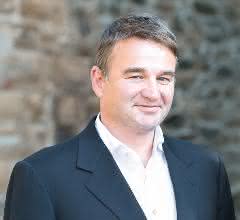
Mr. Pilz, you and your company were represented at Automatica for the first time this year as a provider of service robotics modules. How did the trade fair visitors react to this?
I can be pleased about a very successful entry into the world of robotics modules. The trade visitors were enthusiastic about the coherence of our range. "You'd think Pilz has never done anything other than exactly what we presented," they told us. We were able to show how products from well-known robot manufacturers, such as Yaskawa, interact with our modules. The Yaskawa manipulator, which was integrated into our Smart Factory, took over the HRC: It safely handed over its workpiece - our USB stick - to the customer. In this way, we were able to show how our modules, together with products from other manufacturers, represent a feasible solution for the customer.
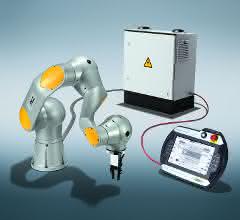
You have initially added the manipulator, the control module and the operating module to your portfolio. What other modules are to follow?
We also presented the first ROS module in Munich. ROS is a popular and widely used operating system from research, which is already increasingly being used by companies in the AGV (automated guided vehicle) sector to combine different components on an AGV. These first ROS modules will not be the only ones, but products such as the configurable small controller PNOZ multi or our safety laser scanner PSENscan will also be modulated in ROS in order to provide customers with additional modules.
With the modules, you want to give users the opportunity to put together their own small robots, for example for pick-and-place tasks or for semi-automated small robot cells. Which end effectors do you offer for this? Are mushroom grippers coming soon?
Not really. But there are grippers from different manufacturers that our arm can ideally accommodate. It is good practice to integrate modules from experts. And this is where ROS saves an enormous amount of time. You already have modules: an arm, a gripper, which the user can put together in a ROS simulation. This is extremely interesting for all non-robotic areas! Let's take an example: a company with around 50 employees, including young employees with a university background and previous knowledge of ROS, can use it to automate an intralogistics process with its own possibilities. An AGV and a robot arm - which can be from Pilz or another manufacturer - can be used to put together a small automation system that increases mobility. The small company does not have to rely on a complete manufacturer.
In other words, a simple, mobile service robot from the modular system. Who do you have in mind as the target group for such an application?
I hope that this modular system will attract the interest of small companies that want to automate better, make processes more efficient and be more agile. We at Pilz are like a start-up in this area, and start-ups like to take care of customers who don't usually fit the mold of a large company. We have now prepared everything so that the customer can put together their own robotic system from the modules. Or they can also make use of our services and support if they need us - be it for CE approval or commissioning. I am convinced that Pilz can be a very competent and reliable partner, especially for a smaller company involved in robotics.
It's also important that we at Pilz don't just look at industrial applications that we know! We have to think outside the box and find manufacturers for solutions in laboratory automation, hospital automation, personal care, hobby, etc. Because service robot modules from Pilz should be used both in industry and beyond.
How long can you hold out from being seen as a robot manufacturer with your new product area?
Our focus is clearly on the modules. However, if at some point we were forced to list the entire robotics service as a machine in our product catalog, then we would be a robot manufacturer.
What would the other robot manufacturers - who are also your customers - say?
If someone really wants to see us as competition, then they will already do so today. But we have a clearly tailored focus - these are modules for service robotics in the industrial and non-industrial sectors, designed for mobility. I would be very pleased if our offer were to be accepted by all those who offer mobility, so that many AGVs drive with our arm. We also offer machine builders that Pilz does not necessarily have to be on the entire machine.
Can you give me an idea of how long your company has been focusing on service robotics?
Six years ago, when my mother Renate Pilz, my sister Susanne Kunschert and I discussed and defined this topic, service robotics was already defined as a future area.
As an automation specialist with safety as its core competence, your focus is on safeguarding the cooperation between man and machine, including safeguarding the dynamically changing work areas brought about by HRC. In this respect, it seems logical to me that Pilz is concerned with robotics as such. Do I see that correctly?
It's a very logical step if you look at the complexity of the control technology. We made a conscious decision in favor of robotics and have received positive feedback that this is the logical next step for our company. It is important to me to emphasize the openness of our modules: If a system integrator in the industrial sector has its own arm but no controller, then it is welcome to add our controller functionality. That would be a wonderful success, because modularity is the be-all and end-all for us.
You see industrial robotics as one of the most important target applications for Pilz, without wanting to neglect the component business in safety technology. What could the weighting look like in future?
One does not exclude the other. Safeguarding robot lines has always been the focus of our safety component sales. Service sales, on the other hand, have focused on solutions. We do not want to neglect this core business, but at the same time it is the task of sales to establish our service modules as a second mainstay. We want to be well established in this area by the next Automatica in two years' time. In other words, we want to have met our own market launch targets.
In your opinion, what is the status of the concrete implementation of service robotics in current production? Do we still see too many "sample applications" instead of real applications?
We will use this technology in our own production, so we can offer solutions based on our own experience. Service robotics is unstoppable.
It's about other improvements on the line, not about speed per se. This is a paradigm shift in production!
That's right. Service robotics and HRC must be built into modern line planning right from the start. With regard to the stations at which workstations are possible that function safely and productively. The aim here is not to reduce cycle times!
So the assembly structure and process definition will have to be different in future?
That is the conclusion. The overall concept starts with factory and plant planning, i.e. right at the beginning. I can't simply include HRC at a later stage. However, HRC can be easily integrated where I am working in the area of flexible production with medium quantities and high model changeovers. We now have a great deal of specialist knowledge, it is constantly growing, and we have to apply it now.
You want to grow with the topic of service robotics. Does that mean you are also thinking about acquisitions?
We at Pilz want to maintain reliable supplier partnerships. We want to network for mutual benefit. That is our basic entrepreneurial attitude. If an acquisition would make sense, then my sister Susanne Kunschert and I will decide whether we want to do this.


You might also be interested in
Fraunhofer IOSB Opens Humanoid Robots Lab
The Fraunhofer IOSB is opening a Humanoid Robots Experience Lab in Karlsruhe, Lemgo, and Ilmenau. Companies and organizations can use these facilities to test potential applications for humanoid robots and develop pilot projects.
 read more...
Artificial Intelligence in Manufacturing
Trumpf and IPAI Are Expanding a European AI Network for Industry
The high-tech company Trumpf is an official partner of the IPAI AI network in Heilbronn. Together, the partners aim to exchange experiences, develop new AI applications for industrial use, and advance the development of artificial intelligence in...
read more...Case Study: Networked Manufacturing Platform for Toolmaking
Using a networked manufacturing platform, Escha GmbH & Co. KG, a manufacturer of industrial fastening technology, has comprehensively modernized its toolmaking operations.
read more...Barcelona Declaration on Robotics and...
Robotics Associations Adopt Global Automation Strategy
The global robotics industry is stepping up its collaboration. The associations AER Automation, A3, IFR, and VDMA Robotics + Automation have formed a long-term alliance by signing the “Barcelona Declaration on Robotics and Automation 2026.” The...
read more...Jane Heffner is the new president of the International Federation of Robotics
Jane Heffner is the new president of the International Federation of Robotics. Adrien Brouillard has been appointed vice president of the global federation.
read more...Greater Transparency in the Robotics Market
RoboFinder Launches as an Independent Comparison Platform
Launch at Gitex Europe: 'RoboFinder' aims to bring more transparency to the professional service robotics market. In this interview, founder and CEO Brian Engels discusses market potential, challenges, and the goals of the new platform.
read more...Artificial Intelligence for the Physical Space
Alibaba Expands Qwen Model Family with a Robotics Suite for Physical AI
Alibaba is expanding its Qwen model family with a robotics suite for Physical AI. The three models—for manipulation, navigation, and simulation—are designed to assist autonomous robots with complex tasks in real-world environments.
read more...International Federation of Robotics
U.S. Robotics Industry Sees Double-Digit Growth
In the U.S., sales of industrial robots rose by 11% compared to the previous year: 38,000 units were newly installed in 2025. This significant recovery is driven by robust growth in the food industry and other non-manufacturing sectors. However, the...
read more...Development Collaboration for Humanoid Robotic Hands Launched
Schunk is entering into a new development partnership with Robert Bosch Robotics. Their shared goal is to develop an industrial-grade robotic hand that can be integrated into various humanoid robot systems.
read more...