
Schunk Expert Days on Service Robotics
Service robotics conquers factories and living rooms
At the tenth Schunk Expert Days on Service Robotics, it became clear that there are more and more intersections between industrial robots, transport systems and smart assistants for commercial and private use. On the other hand, success in service robotics is increasingly determined by the willingness to form networks and cooperate.
The top speaker that Managing Partner/CEO Henrik A. Schunk welcomed to the stage at the start of the Schunk Expert Days was just under 60 centimeters tall: Nao is the name of the humanoid robot, which has more than 25 degrees of freedom and can move its hands, arms, legs, head and torso almost like a human. Connected to IBM Watson, Nao, a demonstrator of artificial intelligence, is able to analyze natural language and give answers independently. Visual recognition tools can also be used to recognize faces and objects and analyse them for specific characteristics.
Success through cooperation
In his keynote speech, Prof. Dr. Thomas Bauernhansl from Fraunhofer IPA used the example of Arena 2036 to illustrate how important cooperation between different disciplines will be in the future in order to solve the complex tasks of tomorrow's production. As the leading research platform for mobility in Germany, Arena 2036 has set itself the goal of rethinking and implementing the entire value chain of the fully digitalized vehicles of the future.

More than 30 partners, from suppliers and IT service providers to car manufacturers and various research institutions, are working together on the areas of mobility, production, work and digitalization. Topics include the use of swarm intelligence in intralogistics, the use of mobile platforms to load machines, as well as the substitution of material flow with information flow. This also includes shifting process complexity to where it can be handled most efficiently, says Bauernhansl. Open source communities in particular, such as the ROS software framework, digital twins or their preliminary stage, digital shadows, as well as the use of systems for data analytics, are important enablers of new types of production scenarios.
Trend towards autonomous systems
Prof. Dr. Sami Haddadin, winner of the Deutscher Zukunftspreis 2017, Prof. Jiping He from the Beijing Institute of Technology (China), Dr. Minas Liarokapis from New Dexterity, a research institute for robotics and bionics at the University of Auckland (New Zealand) and Prof. Dr. Torsten Kröger from KIT, among others, described the path to autonomously operating grippers and handling systems.
The intralogistics sector in particular is currently experiencing a boom in service robotics and is working intensively on intelligent solutions. The presentations by Magazino, DHL, Robert Bosch Startup and Fetch Robotics illustrated how efficiency in large warehouses can be increased with the help of autonomous transport platforms and cloud systems and how the development process from the idea to the market-ready collaborative system can be achieved.
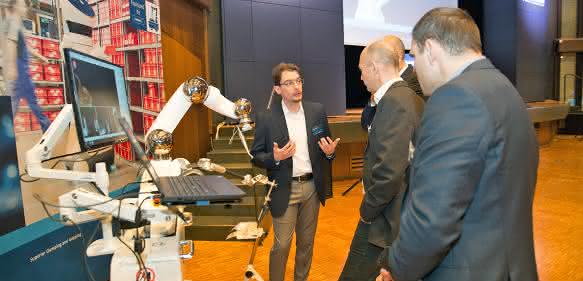
Yvonne Straube from BMW gave an insight into the car manufacturer's research activities, which range from the use of virtual assistants and exoskeletons to the use of robots as hand-guided tools. Similar to the presentation by Søren Peter Johansen from the Danish Technological Institute, BMW also made it clear that service robotics will be an effective way to support and relieve humans in production, for example in parts handling or assembly tasks, without replacing them. On the contrary: robots secure and create jobs, as processes can be designed much more efficiently. Søren Peter Johansen reported that there is now a real bottom-up movement in Denmark: Workers who have recognized the advantages of collaborative systems are calling for their introduction instead of rejecting them out of unfounded fears.
Next year, the Expert Days in Service Robotics will take place outside of Germany for the first time, namely in Denmark: on February 27 and 28, 2019 in Odense. as


You might also be interested in
ESTIA aims to strengthen Europe's cloud
New tech alliance for EU sovereignty
Twelve companies, including Dassault Systèmes, are founding the European Sovereign Tech Industry Alliance (ESTIA). The initiative aims to strengthen Europe's technological independence and define requirements for sovereign cloud services. The start...
 read more...
Deutsche Telekom and Nvidia launch one of Europe's largest AI factories
With the Industrial AI Cloud in Munich, Deutsche Telekom and NVIDIA are creating one of the largest AI factories in Europe. Companies can train AI models, carry out simulations and access 10,000 GPUs.
read more...Leveraging data potential with AI and streaming
Huge data treasures are still lying dormant in many manufacturing companies. And yet it is high time that these treasures were unlocked. There is often a lack of resources and capacity to make data usable in real time. Streaming production data can...
read more...More awareness of noise
Dematic offers solutions that are tailored to different cloud environments and reduce environmental impact through reduced material consumption and improved energy efficiency.
read more...Generative AI in the automation environment
The mechanical engineering and automation industry is undergoing profound change. This transformation is being driven by more volatile global trade, geopolitical crises and increasing market pressure, which demands greater agility, technological...
read more...Rigid data structures have had their day
The traditional data center is no longer the center of data. A hybrid cloud storage approach enables manufacturing companies to both meet the current requirements of data-intensive processes and future-proof their infrastructure.
read more...Software as a service in three stages
CIM Database Cloud is a new out-of-the-box solution from Contact for end-to-end digital product development.
read more...How production can benefit from AI
Together with AI technology, IIoT networking makes it possible to better control machine parameters and optimize quality with predictive quality. Downtimes and set-up times can also be further minimized. Cloud platforms also make these technologies...
read more...More expertise for digital engineering
Altair, a computational science and artificial intelligence (AI) company, has acquired OmniV, a technology from Michigan, USA-based software company XLDyn.
read more...