
Highest accuracy for measurement technology
Sensitive and independent
Automated calibration of measuring equipment. The sensitive Kuka robot LBR iiwa automates the calibration process for measuring equipment of different sizes at Perschmann Calibration.
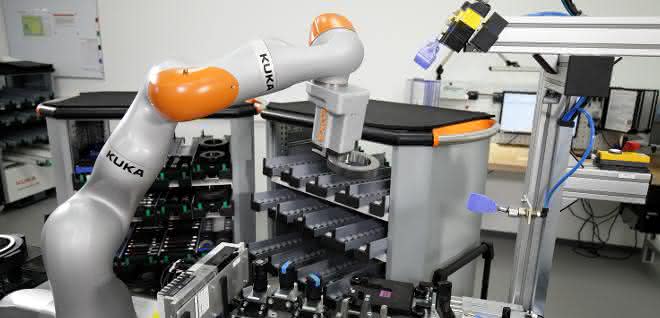
In metrology, the only thing that counts is maximum precision - in itself ideal conditions for the use of robots. For efficient utilization, however, they must be able to grip objects of different sizes without damaging them. At the metrology specialist Perschmann Calibration, the Kuka LBR iiwa robot takes over the loading of a coordinate measuring machine (CMM) and thus automates the calibration process. The measuring equipment is equipped with codes that tell the system which measurements are to be taken.
"A human hair is about 50 micrometres thick, the threads of a spider about five micrometres. The accuracy with which we calibrate measuring equipment at Perschmann Calibration is around 0.5 micrometres," explains Dr. Detlef Rübesame, Head of Technology at Perschmann Calibration. The calibration service provider from Braunschweig specializes in the calibration of manual measuring equipment, including high-precision testing of gauges such as mandrels and setting rings. The measuring equipment must be calibrated at regular intervals. The company's customers come from the traditional mechanical engineering, automotive and aircraft construction sectors and use the measuring equipment to ensure the quality of their production processes.
It's all about maximum accuracy
Measuring equipment must be calibrated regularly in accordance with ISO 9001 standards in order to meet international quality standards. In the calibration process, values are measured so precisely that even small dust particles can influence the measurement. The temperature also influences the result of the measurement. For this reason, not only is the temperature in the measuring room kept constant, but the measuring equipment itself is also air-conditioned for a defined period of time
Medium-sized companies like Perschmann Calibration are constantly on the lookout for forward-looking solutions in order to remain competitive in their field of business. "The company Hexagon, which also supplies the coordinate measuring machine, presented us with a concept in collaboration with Kuka on how we can automate our calibration process and thus calibrate many different measuring devices in a shorter time in an even more customer-friendly way. We took up the idea straight away," reports Detlef Rübesame. The Flex-Fellow solution, on which the sensitive LBR iiwa (intelligent industrial work assistant) is installed, has been in place at Perschmann Calibration for a good year now. It can sensitively pick up various measuring devices from a material supply trolley and feed them to the Hexagon CMM for calibration. The robot, which is also suitable for human-robot collaboration (HRC), works in three-shift operation.
Full automation through Industry 4.0 elements
"The ultra-high-precision Leitz PMM-C is ideal for demanding measuring tasks. With increased accuracy in the lower sub-micrometer range, various measuring devices are reliably calibrated," says Felix Balzer, Manager R&D Sensors and Machines at Hexagon Manufacturing Intelligence. The advantages of the robot-based application for Perschmann are manifold: the process is shortened and the calibration process can be more customer-oriented, as collective processing of different measuring devices is no longer a problem with the lightweight robot. "Automation makes sense, as we work with very large quantities. The system is also set up so that it can work autonomously for longer periods of time," explains Detlef Rübesame. An important question in the planning for the production changeover was how the CMM and the LBR iiwa could recognize and assign the many different geometries of the measuring equipment. The measuring equipment itself solves this challenge by controlling the measuring process. Equipped with a data matrix code, it forwards all important information such as measuring equipment type or diameter to the CMM. Using this special data matrix code (DMC), the CMM can initiate the measurement independently; the intervention of an employee is no longer necessary.
The second major advantage of the system is that the robot recognizes when a compartment is empty and then independently moves to the next full one. This is a real added value, as the robot can work autonomously through the night shift.
Handling of various measuring equipment
The Flex-Fellow is a complete solution consisting of a robot platform on which the HRC-capable LBR iiwa robot is mounted. Two transport units with forklift pockets are available for this purpose. In the first work step, the LBR iiwa moves to the first transport unit and checks whether there is measuring equipment in the individual chutes. It then removes them and feeds them to the reader in the correct position. In addition to scanning, the measuring equipment is also blown off with air in order to remove any dust and prevent the measurement from being falsified. Once the system has recognized which measuring device is involved, the robot clamps it in the clamping device. The CMM then begins the calibration process. When this process is complete, the robot picks up the measuring device again and places it in the second transport unit. Meanwhile, the information about the calibration process is transmitted to a computer, where the certificate for each component is created. pb


You might also be interested in
Plagiarius 2024 negative prize
On January 26, 2024, the Plagiarius campaign awarded its dreaded "Plagiarius" negative prize for the 48th time to manufacturers and retailers of particularly brazen counterfeits and fakes.
 read more...
Ivalua honors winners of the Generative AI...
AI-supported "add-ons" for buyers within 48 hours
Ivalua, provider of cloud-based spend management solutions, announced the winners and innovations of the first Generative AI Innovation Cup. The competition took place in December 2023. It was open to all Ivalua partners and employees - more than...
read more...Efaflex celebrates 50 years of high-speed...
The emphasis is on "fast"
Since day one, Efaflex has wanted to use new technologies as early as possible and drive progress in the industry. This year, the family business is celebrating its 50th anniversary under the motto "Fast Forward".
read more...Security of supply even during power outages
In the winter of 2022, Germany was worried about energy shortages. The drugstore retailer dm did not paint any horror scenarios, but nevertheless saw the possibility of controlled, temporary, regional power cuts (brownouts).
read more...Safety technology in mechanical engineering
Modules with new functions
Euchner's product highlights at EMO 2023 include the communication-capable solenoid interlocks.
read more...Transforming the paper industry towards climate neutrality
Together with partners from industry and research, Voith is developing a project for the optimization of energy and material flows in paper production. The aim of the research project is to develop a digital framework that enables effective process...
read more...Up to 95 percent less flue gas thanks to direct extraction
The requirements for occupational safety measures and safety technology are also constantly increasing in welding technology. The Technical Rules for Hazardous Substances (TRGS) stipulate that welding fumes and harmful substances must be extracted...
read more...Competitive advantages with large machines
Whether 3D-printed components for machines and systems, prototypes or aids for design: additive manufacturing is almost indispensable for modern companies in mechanical and plant engineering and automation if they want to play in the premier league.
read more...Transport technology from the modular system
Many transport tasks can be realized with the help of linear technology. Pre-configured solutions are available to simplify the interaction between the linear unit, motor, gearbox and controller. This minimizes the effort required for research and...
read more...