
Schunk User and Technology Day
In focus: MRK improves ergonomics
How can human-robot collaboration be used in everyday production? What safety concepts are there? How to get started? - These topics were the focus of the second Schunk User and Technology Dialogue. Above all, the ergonomic facilitation of everyday work will become a central aspect of HRC in the future.
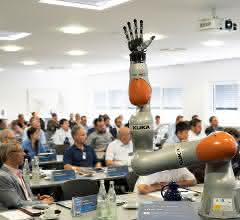
The topics of the User and Technology Day on the subject of "Successfully introducing human-robot collaboration in companies" were as diverse as the participants. The leading robotics companies were represented, as were system integrators, representatives from the automotive industry, mechanical and plant engineering, research and the supplier industry. The imminent robotics revolution is equally important to technologists, process managers and works councils. Above all, the practical relevance proved to be a valuable focus of the event.
Partial automation is gaining in importance
According to Prof. Dr. Markus Glück, Chief Innovation Officer (CINO) and Managing Director of Research and Development at Schunk, four goals dominate the current discussion when it comes to the introduction of HRC: improving ergonomics, making work processes more flexible, increasing efficiency and optimizing logistics, handling and loading processes. HRC scenarios are particularly effective with medium variance, medium quantities and medium throughput. Instead of fully automating processes, partial automation is playing an increasingly important role. "HRC means synergistically combining the strengths of humans and the strengths of robotics," emphasized Glück.
Sebastian Höpfl, Head of Product Management Gripping Systems at Schunk, explained how HRC applications can be designed to comply with standards and be cost-effective at the same time. Even if the standards are easy to master, the greatest challenges lie in the practical implementation and, in particular, in the validation of transient contact in accordance with ISO/TS 15066. It makes sense to contact the certifying organizations, such as the employers' liability insurance association, TÜV or Dekra, as early as possible and discuss the planned applications.
In general, he advised avoiding over-engineering when getting started with HRC. Applications with safe stops, manual guidance or speed and distance monitoring are often much easier and quicker to implement than complex applications with force and power limitations. And you learn much faster in the process. Helmut Schmid, Managing Director & General Manager Western Europe at Universal Robots, also advised a pragmatic approach to standards and safety. "Products must be simple and flexible," was his credo.
User-friendliness and machine intelligence
Dr. Albrecht Höne, Director Human Robot Collaboration at Kuka, sees human-robot collaboration as a key to making production more flexible. The goal is spontaneous, flexible and scalable automation. Höne advises dividing the HRC process into different sections and providing them with different safety functions. In this way, Kuka realizes applications in gearbox assembly, gap dimension testing, friction welding or plug setting, for example. Looking ahead, he believes that there is potential in the development fields of "easy to use" and "deep learning" in particular.
Dr. Daniel Meixner from GTE Industrieelektronik presented how the biometric limit values according to ISO/TS 15066 can be determined and tested in practice. He presented load cells with special springs and damping elements as well as methods for measuring pressure.
Involving employees in HRC projects at an early stage
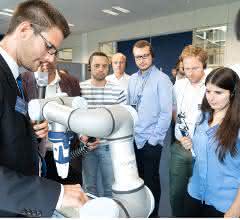
Tea Barisiç from the Corporate Innovation department at Kuka in Augsburg made it clear that the focus of HRC projects must be on people as well as technology. Based on interviews at HRC workplaces, she explored the question of how human-centered automation can succeed. Barisiç advised creating a college environment for employees to learn how to use HRC systems in a playful way and without pressure, thus building trust in the new technology.
She recommended involving works councils, health and safety officers and individual employees in the planning process at an early stage. With this in mind, Markus Glück also summarized at the end of the event: "Making life easier for people will be the great added value of HRC." He went on to emphasize: "We have to start with HRC, because we are facing demographic change. Thousands of employees will soon be retiring and we need to recruit new talent now." as


You might also be interested in
Protection against electrostatic discharge
StoFloor ESD KU 614 from StoCretec: dissipative flooring with the latest technology meets all ESD standards, is economical, extremely durable, mechanically and chemically resistant. The surface can be adjusted to be slip-resistant. The system is...
 read more...
Cables and wires from Helukabel
Food cultivation on a new level
Vertical farming - cultivation in multi-storey greenhouses - is considered one of the most exciting trends in food production. One of the pioneers in this field is the Romanian start-up Ultragreens. The company relies on solutions from Helukabel to...
read more...Further training for specialists to become security experts
With the "CESA - Certified Expert for Security in Automation" qualification, automation expert Pilz offers a two-day expert course designed to provide participants with compact security knowledge in line with the latest standards.
read more...Meaningful data on the service life of the seal
Seals prevent substances from penetrating or entering technical components. The intelligent seals from Freudenberg Sealing Technologies can significantly expand this core task in the future: the seal itself is also a sensor and becomes a "smart...
read more...Online stud configurator according to drawing
For standard bolts, with head, thread or hole
For standard bolts, with head, thread, bore or as a version with recess, mbo Osswald configurators map the standard specifications, are very easy to use, take a lot of work off the user's hands and save a lot of time.
read more...Safe palletizing with the Cobot
Verla-Pharm's medicinal products and food supplements have been available for decades. Ever-increasing throughputs result in ever-increasing logistics costs, whereby optimum utilization of the available production space is necessary.
read more...The tiger among processors
Since the move towards the Industrial Internet of Things (IIoT) and Industry 4.0 has picked up speed, processor boards and modules must be able to process exponentially growing amounts of data.
read more...VDWF publishes "Sustainability Compendium"
Nowadays, nobody can avoid "sustainability": In addition to a far-reaching presence in the media, it is also becoming increasingly important for companies in the tool and mold making industry to develop and implement appropriate concepts.
read more...More transparency and synergies with QM software
Weber, manufacturer of wood and metal sanding machines and extruders, has reorganized its quality management with ConSense IMS Professional. The software solution enables transparent documentation and more efficient processes.
read more...