
New research software
Students conduct research with cobots
Rethink Robotics has introduced the new Software Development Kit (SDK) for its cobot Sawyer. The software upgrade was developed for scientists and students to test programs on Sawyer. The software includes improved compatibility with ROS and the latest open source robotics tools.
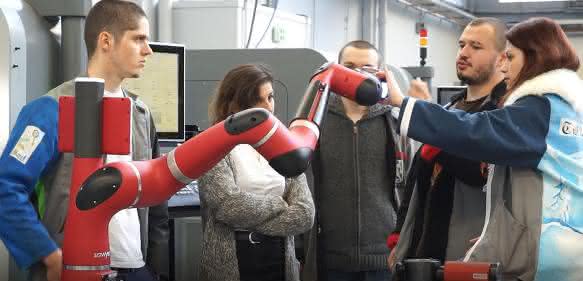
Sawyer SDK is designed to provide scientific research teams worldwide and corporate research and development departments with a range of application possibilities. The kit includes a number of advanced features that allow the user to visualize and control the robot's interaction with its environment. The software integrates with the widely used Gazebo simulator, which simulates the robot and its interaction with the environment and allows researchers to test programs in simulation before running them on the robot. Sawyer's integration with Gazebo is completely open-source based. This allows students to run simulations from their laptop until they are ready to test the programs in real time on the robot.
In addition to the Gazebo connection, Sawyer SDK also includes a new motion interface that researchers can use to program the robot in Cartesian space. This enhancement simplifies motion planning even for programmers without a dedicated robotics background. The software update enables scientists to use resistance and force control even more effectively. Sawyer SDK also supports the ClickSmart gripper set, which is part of the fully integrated robotics solution.
Robotics degree programs and research programs
"Rethink Robotics' robots are used in the world's most prestigious research institutions. This provides us with valuable feedback on what our research customers really need," said Scott Eckert, President and CEO of Rethink Robotics. "As with all of our SDK releases, our goal is to set the standard with industry-leading features that enable universities and corporate R&D departments to advance robotics and publish their research results faster."
Research institutions in the USA and Europe are using Sawyer SDK in their robotics courses and research programs, including Stanford University, the University of California at Berkeley, the École National Supérieure des Arts et Métiers (ENSAM) in France and the German Research Center for Artificial Intelligence (DFKI). The Vision and Learning Lab at Stanford University, for example, is working on equipping robots with different capabilities for both industrial and private use.
"Robotics is a field that combines technological and engineering skills with creativity. The ingenuity of our students in terms of what you can do with the robots is really incredible," says Dr. Animesh Garg from the Department of Computer Science at Stanford University. Animesh and his team have Sawyer perform tasks based on virtual reality (VR) input, automatically breaking down the applications into simpler components. They also teach Sawyer to use tools such as hammers or screwdrivers.
The software development kit will be available for all Sawyer cobots from March 2018 and will provide access to both the Intera manufacturing software and the SDK software. as


You might also be interested in
Hamburg Regional Court issues preliminary injunction against Elite Robots Germany
In the copyright dispute between Teradyne Robotics and Elite Robots Germany, the Hamburg Regional Court has issued an interim injunction. The distribution of the software and products concerned is prohibited, and there is also a comprehensive...
 read more...
Schunk founds tech spin-off for humanoid robot hands
Schunk is bundling its activities in humanoid robotics by founding its own spin-off at the beginning of January. The aim of the new company is to develop modular humanoid robot hands for industrial applications.
read more...Partnership for humanoid robotics
Schaeffler and Neura Robotics jointly develop humanoids
Schaeffler and Neura Robotics will work together in the future to develop and supply key components for humanoid robots. The systems will also be integrated into Schaeffler's global production network.
read more...Yaskawa at the Automatica 2025
AI meets robotics
At this year's Automatica, everything at Yaskawa revolves around AI-based robotics solutions for the smart factory and beyond. As a trade fair highlight, the manufacturer is presenting its new Motoman Next product concept.
read more...Kassow Robots at the Automatica
7-axle vehicle in action
At Automatica, Kassow Robots will be presenting a wide range of industrial applications for production and logistics tasks that provide new impetus for efficiency and flexibility in industrial automation.
read more...Robotics and automation in six exhibition halls
From June 24 to 27, 2025, Automatica, the trade fair for intelligent automation and robotics, will bring industry and research together in six exhibition halls. Preparations are in full swing.
read more...Interview with Jörg Rommelfanger
Robotics in 25 years
The annual IFR report shows that the number of industrial robots is steadily increasing worldwide. They have already played an important role in ABB's portfolio for decades. In an interview with INDUSTRIAL Production, Jörg Rommelfanger, Head of...
read more...Reliable end effector for cobots
Collaborative robots are now widely used for a wide range of handling tasks. SMC offers three versions of the RMH pneumatic gripper for this purpose; it is compatible with cobots from a total of twelve companies.
read more...7-axis cobots with controller in robot base
With the Edge Edition, Kassow Robots has launched the world's first 7-axis cobots with a controller integrated into the robot base.
read more...