
Rope robotics
Endless revolutions
Rope robot with an endless axis of rotation. Rope robot systems are being researched at the ISW at the University of Stuttgart, including a rope robot with an endless axis of rotation. The use of ropes as driving elements opens up new application possibilities, particularly for extended handling tasks.
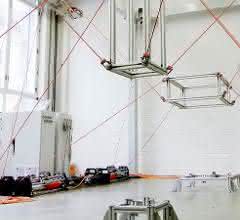
Rope robots are special types of parallel robots and mechanisms. In conventional parallel robots, rigid joints are used as drive elements, which are replaced by ropes in cable robots. Probably the best-known application of a parallel cable robot is the SpiderCam (spidercam.tv), which consists of a camera system that is moved with four cables over the surfaces of stadiums, concerts or other major events. In addition to applications in the entertainment industry, cable robot systems can also be used as industrial handling systems, for example to transport objects in a highly dynamic manner.
Several test rigs have been set up at the ISW for the experimental investigation of rope robots. The basic components of one of the rope robots available at the institute consist of ropes as force-transmitting elements, winches for winding and unwinding the ropes, the frame for attaching the winches, an industrial controller for real-time control of the rope winches and the movable platform as an assembly device for an end effector. The redundant tensioning of the platform with the cables results in the following advantages for cable robots: High rigidity comparable to industrial robots, large and flexible workspaces and high achievable speeds and accelerations.
With conventional cable robots, the platform's ability to rotate is limited to a maximum of plus/minus 45 degrees around the respective spatial axes and also depends on the position approached in the workspace. These characteristics limit the areas of application for conventional cable robots. In order to increase the rotational capability, cable robots can be supplemented with additional actuators, but the extended rotational capability must be purchased at the cost of additional weight and a media feed at the expense of the workspace. This also reduces the payload and the maximum achievable dynamics of the cable robot.
To avoid these disadvantages, the "Endless Z" research project is investigating a new concept that avoids additional actuators by using additional cables. One possible design is to replace the robot platform with a crankshaft geometry. Here, the additional degrees of freedom due to the added rotational joints must be taken into account in the kinematic description. In addition to the crankshaft geometry, other concepts are also the subject of research. For the investigations, existing algorithms for calculating workspaces as well as rope-rope and rope-platform collisions are being further developed for these special cases in the field of rope robotics. This is intended to open up further areas of application for cable robots where high rotational capability is required.
T. Reichenbach, A. Verl/as


You might also be interested in
Basler acquires 76% of Indian image processor
Basler, supplier of image processing components for computer vision solutions, has acquired 76% of the Indian sales partner Alpha TechSys Automation.
 read more...
Process monitoring and fault detection
Cameras ensure quality during laser melting
Powder bed-based laser melting (PBF-LB/M) opens up new possibilities in additive manufacturing. Modern camera systems provide crucial process data to further increase quality and efficiency.
read more...Vision Sensor is three times faster than its predecessor
The 'CS-62' vision sensor from di-soric is around three times faster than its predecessor, the 'CS-60'. In combination with the 'nVision-i 25.1' software, it enables image processing solutions that were previously reserved for smart cameras.
read more...Thermal imaging cameras for quality control
Automated thermal imaging cameras are often suitable for quality control applications where temperature plays a role. However, while there are various solutions on the market for slow processes, it is challenging to select a camera that reliably...
read more...Easy entry into industrial VGA thermography
Reliable temperature measurement is a prerequisite for the success of many industrial processes. Berlin-based manufacturer Optris presents the Xi 640 infrared camera, a new member of its Compact Line, which enables non-contact temperature...
read more...Powder bed-based laser melting optimized
Aconity3D has set itself the goal of optimizing the stability of the manufacturing method of powder bed-based laser melting and thereby promoting its use in a wide range of industries. By using high-speed industrial cameras from SVS-Vistek, the...
read more...INDUSTRIAL Production Products of the year...
2nd place, category handling, assembly and production logistics: SICK
safeVisionary2 is the first 3D time-of-flight camera with Performance Level c safety certification. It enables safe three-dimensional environmental detection and won 2nd place in the competition for Product of the Year 2024 in the handling, assembly...
read more...Nomination Products of the Year 2024
SICK: Camera systems safeVisionary2
safeVisionary2 is the first 3D time-of-flight camera with Performance Level c safety certification. It enables safe three-dimensional environmental detection and has been nominated in the 2024 Product of the Year competition in the handling,...
read more...AI vision brings additional opportunities
The seamless integration of AI into the consumer sector has helped to improve our quality of life and make interactions with technology more efficient. In industry, AI vision with machine learning opens up new possibilities that are not covered by...
read more...