
Disinfection robot
Robots help in the fight against the coronavirus
The UVD robot from Danish manufacturer Blue Ocean Robotics is used for surface disinfection in hospitals. It eliminates harmful pathogens within 10 minutes.
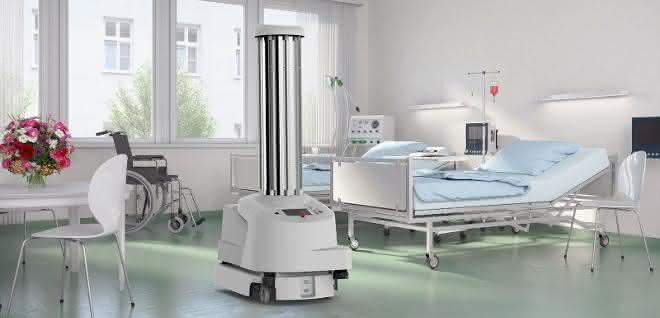
Robots are playing an important role in combating the coronavirus worldwide, not least in surface disinfection in hospitals. For example, demand for the UVD disinfection robot has risen sharply since the outbreak of the COVID-19 pandemic: Chinese hospitals ordered more than 2,000 UVD robots from Danish manufacturer Blue Ocean Robotics. They were deployed in Wuhan, the origin of the global pandemic. The robots are currently being used in more than 40 countries - in Asia, Europe and North America. Ultraviolet light (UV-C) is used to kill harmful pathogens. The robot has won the IERA Award, an innovation prize awarded jointly by the IEEE and the International Federation of Robotics (IFR).
"With our robots, we are helping to solve one of the biggest problems of our time: containing the spread of viruses and bacteria and thus saving lives," says Claus Risager, CEO of Blue Ocean Robotics. "Demand for the UVD has skyrocketed with the outbreak of COVID-19 infections. Our existing customers are buying significantly more devices than before the crisis, but many new customers are also ordering UVD robots to combat coronaviruses and other harmful microorganisms." The robot is thus continuing its success story. Blue Ocean Robotics has recorded annual sales growth of more than 400% in the last two years.
Robot moves autonomously
The Danish robot moves autonomously through operating theaters and patient rooms and irradiates all critical surfaces with the optimal amount of UV-C light to kill viruses and bacteria. The more intensively the robot irradiates a surface, the more harmful microorganisms are destroyed. 99.99 percent of all viruses and bacteria in a typical patient room are killed within ten minutes.
"The UVD robot supports the cleaning staff in their work," said Claus Risager. For safety reasons, the devices work independently in the rooms and automatically switch off the UV-C light as soon as someone enters the room. The collaborative robot can be used in different rooms - not just in hospitals. The technology also works in offices, shopping centers, schools, airports and production facilities.
"The potential of robots to support us during the current severe coronavirus pandemic is enormous," said Dr. Susanne Bieller, Secretary General of the IFR. "They support us in healthcare, but also in the development, testing and production of medicines, vaccines and other medical devices and aids. Disinfection tasks - such as those carried out by the UVD robot - or the safe distribution of hospital materials in quarantine zones without human contact - which the mobile robot Phollower from Photoneo performs, for example - are just two of many examples." as


You might also be interested in
The AKIMI Research Project at WZL
Agent-Based AI Aims to Simplify Robotics for Small and Medium-Sized Businesses
The AKIMI research project is developing an agent-based AI designed to significantly simplify the setup, programming, and reconfiguration of robotic systems for small and medium-sized enterprises. The goal is to make robotics more flexible and...
 read more...
BS Rollen Strengthens Its Presence in North Rhine-Westphalia
With the groundbreaking ceremony, BS Rollen is launching the construction of a new company facility in Hückeswagen. The new building will house administrative offices, an assembly line, and a high-bay warehouse, and is intended to facilitate further...
read more...Intelligent brownfield networking
Many industrial companies are struggling with established plant structures and proprietary interfaces. Stefan Klaus' presentation will show in a practical way how brownfield environments can be efficiently networked with open technologies and made...
read more...Factory-X in practice
How can set-up processes in highly variant production be automated efficiently? Markus Benndorff from soffico shows how Factory-X, industrial data rooms and modular architectures create new possibilities for flexible production concepts.
read more...Mechanical engineering | Case study
Cordless in brush production
The machine manufacturer Wöhler Bohemia is integrating wireless HMI panels from Keba into its brush production systems. The background to this is the need for flexibility, robotics integration and new market strategies.
read more...International product approvals as a strategic competitive advantage in the global market
Which certificates are valid worldwide? Christian Latte, Head of Technical Compliance and Approval Officer at Hummel AG, explains this in an interview. He provides insights into product approvals and explains why early approval strategies shorten...
read more...Foundry modernizes plant park with continuous wire belt shot blasting system
The Spanish foundry Funosa is modernizing its equipment fleet with an RDGE 1250 wire belt continuous shot blasting machine from Rösler. Focus: sand removal from heavy iron castings, energy efficiency, ease of maintenance and ESG strategy.
read more...How bridging steps, stairs and catwalks are changing processes in production and logistics
At Logimat 2026, Munk Günzburger Steigtechnik will be showcasing modular bridging steps, stairs, platform and walkway systems for production, warehousing and logistics. With online configurators, distances can be efficiently shortened, processes...
read more...Drilling cycles optimized
A new replaceable head drill from Walter can reduce machining time in series production thanks to its patented interface and screwless design.
read more...