
Industrial PC
Robot teaching without programming
Robots are the backbone of the smart factory. Increasingly, however, these digital helpers can also be found in other environments. A new solution makes the use of robots interesting for small and medium-sized companies in many industries. An industrial PC plays a central role in this system.
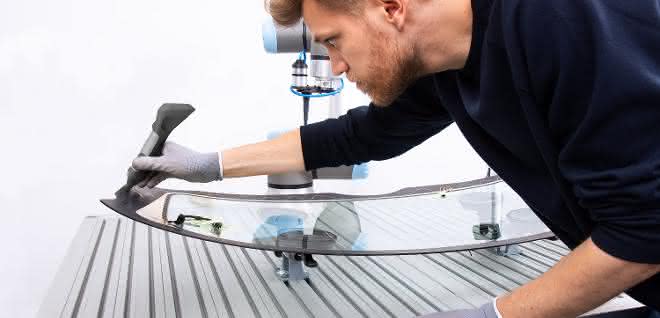
In an industrial environment, robots can be used to simplify work in hard-to-reach areas and the execution of complicated and repetitive motion paths. This allows skilled personnel to be deployed more effectively elsewhere.
But programming such robots is complex, expensive and time-consuming. There is also a glaring shortage of skilled workers in this field. The Dresden-based company Wandelbots now offers a way out of this predicament with an intuitive robot programming system that enables even non-programmers to learn how to program robots. The solution has been specially developed to meet the requirements of small and medium-sized companies and can be used cost-effectively and flexibly without the need for in-depth specialist knowledge.
Wandelbots was founded in 2017 by seven research assistants from the Faculty of Computer Science at TU Dresden. The aim was to make robotics easy and practical in order to give everyone access to robots, regardless of previous knowledge of robotics. The "TracePen", a hand-held, intelligent pen for intuitive robotics teaching that can be used for various applications, finally reached market maturity. Around 110 employees from 14 nations work on robotics solutions at the headquarters in Dresden. The Dresden-based company aims to make robotics accessible to a wide range of users.
Simple and flexible teaching
One of the latest developments is an intuitive robot programming system that uses an app and the TracePen teaching device to easily and flexibly implement or modify robot processes. The TracePen enables a wide range of application scenarios in different industries. The current Wandelbots platform is not a homogeneous, self-contained system. Instead, the solution supports different robots and their programming languages. "And that is precisely what is revolutionary about the solution," says Dr. Patrick Grosa, Head of Business Acceleration at Wandelbots. "Until now, robots were more or less closed systems with their own programming for specific tasks. Reprogramming them for new processes was costly, time-consuming and usually only carried out by specialists."
Using the Wandelbots platform enables almost any employee to set up a robot for a new task, carry out the necessary reprogramming and read out the robot data in the shortest possible time. The interaction between robot, app and teaching device simplifies programming. This solution can be used wherever monotonous routine tasks need to be carried out. Complex automation processes in particular benefit from the new programming method by pointing. For example, robots in industrial environments can carry out work in places that are difficult to access or on complicated paths of movement. In addition to optical inspection, examples include welding processes or the application of adhesive strips.

The movement of the TracePen shows the robot the path to be learned. The software displays this movement in detail. The result can be readjusted and refined by defining individual points (keyframes). This allows adjustments to be made in the precision range of repeat accuracy. The way in which the robot should move between the defined points can be adapted to the requirements. The user can control the individual robot joints directly. In addition, a range can be defined in which the robot is allowed to move.
Installation in several steps
The installation takes place in several steps, with the installation of the hardware coming first. These are the tracking stations, TracePen, tablet and industrial computer. The Wandelbots platform is then connected to the industrial PC, which is connected to the robot's controller as the control center for the TracePen. With the support of the tracking stations, the TracePen is then calibrated in the second step. The pen is fixed to the holder provided for this purpose on the robot. Calibration using infrared light patterns is fully automatic and is completed in less than 30 seconds.
The actual programming can then begin. "The process understanding of the task is crucial for this, not the user's programming knowledge," says Grosa. To initiate this process, the operator selects the appropriate attachment for the TracePen and starts the app. They then use the TracePen to carry out the relevant task. The data is recorded by the software down to a tenth of a millimeter. The exact sequence of the teaching process can be tracked in the app.
The skills that a robot is taught for a specific task area can be edited and refined in the next step. Frequently used skills can be reused, modified and implemented in new skills with the help of the keyframe selector. Finally, the code for the robot is generated in the programming language used. This process takes just a few seconds and is fully automated. The generated code can be edited manually at a later stage. This process is compatible with all conventional certification and simulation processes. The code can then also be transferred to other robots. With its robot solution, Wandelbots is opening up the possibility of using digital helpers to a wide range of users. The programming system is compact and flexible to use. The industrial PC from Kontron, which is a central element of the programming solution, plays a significant role in this flexibility.
Industrial PC with individual adaptations
The industrial PC is based on the KBox-B series from Kontron. The entire programming software stack is based on this. The Dresden scientists had been in contact with Kontron experts in the field of industrial automation for some time. It was therefore obvious that a Kontron industrial PC was one of the options tested during the development of the new robotics solution. It was important to Wandelbots that the components for the system were robust and flexible, had sufficient communication interfaces, but also had special specifications such as WiFi function and allowed firmware and BIOS updates to be carried out easily. The provision of two additional Ethernet ports via the PCIe interfaces of the KBox and the appealing design also influenced the decision in favor of the Kontron product.
After an extensive test phase with various industrial PCs, Wandelbots decided to use the customized KBox for the programming platform. "We had a clear idea of what the unit should offer," says Grosa. "The KBox met our expectations in full, and Kontron also implemented our requirements and wishes regarding some individual customizations without any problems. We were looking for a competent partner with many years of experience, especially with the industrial requirements that a system has to meet. The partnership also gives us planning security with regard to future evaluations. We found this partner in Kontron. In addition, the expertise of the Kontron team helped us a lot during the entire test and implementation phase. The partnership-based cooperation has resulted in solutions with which we can reach a large number of users from different sectors. We are only at the beginning of a development here," says the robotics specialist.


You might also be interested in
Fraunhofer IOSB Opens Humanoid Robots Lab
The Fraunhofer IOSB is opening a Humanoid Robots Experience Lab in Karlsruhe, Lemgo, and Ilmenau. Companies and organizations can use these facilities to test potential applications for humanoid robots and develop pilot projects.
 read more...
Artificial Intelligence in Manufacturing
Trumpf and IPAI Are Expanding a European AI Network for Industry
The high-tech company Trumpf is an official partner of the IPAI AI network in Heilbronn. Together, the partners aim to exchange experiences, develop new AI applications for industrial use, and advance the development of artificial intelligence in...
read more...Case Study: Networked Manufacturing Platform for Toolmaking
Using a networked manufacturing platform, Escha GmbH & Co. KG, a manufacturer of industrial fastening technology, has comprehensively modernized its toolmaking operations.
read more...Barcelona Declaration on Robotics and...
Robotics Associations Adopt Global Automation Strategy
The global robotics industry is stepping up its collaboration. The associations AER Automation, A3, IFR, and VDMA Robotics + Automation have formed a long-term alliance by signing the “Barcelona Declaration on Robotics and Automation 2026.” The...
read more...Jane Heffner is the new president of the International Federation of Robotics
Jane Heffner is the new president of the International Federation of Robotics. Adrien Brouillard has been appointed vice president of the global federation.
read more...Greater Transparency in the Robotics Market
RoboFinder Launches as an Independent Comparison Platform
Launch at Gitex Europe: 'RoboFinder' aims to bring more transparency to the professional service robotics market. In this interview, founder and CEO Brian Engels discusses market potential, challenges, and the goals of the new platform.
read more...Artificial Intelligence for the Physical Space
Alibaba Expands Qwen Model Family with a Robotics Suite for Physical AI
Alibaba is expanding its Qwen model family with a robotics suite for Physical AI. The three models—for manipulation, navigation, and simulation—are designed to assist autonomous robots with complex tasks in real-world environments.
read more...International Federation of Robotics
U.S. Robotics Industry Sees Double-Digit Growth
In the U.S., sales of industrial robots rose by 11% compared to the previous year: 38,000 units were newly installed in 2025. This significant recovery is driven by robust growth in the food industry and other non-manufacturing sectors. However, the...
read more...Development Collaboration for Humanoid Robotic Hands Launched
Schunk is entering into a new development partnership with Robert Bosch Robotics. Their shared goal is to develop an industrial-grade robotic hand that can be integrated into various humanoid robot systems.
read more...