
Robdekon Competence Center
Robot systems for hostile environments
If chemically contaminated areas have to be decontaminated or nuclear facilities dismantled, workers are exposed to health risks. In future, robotic systems will carry out such decontamination work. The new Robdekon competence center, which is being funded by the BMBF with twelve million euros, is working to make this a reality.
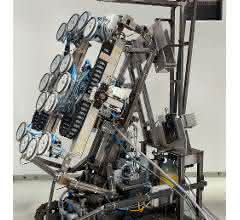
Robdekon stands for "Robotic systems for decontamination in hostile environments" and is dedicated to research into autonomous or semi-autonomous robotic systems. It is coordinated by the Fraunhofer Institute of Optronics, System Technologies and Image Exploitation IOSB. In addition to the Karlsruhe and Ilmenau sites of the Fraunhofer IOSB, the Karlsruhe Institute of Technology (KIT), the German Research Center for Artificial Intelligence (DFKI) and the FZI Research Center for Information Technology, the innovation partner of the KIT, are also involved as research institutions. Industrial partners in the consortium are Götting, Kraftanlagen Heidelberg, ICP Ingenieurgesellschaft Prof. Czurda und Partner and KHG Kerntechnische Hilfsdienst.
Robdekon is the first competence center for robotic systems in hostile environments and has been funded by the BMBF as part of the "Research for Civil Security" program since mid-June 2018. It will initially run for four years, but the aim is for the competence center to continue in the long term.
"Our consortium combines outstanding expertise from the fields of robotics, remediation of contaminated sites and dismantling of nuclear facilities," says Professor Jürgen Beyerer, spokesperson for the Robdekon competence center. He is Professor of Computer Science at KIT and also Director of the Fraunhofer IOSB. "We will now systematically advance research into multisensory environmental detection, algorithms for motion planning and telepresence technologies. This will enable robots to carry out decontamination activities independently, while humans coordinate and monitor the work from a secure control station and intervene remotely in difficult tasks."
When talking about robots, however, one should not think of classic industrial robots or human-like (humanoid) robots, explains Beyerer: "We are focusing on innovative concepts such as climbing robots or automated construction machinery. " The project partners have various complementary laboratories, which are to be expanded, networked and made accessible to external interested parties in the coming years. With the help of users and industry partners, promising approaches from research are to be turned into practical systems. A coordination office for the competence center will be set up at the Fraunhofer IOSB as a central point of contact for all inquiries relating to robot-based decontamination.
Fraunhofer IOSB: Algorithm toolbox and autonomous excavator
In scientific terms, Fraunhofer IOSB will focus on further developing autonomy capabilities for construction machinery: "In particular, we are contributing our algorithm toolbox for autonomous mobile robot systems to Robdekon," explains the responsible department head Christian Frey. "It makes it possible to navigate in rough terrain, avoid obstacles and control manipulators - so that an excavator shovel can actually pick up contaminated material and unload it at the desired location."
The institute already has several all-terrain robotic vehicles and its first automated excavator. Christian Frey: "The aim now is to transfer these autonomy capabilities to other machines and make them even more flexible, more powerful and easier to handle."
KIT: Decontamination, telepresence and living lab
One focus of the work at KIT is on robotic systems that can carry out decontamination work autonomously or semi-autonomously, for example in nuclear power plants. Researchers at the Chair of High-Performance Humanoid Technologies (H²T) and the Research Laboratory for Intelligent Process Automation and Robotics (IPR) are designing and building robotic systems that can clean or dismantle contaminated and biologically or chemically contaminated surfaces or plant components. This includes developing methods for three-dimensional environmental detection, inspecting the working environment, planning and executing decontamination tasks such as removing hazardous contaminants from objects or surfaces and, last but not least, programming the corresponding control software.
These devices are monitored and controlled using telepresence technologies that are being developed at the Chair of Intelligent Sensor-Actuator Systems (ISAS). A so-called teleoperator, such as a robot, represents the user on site in environments that may be far away and hostile to humans. It can, for example, track the user's head movements and then transmit corresponding camera images. ISAS is also investigating methods to measure and visualize the distribution and intensity of pollution so that operations can be carried out as efficiently as possible.
Finally, the Institute for Technology and Management in Construction (TMB) is developing a living lab in which the robots will be tested in various realistic environments and trained to work in nuclear power plants. In addition, the TMB is working on a special robot that can inspect concrete surfaces in particular for hazardous contaminants, detect them and then remove them. In the final step, the scientists are investigating how the new methods and devices can be used in practice on landfills or contaminated sites.
FZI: Force-based handling of hazardous materials and augmented reality
The FZI Research Center for Information Technology will develop force-based manipulation strategies for mobile robots in the Robdekon competence center. These will be able to support humans in difficult terrain and when dealing with unknown objects when dismantling, measuring or recovering contaminated objects, either partially or fully autonomously. FZI scientist Arne Rönnau explains: "The FZI already has a great deal of expertise in the development of force-based robotics solutions. We are pleased that we can now contribute this knowledge to the competence center and thus make health-critical work safer for humans."
The project work also includes detailed three-dimensional mapping of the environment and the integration of efficient navigation algorithms. This task, as well as the development of intuitive, clear operating concepts for human-robot interaction, is being carried out by the FZI. The Karlsruhe scientists are also relying on the use of new augmented reality and virtual reality systems for the direct integration of important environmental information into the three-dimensional representations.
DFKI: Robots for extreme environments and hybrid teams
The Robotics Innovation Center of the German Research Center for Artificial Intelligence (DFKI), headed by Professor Frank Kirchner, is contributing its many years of expertise in the development of mobile autonomous robots specifically for use in hostile and extreme environments such as space or the deep sea to the competence center. In order to achieve the necessary autonomy and thus the systems' ability to act, robots used in decontaminated areas must meet very similar requirements, particularly with regard to their mobility, robustness and learning ability (artificial intelligence).
The DFKI research department has expertise in the areas of machine learning, teleoperation and human-robot collaboration in order to ensure the safe cooperation of humans and robots in hybrid teams during dismantling and decontamination processes. In Robdekon, the Robotics Innovation Center will further develop innovative robot systems that have the necessary capabilities for this area of application. as


You might also be interested in
Fraunhofer IOSB Opens Humanoid Robots Lab
The Fraunhofer IOSB is opening a Humanoid Robots Experience Lab in Karlsruhe, Lemgo, and Ilmenau. Companies and organizations can use these facilities to test potential applications for humanoid robots and develop pilot projects.
 read more...
Artificial Intelligence in Manufacturing
Trumpf and IPAI Are Expanding a European AI Network for Industry
The high-tech company Trumpf is an official partner of the IPAI AI network in Heilbronn. Together, the partners aim to exchange experiences, develop new AI applications for industrial use, and advance the development of artificial intelligence in...
read more...Case Study: Networked Manufacturing Platform for Toolmaking
Using a networked manufacturing platform, Escha GmbH & Co. KG, a manufacturer of industrial fastening technology, has comprehensively modernized its toolmaking operations.
read more...Barcelona Declaration on Robotics and...
Robotics Associations Adopt Global Automation Strategy
The global robotics industry is stepping up its collaboration. The associations AER Automation, A3, IFR, and VDMA Robotics + Automation have formed a long-term alliance by signing the “Barcelona Declaration on Robotics and Automation 2026.” The...
read more...Jane Heffner is the new president of the International Federation of Robotics
Jane Heffner is the new president of the International Federation of Robotics. Adrien Brouillard has been appointed vice president of the global federation.
read more...Greater Transparency in the Robotics Market
RoboFinder Launches as an Independent Comparison Platform
Launch at Gitex Europe: 'RoboFinder' aims to bring more transparency to the professional service robotics market. In this interview, founder and CEO Brian Engels discusses market potential, challenges, and the goals of the new platform.
read more...Artificial Intelligence for the Physical Space
Alibaba Expands Qwen Model Family with a Robotics Suite for Physical AI
Alibaba is expanding its Qwen model family with a robotics suite for Physical AI. The three models—for manipulation, navigation, and simulation—are designed to assist autonomous robots with complex tasks in real-world environments.
read more...International Federation of Robotics
U.S. Robotics Industry Sees Double-Digit Growth
In the U.S., sales of industrial robots rose by 11% compared to the previous year: 38,000 units were newly installed in 2025. This significant recovery is driven by robust growth in the food industry and other non-manufacturing sectors. However, the...
read more...Development Collaboration for Humanoid Robotic Hands Launched
Schunk is entering into a new development partnership with Robert Bosch Robotics. Their shared goal is to develop an industrial-grade robotic hand that can be integrated into various humanoid robot systems.
read more...