

Retrofit of a production cell
Pecking on the conveyor belt
ASA has designed and built a picker cell for the packaging of gluten-free foods for Dr. Schär, a food specialist for special dietary requirements, which can be reliably integrated into a line that has been in operation for twenty years.
Production facilities that have existed for decades often still have technologies that work very well, but no longer or only partially meet today's product quality and quantity requirements accompanied by higher output. At the same time, in addition to cost savings, producers increasingly want to think in terms of resources and the environment. To meet these requirements, ASA offers retrofit concepts for existing production lines. Only critical modules are replaced or supplemented with new requirements.
At Dr. Schär, only one cell in a production line consisting of a total of five cells was replaced by a new one. The retrofit concept offers mechanical and electrical interfaces that allow the new production cell to be integrated into the existing system in order to replace existing system sections, thereby increasing production capacity and ensuring product quality.
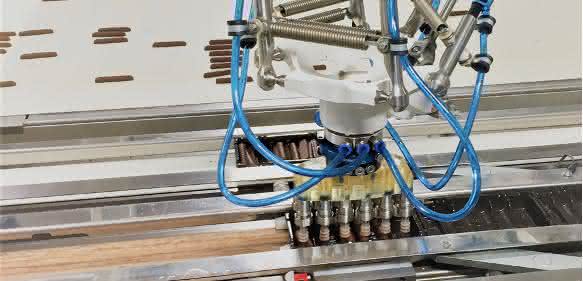
In detail, the development of this concept focused on the core task: To pick products "on the fly" from the running conveyor belt and place them sorted in blister packs. All other existing processes in the environment were not touched in the existing system. An ASA standard cell, equipped with a delta picker and vision system for product position detection with a welded steel base frame construction, served as the basis for the further cell design. Complex product grippers, manufactured using a 3D injection process and equipped with a gripper quick-change system, meet the requirements of the multiple product variant concept.
The frame was designed to fit into the existing space, so that the entire existing container logistics (product packaging) remained unaffected. The connection to the existing control technology was also implemented in such a way that the operation of the production system remained unchanged. This ensured that the production start-up was completed in a short time.
The advantages of this concept from ASA: short implementation times (from concept to start of production), calculable investment, increased product quality, short installation and commissioning time, convinced the customer and met their requirements for increasing performance, ensuring today's standards coupled with environmentally conscious, sustainable action in the best possible way. as


You might also be interested in
Soft grippers for delicate foods
Irregularly shaped, fragile, and varying in size and weight: products such as potatoes, baked goods, and dairy products push mechanical grippers to their limits.
 read more...
Development Collaboration for Humanoid Robotic Hands Launched
Schunk is entering into a new development partnership with Robert Bosch Robotics. Their shared goal is to develop an industrial-grade robotic hand that can be integrated into various humanoid robot systems.
read more...Robot-controlled packaging of rolls
Koch Robotersysteme, a company specializing in the integration of robotic systems, has developed a complete, automated packaging line for packaging rolls based on Tentoma’s RoRo StretchPack packaging machine.
read more...Robotics and autonomous order picking
Locus Robotics acquires Nexera Robotics and expands autonomous warehouse logistics
Locus Robotics takes over Nexera Robotics and may have taken a decisive step towards truly universal warehouse automation. A new gripping technology should now make possible what was previously considered difficult to automate.
read more...Gentle wheel handling
The newly founded Eisenmann Robotics division develops new robotics concepts to increase the level of automation in modern production facilities.
read more...Gripping systems and vacuum generators
Schmalz is presenting new gripping systems and vacuum generators at Automatica. Exoskeletons, which allow employees to move heavy workpieces effortlessly, will also be on display.
read more...Smart universal gripper for power electronics
The power electronics manufacturer Semikron Danfoss uses the EGU 50 mechatronic parallel gripper from Schunk in a robotic cell. It handles different components and feeds them to a measuring line. With its functionalities, it meets all requirements...
read more...Schmalz takes over finger gripper from Soft Robotics
The vacuum specialist Schmalz is expanding its gripper portfolio and acquiring the mGrip product family from the US company Soft Robotics (SRI), including all finger gripper configurations, patents and the associated know-how.
read more...Soldering with special gripper
In order to make the mini wave soldering of large panels stable and reproducible, Eutect developed a special gripper that prevents the panel from bending, among other things.
read more...