
Transport robots
Omron robot whizzes through Škoda plant
The autonomous robot from Omron will help to continuously improve occupational safety at the Škoda plant in Vrchlabí and minimize work risks. It recognizes people who cross its path, as well as other vehicles or stationary obstacles.
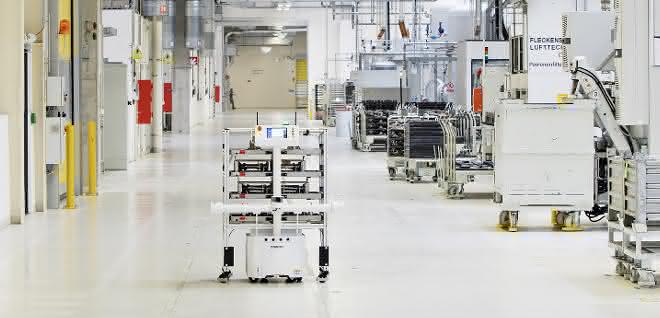
Škoda is consistently driving forward the digitalization of its production as a central cornerstone of its Strategy 2025. The Czech car manufacturer is now using a fully autonomous, self-learning transport robot at its Vrchlabí component plant. This robot is able to recognize obstacles on its way through the plant and incorporate further information from the surroundings into its route planning in real time. If necessary, it changes its route in order to reach its destination as quickly as possible at all times. In this way, it helps to further increase work safety and the efficiency of transport processes in the plant.
"The first fully autonomous robot at Škoda Auto is deliberately being used at the Vrchlabí plant. This once again underlines the central importance of this plant as a state-of-the-art high-tech location," says Škoda Board Member for Production and Logistics, Michael Oeljeklaus. "With the new transport system, we are consistently continuing the introduction of technological innovations in our plants in line with Industry 4.0," Oeljeklaus continued.
Without lane guidance, magnetic strips or reflectors
The transport robot transports up to 130 kilograms of freight at a time and chooses the right routes fully autonomously. Unlike conventional driverless transport systems, it does not require lane guidance using induction loops, magnetic strips or reflectors. To learn the route, the vehicle is simply guided once along the route between the stations using a tablet or joystick. It independently detects its surroundings and changes in its environment and changes its route if necessary.
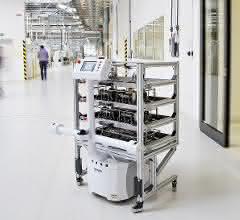
Modern technology enables the robot to find its way around: With the help of sensors and laser scanners, it recognizes vehicles and stationary obstacles as well as people who cross its path. The control system determines the approach speed and recognizes whether a collision is imminent. If this is the case, the robot stops automatically or drives around the obstacle.
Unlike other systems used by Škoda, it adjusts its route immediately based on information from its surroundings without having to stop. If the fully autonomous robot detects that it regularly encounters obstacles on its route at a certain point, it changes its route permanently. Depending on requirements, the electrically powered system is able to head for any destination on the 16,000 square meter site of the Vrchlabí plant.
120 trips a day
The robot completes around 120 trips a day and covers a total distance of 35 kilometers on its route between the mechanical measuring center and the processing machines. The test phase and pilot operation have already been completed, and the robot has been in regular operation since June 2018.
Rising production figures at Škoda mean higher capacity utilization of the plants and a higher volume of traffic in the factory. The autonomous robot helps to continuously improve occupational safety in Vrchlabí and minimize work risks. Škoda systematically relies on Industry 4.0 technologies in production, such as cooperating robots. They are used in the production of direct-shift gearboxes at the Vrchlabí plant and support employees in one of the most sensitive activities in gearbox production - inserting the shift piston. A handling robot also supplies dozens of machines with parts and returns empty containers to the warehouse. The extensive "Transparent Factory" IT system is also part of the operation. as


You might also be interested in
Plagiarius 2024 negative prize
On January 26, 2024, the Plagiarius campaign awarded its dreaded "Plagiarius" negative prize for the 48th time to manufacturers and retailers of particularly brazen counterfeits and fakes.
 read more...
Ivalua honors winners of the Generative AI...
AI-supported "add-ons" for buyers within 48 hours
Ivalua, provider of cloud-based spend management solutions, announced the winners and innovations of the first Generative AI Innovation Cup. The competition took place in December 2023. It was open to all Ivalua partners and employees - more than...
read more...Efaflex celebrates 50 years of high-speed...
The emphasis is on "fast"
Since day one, Efaflex has wanted to use new technologies as early as possible and drive progress in the industry. This year, the family business is celebrating its 50th anniversary under the motto "Fast Forward".
read more...Security of supply even during power outages
In the winter of 2022, Germany was worried about energy shortages. The drugstore retailer dm did not paint any horror scenarios, but nevertheless saw the possibility of controlled, temporary, regional power cuts (brownouts).
read more...Safety technology in mechanical engineering
Modules with new functions
Euchner's product highlights at EMO 2023 include the communication-capable solenoid interlocks.
read more...Transforming the paper industry towards climate neutrality
Together with partners from industry and research, Voith is developing a project for the optimization of energy and material flows in paper production. The aim of the research project is to develop a digital framework that enables effective process...
read more...Up to 95 percent less flue gas thanks to direct extraction
The requirements for occupational safety measures and safety technology are also constantly increasing in welding technology. The Technical Rules for Hazardous Substances (TRGS) stipulate that welding fumes and harmful substances must be extracted...
read more...Competitive advantages with large machines
Whether 3D-printed components for machines and systems, prototypes or aids for design: additive manufacturing is almost indispensable for modern companies in mechanical and plant engineering and automation if they want to play in the premier league.
read more...Transport technology from the modular system
Many transport tasks can be realized with the help of linear technology. Pre-configured solutions are available to simplify the interaction between the linear unit, motor, gearbox and controller. This minimizes the effort required for research and...
read more...