
Interview with Jürgen von Hollen
MRK is not witchcraft
Acceptance of robots as colleagues is increasing, but there are still reservations. Jürgen von Hollen, President of Universal Robots, spoke to handling editor Annina Schopen about the new e-Series, Universal Robots' recipe for success and the challenges of implementing HRC in Germany.
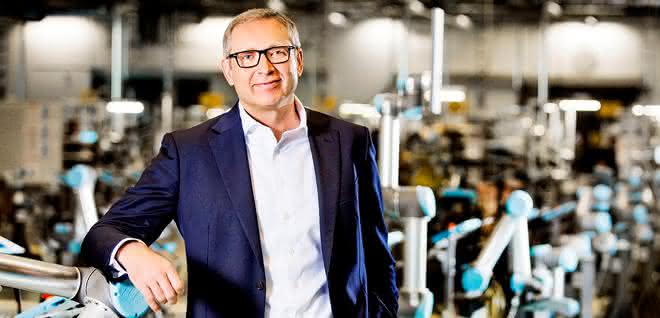
Mr. von Hollen, you presented your e-Series at Automatica. What distinguishes the new series from the previous UR arms?
Von Hollen: Fundamentally, we at Universal Robots remain true to the promise we have been making to our customers for over ten years as a pioneer in collaborative robotics: Our robots are flexible to use, easy to set up and program, pay for themselves quickly, and they are safe. We have sharpened this profile with the e-Series and want to further expand our leading position on the market.
The most obvious new feature of the e-Series is the robot's user interface, whose look and feel we have completely redesigned. It is even more intuitive for the user - thanks to the simplified navigation, an application can be programmed with fewer clicks than before. This has a direct impact on the time required for commissioning and therefore also on the amortization period.
However, there are also new features that are not immediately obvious: For example, the e-Series has a force-torque sensor integrated into the wrist and is therefore much more sensitive than the previous models. This extends the range of applications to include more complex applications such as polishing and makes the robot even more flexible overall. We have also equipped our patented safety system with two new functions: the safety-monitored stop time and the safety-monitored stop distance. Each of the 17 safety functions is now certified by TÜV to Performance Level d Cat. 3. This is an absolute novelty on the market and a milestone for human-robot collaboration.
We have also worked on many small details. These include a more powerful bus system, the simplified tool connection and the robot base, whose design we have standardized.
How has the new series been received?
Von Hollen: Even at the product launch at Automatica, the interest was overwhelming. The industry speculated for a long time about what Universal Robots' next big step would be. And I won't deny that I also felt a certain amount of tension shortly before the launch. The relief was all the greater when the initial feedback showed that we had backed the right horse with the e-Series.
There are now competitors that produce lightweight robots, and traditional manufacturers of large robots such as ABB and Kuka are also pushing into the segment. What are you doing differently?
Von Hollen: An important recipe for success is the openness of our platform. We focus purely on the robot arm and deliberately refrain from supplying the gripping technology at the same time. Instead, we offer Universal Robots+, an online ecosystem on which more than 90 peripheral products from various developers are offered as plug & play components - including grippers, sensors, software and other accessories. This enables users and integrators to easily tailor their application to their own requirements. Everyone gets exactly what they need and only pays for what they need.
The Universal Robots Academy should also be mentioned in this context. This is an online training course that enables users to learn how to program our robots in less than 90 minutes using various training modules.
Our strategy is simple: we take the complexity away from the machine, thereby releasing innovation and creativity in humans. This pays off for our customers.
Universal Robots is a pioneer in collaborative robotics. Do you sense an increasing acceptance of robots as colleagues?
Von Hollen: We are indeed feeling it, and there are also factors beyond our business figures that prove this. For example, we are very pleased to note that it is now absolutely common for the UR robots to be affectionately given individual names by employees of the respective companies. This shows wonderfully how much the workforce appreciates the relief associated with the robots.
Nevertheless, there are still reservations. We want to dispel them. We have the support of our users as convinced multipliers, and that is more than helpful.
What are you doing to allay customers' fears of HRC?
Von Hollen: There are a few things to consider when implementing HRC applications safely, but it's not rocket science either. We take every opportunity to educate companies about this topic - be it in person at their premises, for example during our roadshow, at trade fairs or via whitepapers and e-books that we make available to them.
Where do you see challenges in implementing HRC in Germany?
Von Hollen: The biggest challenge is to first create awareness of the possibilities of HRC among our target group, i.e. small and medium-sized enterprises. In fact, many SMEs do not yet see robotics as a realistic option for their business. This is a challenge posed by a lack of awareness, which we are happy to take on.
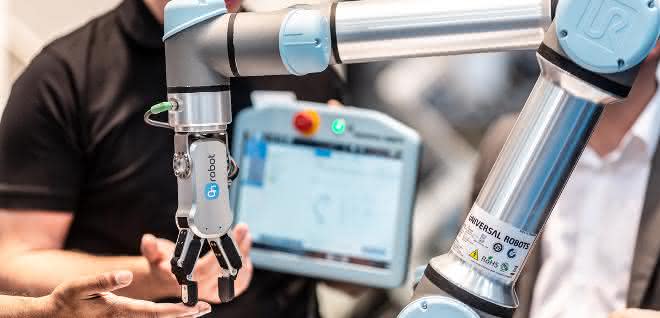
How can SMEs find out whether the use of a robotic arm is worthwhile for them? When does the purchase start to pay off?
Von Hollen: There are processes in every company that can be optimized. If you want to get into automation with collaborative robots, untrained users should first consider simple applications such as pick & place or machine loading. These can often be automated with little effort.
With a little experience, you can then venture into more complex applications, such as those that require image processing or additional sensor technology. We also spend a lot of time on site with our partners advising customers: Where is there potential for optimization, how can I identify processes that are easy to automate? In this way, we want to consciously sharpen the user's focus.
It is always important for us to emphasize that our robots are a profitable investment, even for SMEs with a limited budget. As a rule, they pay for themselves within a year.
What do robots still need to learn?
Von Hollen: Collaborating robots don't have to be able to do everything a human can do. Our concept is based on the interaction of both parties, in which they each contribute their strengths: the robot performs tasks with a high degree of reliability, while the human makes the important decisions and sets the pace. Artificial intelligence, for example, is therefore a topic that we still see in the distant future in the field of human-robot collaboration.
What are you presenting at Motek?
Von Hollen: We are continuing our educational approach at Motek. Instead of spectacular show applications, we are focusing on a practical trade fair concept. We will show applications as they are used in industry and allow visitors to touch and try out the robots themselves. In this way, we want to further lower the barriers to automation.
Mr. von Hollen, thank you very much for the interview.


You might also be interested in
Fraunhofer IOSB Opens Humanoid Robots Lab
The Fraunhofer IOSB is opening a Humanoid Robots Experience Lab in Karlsruhe, Lemgo, and Ilmenau. Companies and organizations can use these facilities to test potential applications for humanoid robots and develop pilot projects.
 read more...
Artificial Intelligence in Manufacturing
Trumpf and IPAI Are Expanding a European AI Network for Industry
The high-tech company Trumpf is an official partner of the IPAI AI network in Heilbronn. Together, the partners aim to exchange experiences, develop new AI applications for industrial use, and advance the development of artificial intelligence in...
read more...Case Study: Networked Manufacturing Platform for Toolmaking
Using a networked manufacturing platform, Escha GmbH & Co. KG, a manufacturer of industrial fastening technology, has comprehensively modernized its toolmaking operations.
read more...Barcelona Declaration on Robotics and...
Robotics Associations Adopt Global Automation Strategy
The global robotics industry is stepping up its collaboration. The associations AER Automation, A3, IFR, and VDMA Robotics + Automation have formed a long-term alliance by signing the “Barcelona Declaration on Robotics and Automation 2026.” The...
read more...Jane Heffner is the new president of the International Federation of Robotics
Jane Heffner is the new president of the International Federation of Robotics. Adrien Brouillard has been appointed vice president of the global federation.
read more...Greater Transparency in the Robotics Market
RoboFinder Launches as an Independent Comparison Platform
Launch at Gitex Europe: 'RoboFinder' aims to bring more transparency to the professional service robotics market. In this interview, founder and CEO Brian Engels discusses market potential, challenges, and the goals of the new platform.
read more...Artificial Intelligence for the Physical Space
Alibaba Expands Qwen Model Family with a Robotics Suite for Physical AI
Alibaba is expanding its Qwen model family with a robotics suite for Physical AI. The three models—for manipulation, navigation, and simulation—are designed to assist autonomous robots with complex tasks in real-world environments.
read more...International Federation of Robotics
U.S. Robotics Industry Sees Double-Digit Growth
In the U.S., sales of industrial robots rose by 11% compared to the previous year: 38,000 units were newly installed in 2025. This significant recovery is driven by robust growth in the food industry and other non-manufacturing sectors. However, the...
read more...Development Collaboration for Humanoid Robotic Hands Launched
Schunk is entering into a new development partnership with Robert Bosch Robotics. Their shared goal is to develop an industrial-grade robotic hand that can be integrated into various humanoid robot systems.
read more...